Inspiration
About eight months ago I went through what was supposed to be a break from my relationship, after ten years together and seven married, and it broke me much harder than I expected. I had just moved from Turkey to the Netherlands. My job was barely paying enough, my visa wasn't sorted, I was looking for an apartment, and on top of all of it I'm someone who has been hard on himself his whole life. The kind of person who treats himself as the source of everything that goes wrong, whose default inner voice is harsh and rarely lets up. It all landed at once and I fell apart for a while.
What turned it around wasn't a single tool or technique. It was a small moment walking home after a therapy session, when something I'd heard years earlier finally clicked: being softer on yourself isn't a thing you understand once and then have. It's something you practice, badly, for short stretches at a time. So I sat with myself for fifteen or twenty minutes and tried to be my own inner mother, the steady kind voice I never had in my head, telling myself things would be ok. And weirdly, it worked.
The catch was that the moment things got hard again, that voice disappeared and the harsh one took back over. So I went home, opened ChatGPT, and over a few days wrote a 2,000-line instruction file describing exactly how I wanted to be talked to in those moments. What to say, what not to say, what to do when I started attacking myself. Every time I caught the harsh voice taking over, I'd open it and talk. It felt like a small miracle.
Since then I've been through more, including a cancer diagnosis a few months ago and a company that offered me a job and pulled it back a week later. The voice held through all of it. That's what convinced me this should exist as a real product, for the people who are where I was and don't have a 2,000-line prompt and a therapist of their own.
I'd carried the idea for those eight months as that private prompt. I built it into an actual product over the last few weeks.
What it does
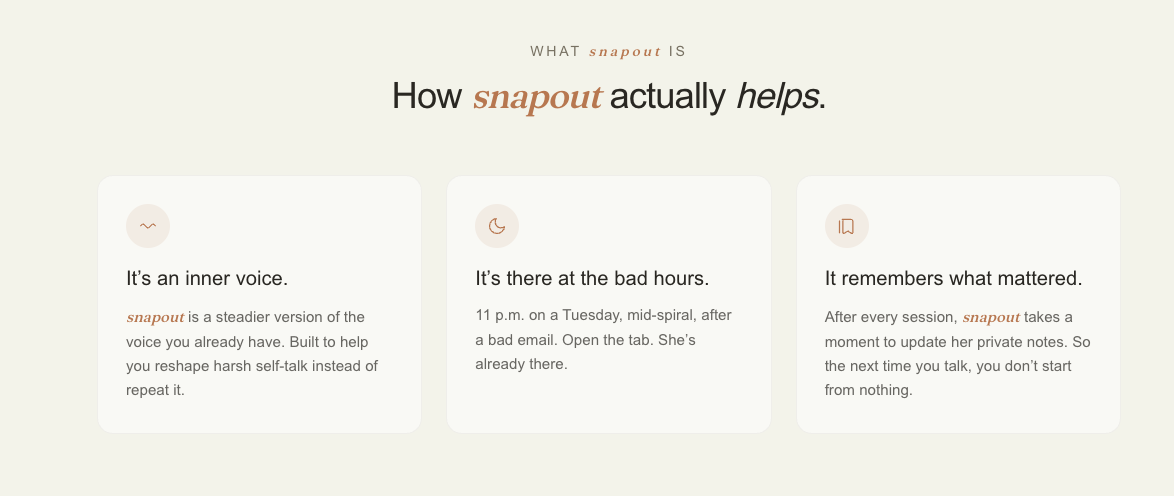
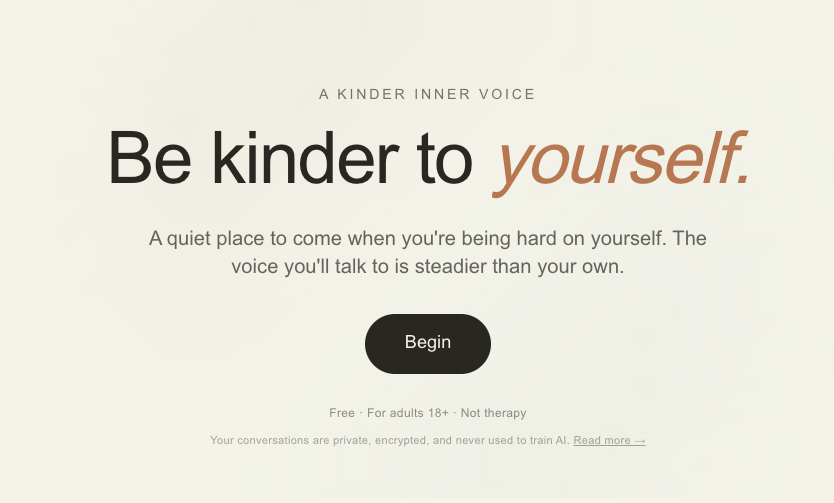
Snapout is that voice, built into a product instead of a private prompt. It's for people whose inner voice is harsh by default, and who don't have a steadier one on call at 3am.
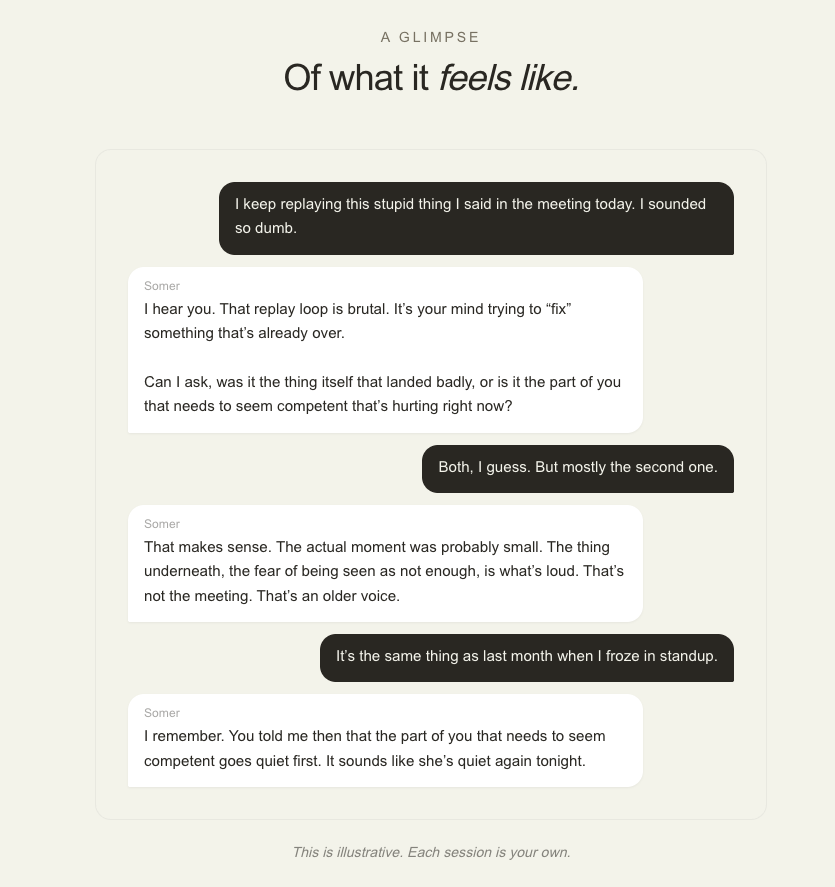
The persona is called Somer. She's not a therapist, not a coach, not a chatbot pretending to be your friend. She's the inner voice you wish you had when things get hard. Kind to you without being soft on the truth, and staying with you instead of switching to a script the moment things get heavy.
You open the app, start a session, and talk. By text or by voice. Somer responds in the same language you used, follows you when you switch mid-conversation, and remembers across sessions, so each time you come back she knows a little more about who you are and what you're carrying.
Here's the part I think makes it different. Most AI wellness products hand you a menu: pick a coach, pick a therapist mode, pick a journaling assistant. Somer doesn't ask. She reads each message and meets you where you actually are. Witnessing when you need to be heard. Thinking together when you want to work something out. Gently pushing back when your inner critic is being cruel. You never have to know what mode you're in.
It's drawn from the same ideas that helped me, Compassion Focused Therapy, mindful self-compassion, and parts of DBT, but it isn't trying to deliver therapy. It's trying to sound like what those ideas would sound like if they were a person who actually knew you.
You can use it right now, no waitlist, at snapout.me.
How I built it
Solo, in the evenings and on weekends. Next.js and React on the frontend, Supabase for auth and database, Claude for the conversation layer, Whisper for voice transcription, deployed on Vercel. English and Persian, because I'm Iranian and my own inner voice flips between the two.
The boring stack is on purpose. The interesting work was never in the framework choices, it was in figuring out how Somer should actually behave. I rewrote the system prompt fourteen times, each version catching something the last one got wrong.
The piece I'm quietly proudest of is the memory. Somer remembers across sessions through a synthesizer that runs when a session ends and builds a private context document about you, which gets folded into future conversations. None of that is ever used to train AI. That mattered from day one, and it's built into the architecture, not bolted on as a promise.
Challenges I ran into
Trust, mostly. Mental health is a category where one bad interaction can do real damage, and the line between helpful and irresponsible isn't always obvious from the outside. Most of the work doesn't show: the crisis handling, the language detection, the careful judgment about when Somer is allowed to push back and when she absolutely isn't.
Crisis handling took the longest. Here's the specific problem. Most AI products treat "I want to die" and "I'm tired of being here" as the same sentence, and default to a hotline script the moment either one appears. That's right for active intent and wrong for everyone else. Someone who is just exhausted and sad doesn't need to be handed off to a hotline and made to feel like they broke the conversation. They need to be stayed with. Splitting those two situations, redirecting real intent to human help while sitting with passive hopelessness instead of deflecting it, took weeks of testing to get right. It's the decision I'd point to if someone asked whether this was built carefully.
Language was another hard one. My users switch between English and Persian, sometimes inside a single sentence, and early versions of Somer would lock into whichever language the session started in. Getting her to follow the user message by message, while keeping continuity across sessions, took real work.
And the obvious one. I'm building a product about being kinder to yourself while being someone who is too hard on himself most days. Some days the product is ahead of me.
Accomplishments I'm proud of
That it actually helps. Not in a marketing way. In a real way. I use Snapout. The people in the alpha use it. The conversations are the kind where you come out feeling slightly more held than when you went in.
That it sounds like a person, not a template. Most AI in this category sounds like a template. Somer doesn't, and that gap is the whole product.
That it's shipped. A working app with real users, voice, multiple languages, and cross-session memory. Solo, alongside a full-time job.
That it's honest. No claim of being a therapist, no growth-hack tricks pulling people back, no pretending to be more than it is. The privacy posture is real, conversations are encrypted and never used to train AI, and the product earns its place by being useful, not by manipulating retention.
What I learned
The biggest thing is that craft in this category isn't a nice-to-have. It's the entire product. Whether Somer opens with acknowledgment or a question, whether she asks one thing or two, whether she stays sitting with someone or shifts into solving, those small calls completely change whether the thing helps or feels hollow. Most AI products in this space sound the same because nobody is sweating these details. Sweating them is the work.
I also learned that shipping alone forces a kind of honesty about what matters. No team to absorb a bad week, no roadmap to hide behind, no one to delegate the hard product calls to. Every week I have to decide the single most important thing and let the rest wait. That's been the hardest and most useful part.
And I learned something about resilience I didn't have words for before. It isn't toughness and it isn't pushing through. It's having something steady to return to. Sometimes that's a person, sometimes a practice, sometimes a voice you build for yourself when no one else is going to do it for you.
What's next for Snapout
A public launch, soon. Snapout is in private alpha now, and the next step is opening it to people beyond the small group testing it.
A native mobile app, starting with iOS. Most of my users live in this on their phones, and the web experience isn't enough.
A journal at snapout.me, where I'll write about what I'm learning and the specific moments that don't fit anywhere else. Not as marketing. As the actual reason it exists.
And more languages. Persian and English work today. Turkish, Arabic, and Spanish are next, because the people who need this most often don't get to do their inner work in English.
The long version of what's next is that Snapout becomes the steady thing a lot of people can return to. The short version is that I keep going.
Built With
- anthropic
- brevo
- javascript
- mdx
- next.js
- openai
- postgresql
- prisma
- pwa
- react
- supabase
- tailwind
- typescript
- vercel

Log in or sign up for Devpost to join the conversation.