-
-

-
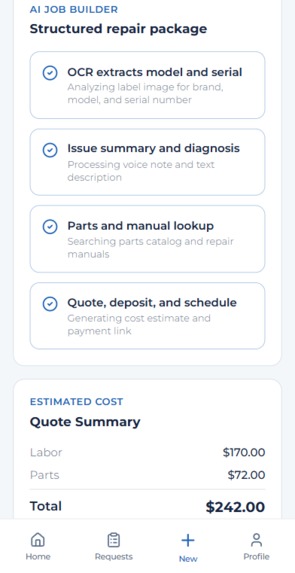
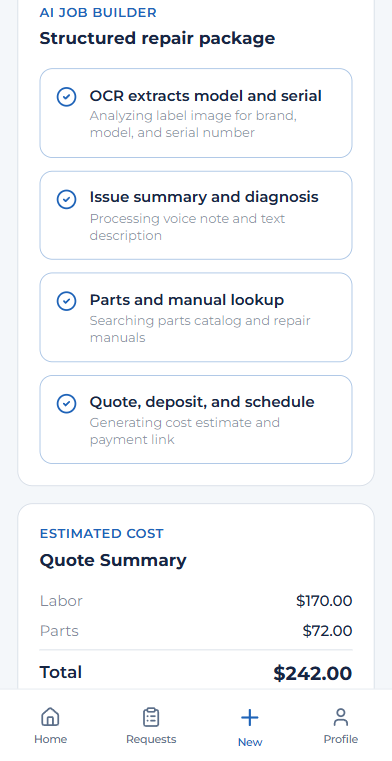
OCR+LLM Quote summmary request intake page
-
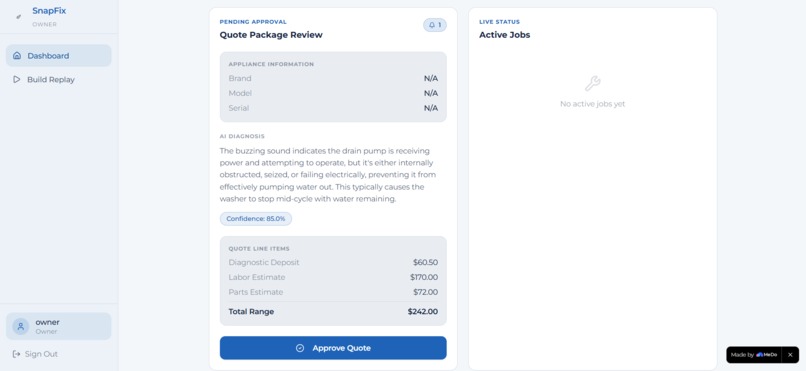
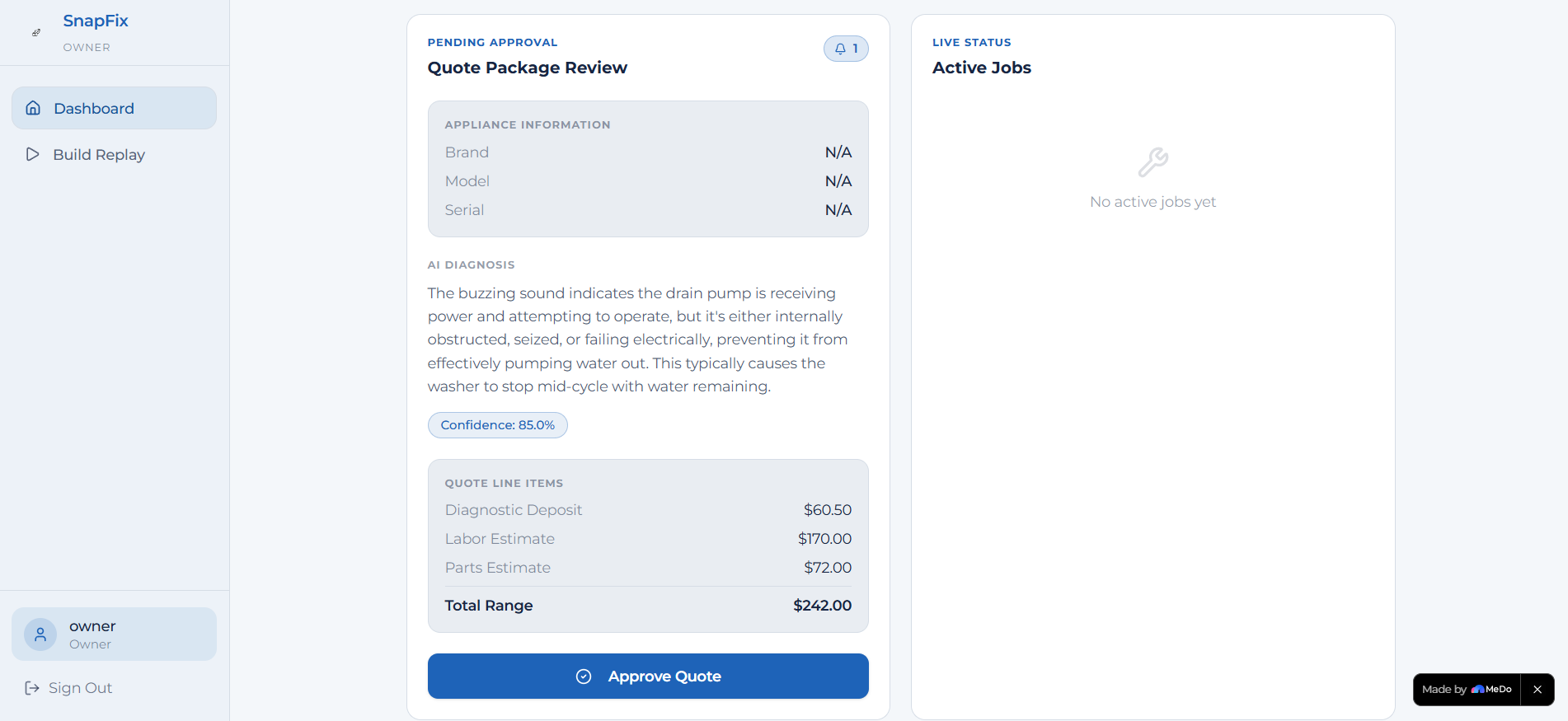
Owner Quote approval page
-
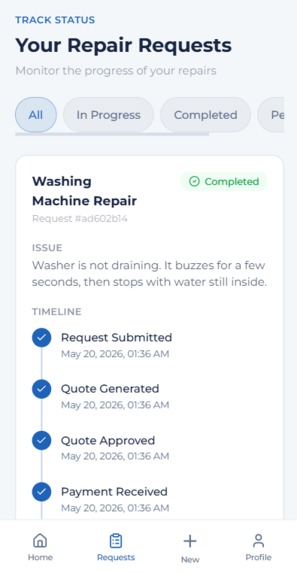
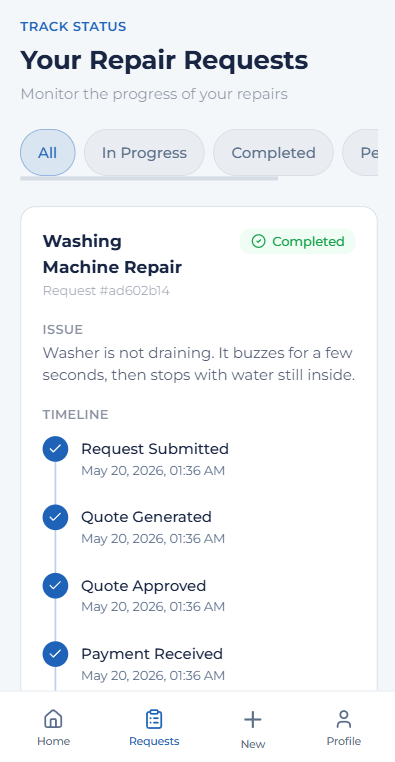
Customer payment & request tracker page
-
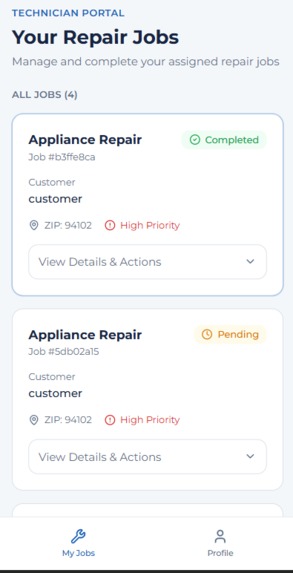
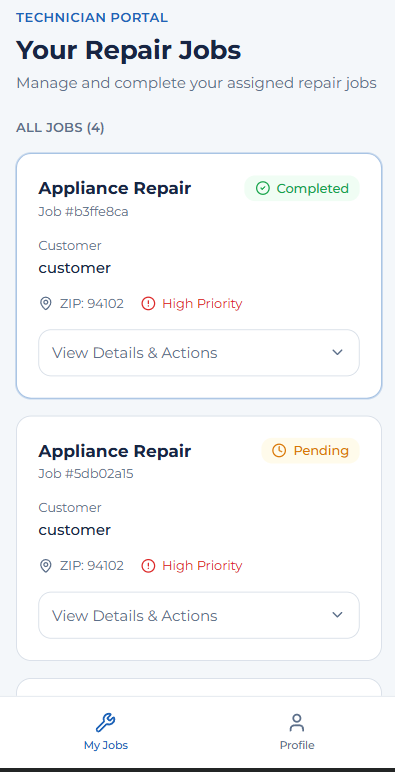
Technician Repair request Page

Inspiration
Picture this. A customer calls a repair shop and says: "My washer is making a weird noise and there's water on the floor."
The shop owner puts down his wrench, grabs a clipboard, and starts the routine. What brand? What model? Can you read me the serial number? Can you send a photo? Let me look that up. Let me check if we have the part. Let me calculate the labor. I will call you back in 30 minutes with a quote.
He does this 20 times a day. That's 10 hours spent quoting -- before he fixes a single appliance.
We talked to a shop owner who told us: "I became a repairman to fix things. Instead, I am a full-time secretary who occasionally holds a wrench."
We thought -- what if a customer could just snap a photo, say what's wrong, and get a quote before they hang up the phone?
What it does
A customer opens SnapFix. They snap a photo of their broken washer. They take a close-up of the model sticker on the back. They hit record and say: "It gets stuck near the end and sounds like it's trying to pump. There's water sitting in the drum."
They hit Submit.
60 seconds later, the shop owner's screen shows:
- The exact brand, model, and serial number — pulled from the photo automatically
- A diagnosis: "Likely drain pump failure or filter blockage"
- The replacement part, its price, and whether it's in stock
- A confidence score: 87% match
- A quote range: $189 – $249
- A button that sends the customer a payment link to lock in their appointment
The owner glances at it, taps Approve, and the customer pays a $29 deposit from their phone. A technician gets a work order with the diagnosis already written, a step-by-step checklist, and the customer's address. When the job is done, the invoice writes itself.
No clipboard. No callback. No calculator. No "let me get back to you."
How we built it
We didn't write SnapFix in one shot. We built it the way you'd build a house -- one conversation at a time, 53 in total.
The first few conversations were about the big picture. We described the three people who would use the app — the customer, the shop owner, and the technician — and what each of them needed to see. MeDo generated the entire foundation: the pages, the navigation, the login system, the database.
Then we added the intelligence. One conversation to teach it how to read a model label from a photo. Another to make it understand voice notes. Another to connect the brain -- the AI that takes all of that messy input and turns it into a clean diagnosis and quote.
Then came payments. This was the hardest part. We needed the owner to approve a quote, the customer to pay online, and the system to confirm the payment and create a work order -- all automatically. That took 8 back-and-forth conversations to get right.
Then we broke things. And fixed them. And broke them again. And fixed them again. That's the part nobody talks about at hackathons, but it's the part that makes software real.
Challenges we ran into
Here's a story about the bug that almost made us start over.
We had everything working -- the intake form, the AI pipeline, the payment flow. Then we logged in as a customer and visited "My Repairs."
Empty. Nothing. Zero.
The data was in the database. We could see it. But the app couldn't figure out which customer was looking at it. It was like having a filing cabinet full of folders but no names on the tabs.
The problem was buried deep -- the login system and the customer records were two separate worlds with no bridge between them. Normally, fixing this means redesigning the database from scratch.
We explained the problem to MeDo -- not in technical terms, just "the customer logs in but can't see their own repairs." In 3 conversations, MeDo figured out where the disconnect was, built the bridge, updated the security rules so customers could only see their own data, and changed six different files to make it all work together.
We deployed it. Held our breath. Logged in as a customer.
Everything was there. First try.
That was the moment we stopped thinking of MeDo as a tool and started thinking of it as a teammate.
Accomplishments that we're proud of
The number we keep coming back to: 30 minutes → 30 seconds. That's how much faster a quote gets generated with SnapFix. For a shop doing 20 quotes a day, that's an entire workday given back to actual repairs.
But beyond the math, we're proud that this isn't a prototype with fake buttons. The payment link actually charges a card. The invoice actually calculates the balance. The technician actually sees the diagnosis. Every screen does what it promises.
We're also proud of the mess. 53 conversations. 7 bugs that could've been showstoppers. Each one found, diagnosed, and fixed through dialogue -- not by abandoning the project and starting over.
What we learned
Nobody cares how you built it. They care if it works. We spent the first week obsessing over architecture. Then we spent the second week obsessing over whether a real shop owner would actually use this. The second week mattered more.
The first version is never the product. MeDo generated a beautiful v1 in the first three conversations. But the real product was born between conversations 16 and 25, when we were knee-deep in bugs and edge cases. That's where software gets forged.
The boring industries need the most help. Nobody at a hackathon gets excited about appliance repair. But that's exactly why 150,000 repair shops in the US are still running on clipboards -- nobody's building for them. The best opportunities hide where the spotlight isn't.
What's next for SnapFix
Right now, SnapFix works for one shop. The vision is to make it work for every shop -- and then every trade.
Next month: Automatic text and email notifications so the customer never has to wonder what's happening with their repair.
In three months: A mobile app so technicians can use SnapFix on the road, and an inventory system so the shop always knows what parts are in the van.
The long-term dream: SnapFix becomes the platform that any field service business -- plumbers, electricians, HVAC techs -- can plug into and go from "what's wrong?" to "here's your invoice" in under a minute.
We started with washing machines and toasters. We are not stopping there ;)
Built With
- edge-functions
- llm-api
- medo
- ocr-api
- postgresql
- react
- speech-to-text-api
- stripe
- supabase
- tailwind-css
- typescript
- vite


Log in or sign up for Devpost to join the conversation.