Inspiration Understanding nutritional information from food items can be tedious and inaccessible for many people. With rising health awareness, there's a growing need for tools that make dietary tracking easier and more intuitive. We wanted to build something that lets people simply take a photo of their meal and instantly get detailed nutrition insights—reducing the barrier to healthy living.
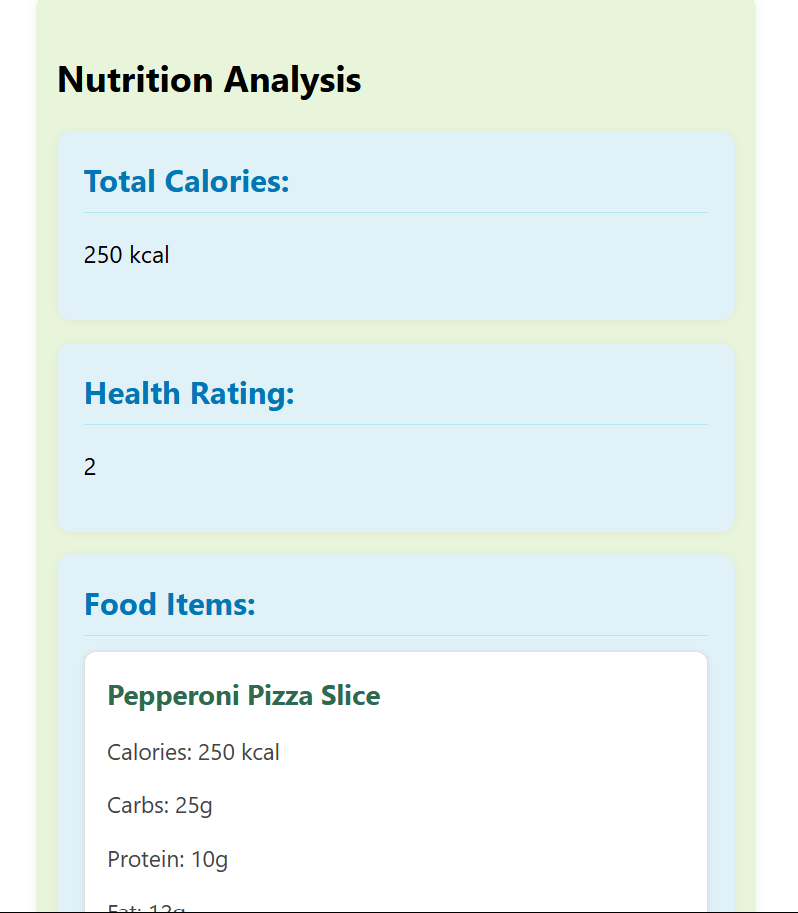
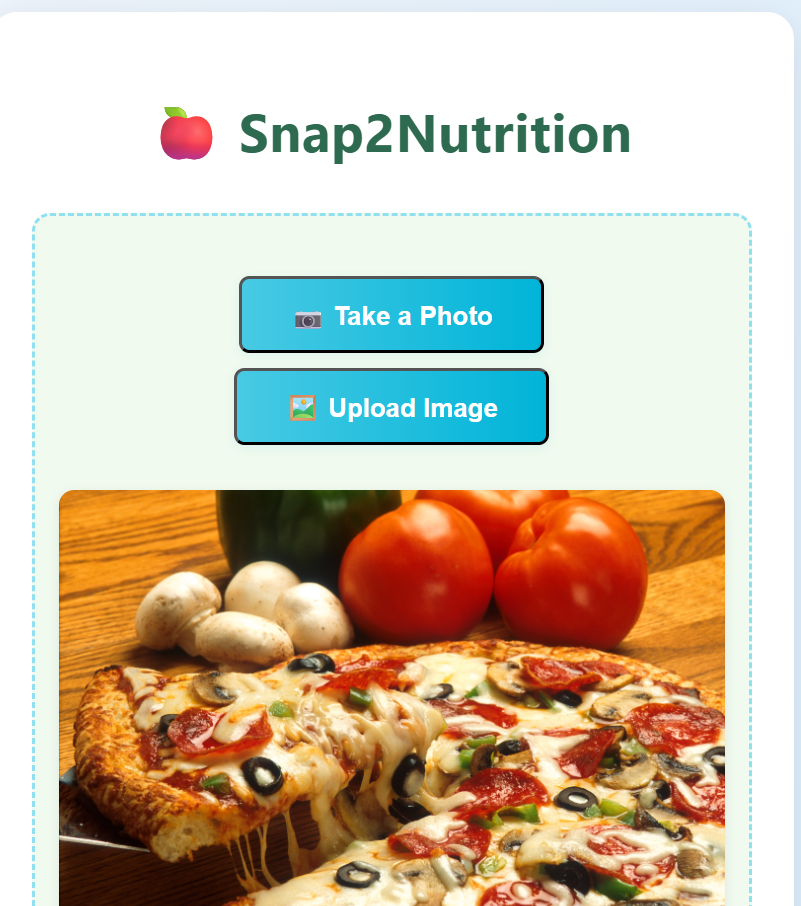
What it does Snap2Nutrition is a deep learning-powered app that identifies food items from an image and provides a comprehensive breakdown of their nutritional content. Users can snap a photo of their meal, and the app uses object detection and classification models to recognize the foods. It then maps each item to a nutrition database and displays calories, macronutrients, and other dietary facts in a clean, user-friendly format.
How we built it Frontend: A simple React web interface for image upload and display of results.
Backend: Python Flask API handles image inputs, triggers model inference, and returns processed nutritional data.
ML Models: We integrated YOLOv5 for food detection and custom-trained classifiers for food item recognition.
Nutrition Data: We used the USDA FoodData Central API to fetch detailed nutritional values of detected food items.
Deployment: Hosted the model and backend on a local server (or optionally cloud services like Heroku or AWS).
Challenges we ran into Accurately detecting and classifying food items in complex and cluttered images was difficult.
Mapping detected items to standardized nutrition data required extensive data normalization and fuzzy matching.
Balancing model performance and inference time to keep the app responsive and useful in real-world settings.
Accomplishments that we're proud of Successfully integrated a full pipeline from image upload to nutrition report generation.
Built and fine-tuned a working prototype that general users can interact with.
Used machine learning in a practical, real-world scenario to address a common health challenge.
What we learned Training object detection models for real-world data needs a lot of carefully curated images and annotation work.
Bridging the gap between ML model outputs and user-friendly applications involves many non-obvious engineering steps.
The importance of combining multiple disciplines—computer vision, web development, and data science—for a complete solution.
What's next for Snap2Nutrition Improve food detection accuracy using more robust models and diverse datasets.
Enable multi-food portion size estimation to give more precise nutritional analysis.
Launch a mobile-friendly version or Android/iOS app for easier on-the-go use.
Add features like dietary tracking, meal suggestions, and integration with fitness apps.
Built With
- flask
- google-generative
- pillow

Log in or sign up for Devpost to join the conversation.