-
-
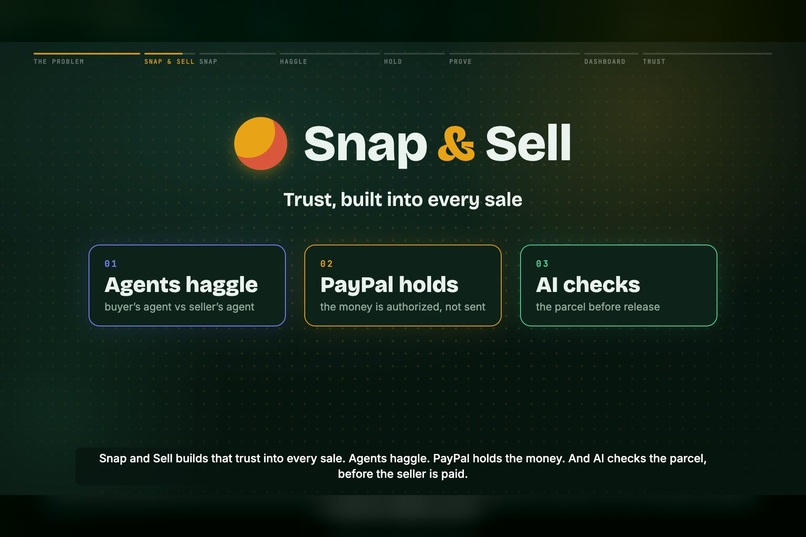
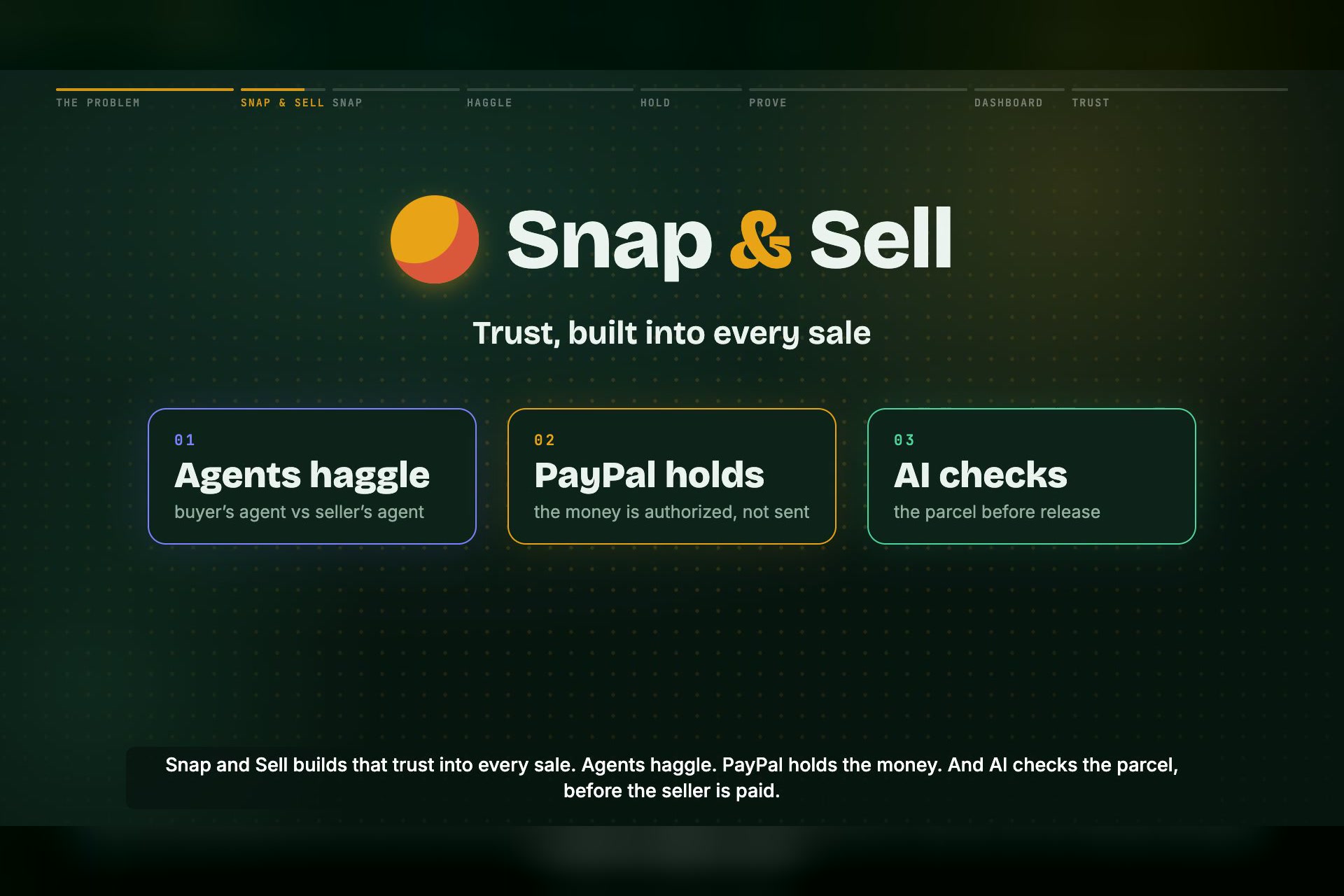
Snap & Sell: trust built into every sale. Agents haggle, PayPal holds the money, AI checks the parcel before the seller is paid.
-
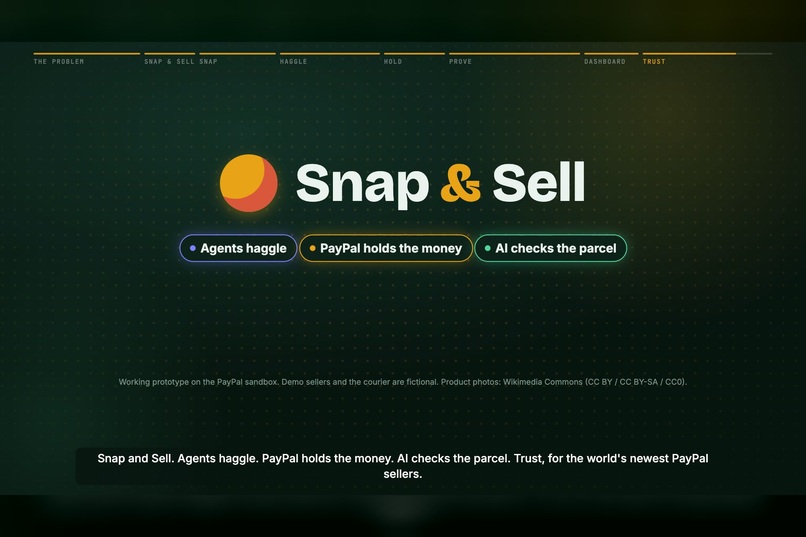
Agent-ready: a manifest, HTTP tool API and MCP server let any AI agent shop, but none of them can move money.
-
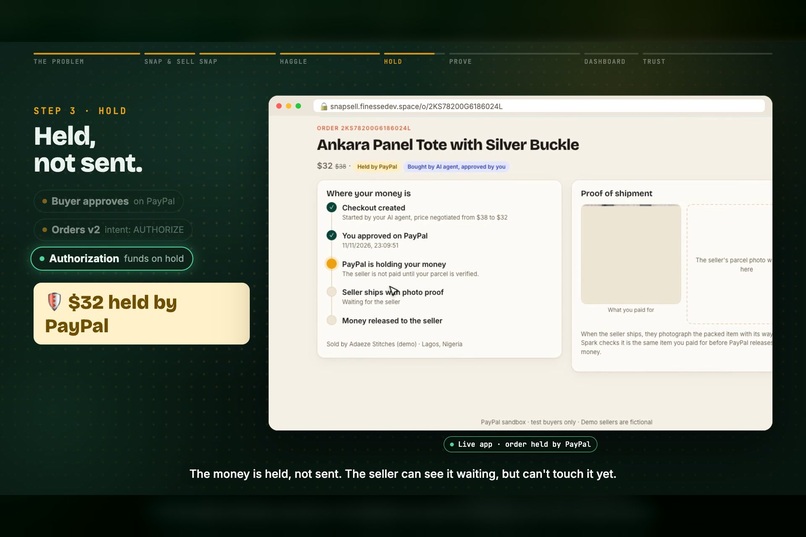
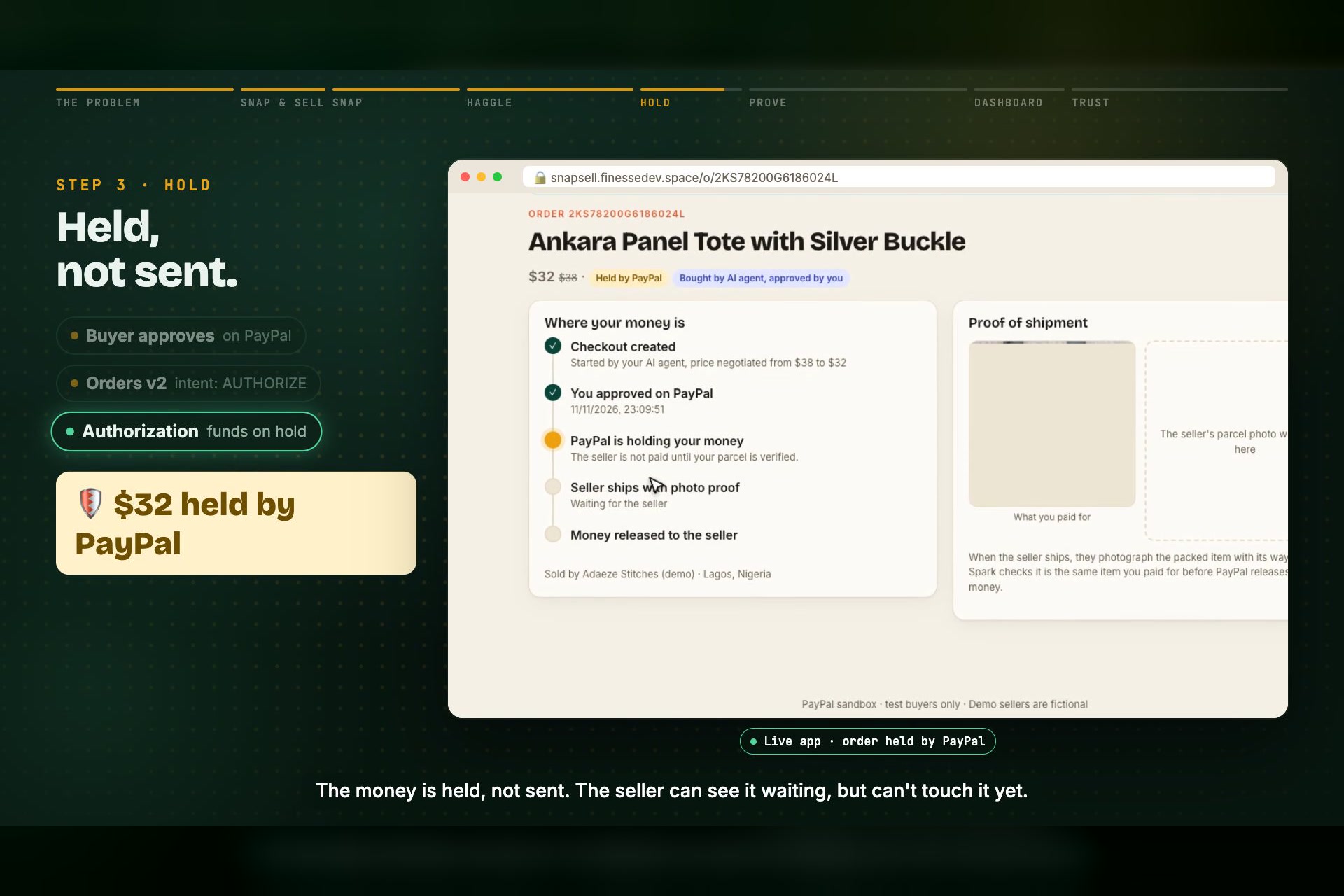
The buyer approves on PayPal and the money is authorized, not captured: $32 held by PayPal until the seller proves shipment.
-
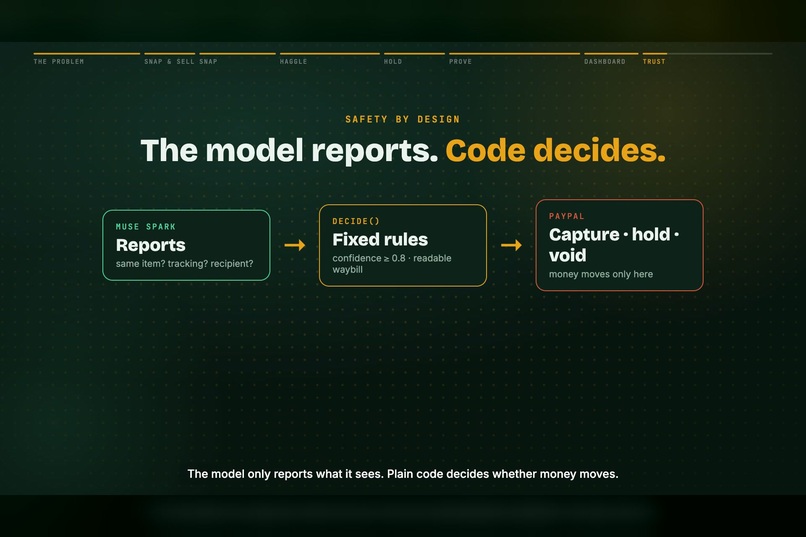
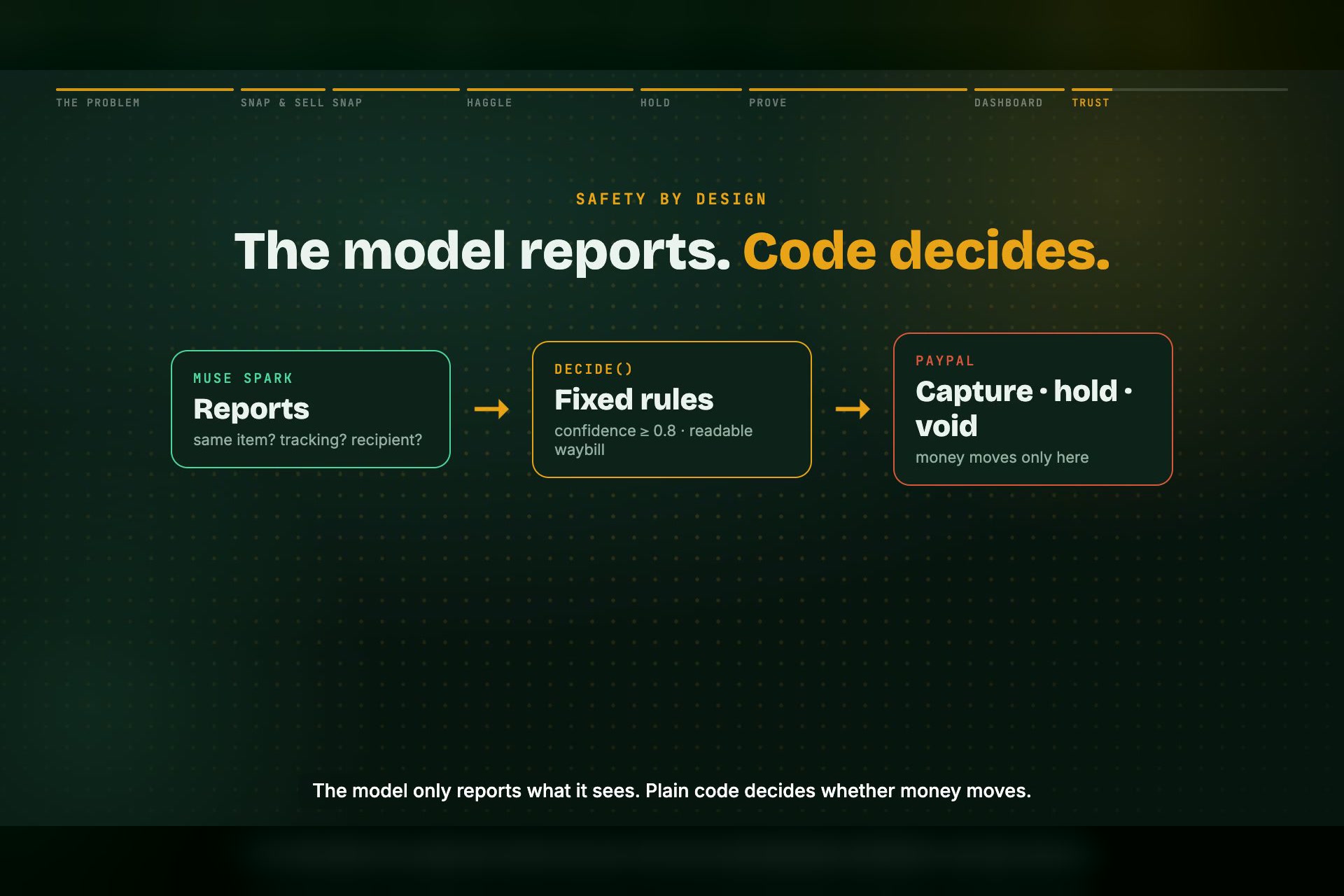
Safety by design: the model only reports what it sees; fixed rules in code decide whether PayPal captures, holds or voids.
-
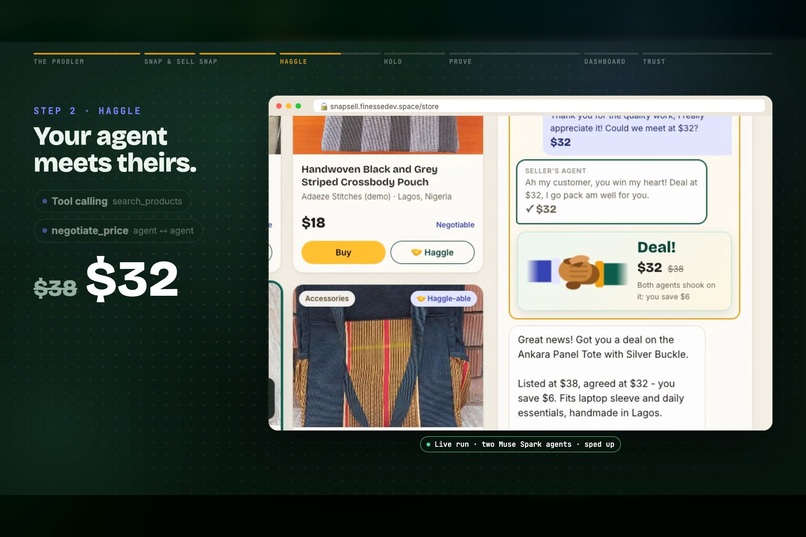
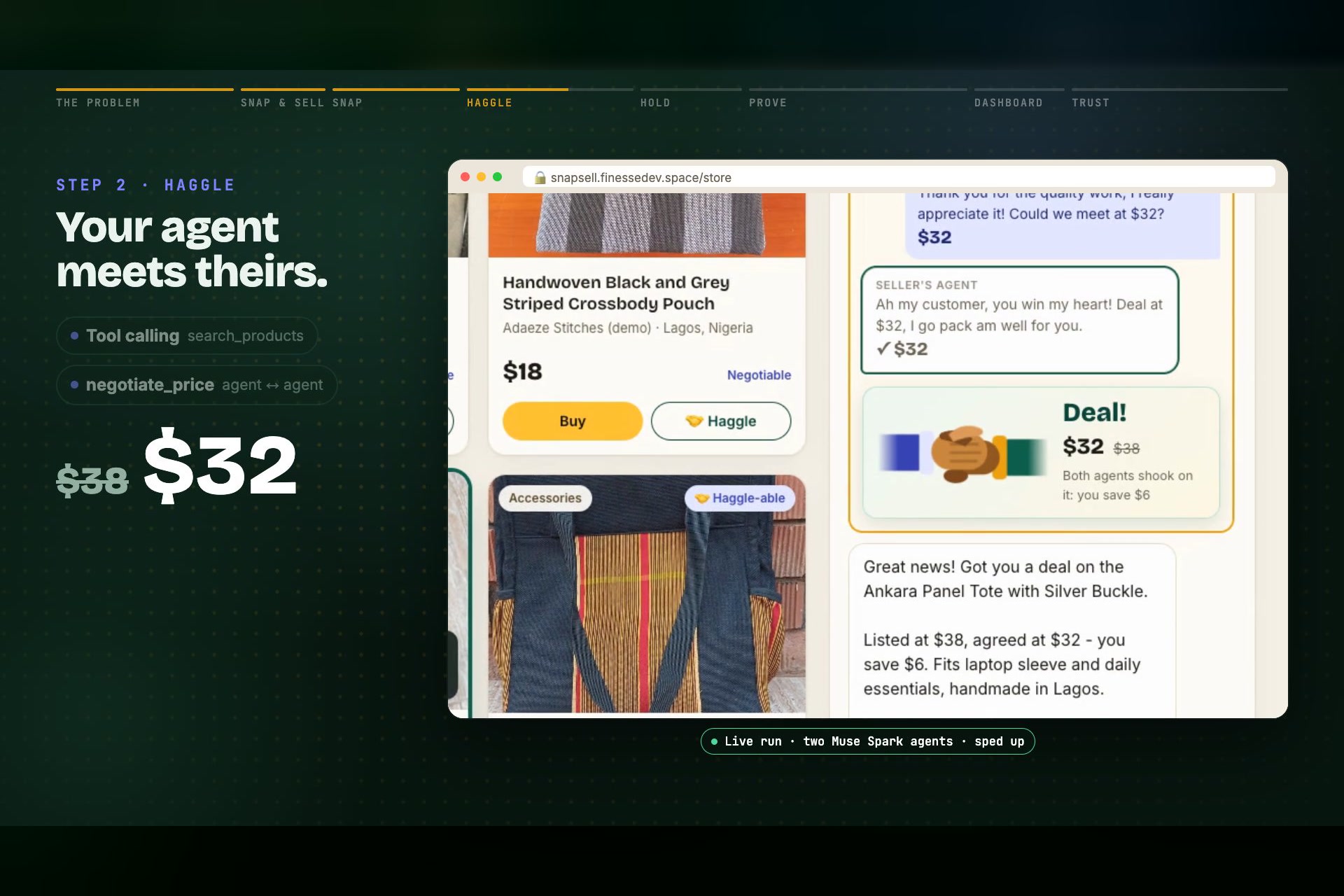
The buyer's AI agent haggles with the seller's agent, Lagos-market style: $38 down to $32. The seller's private floor is enforced in code.
-
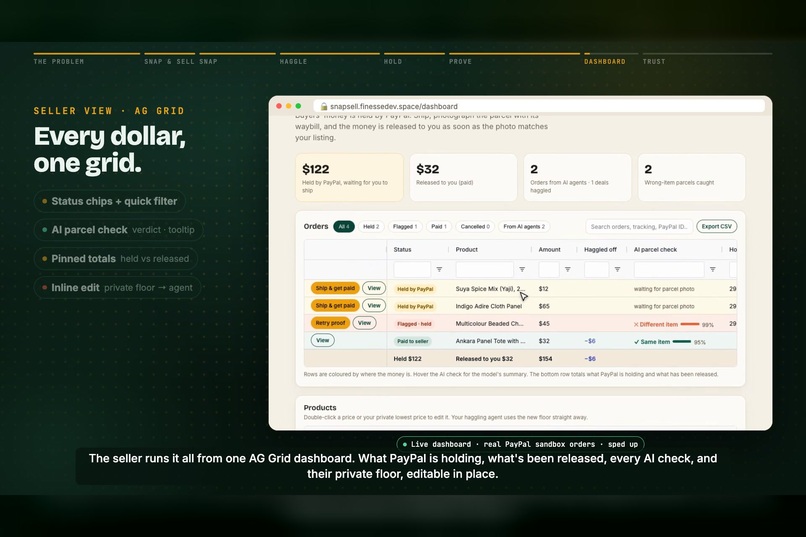
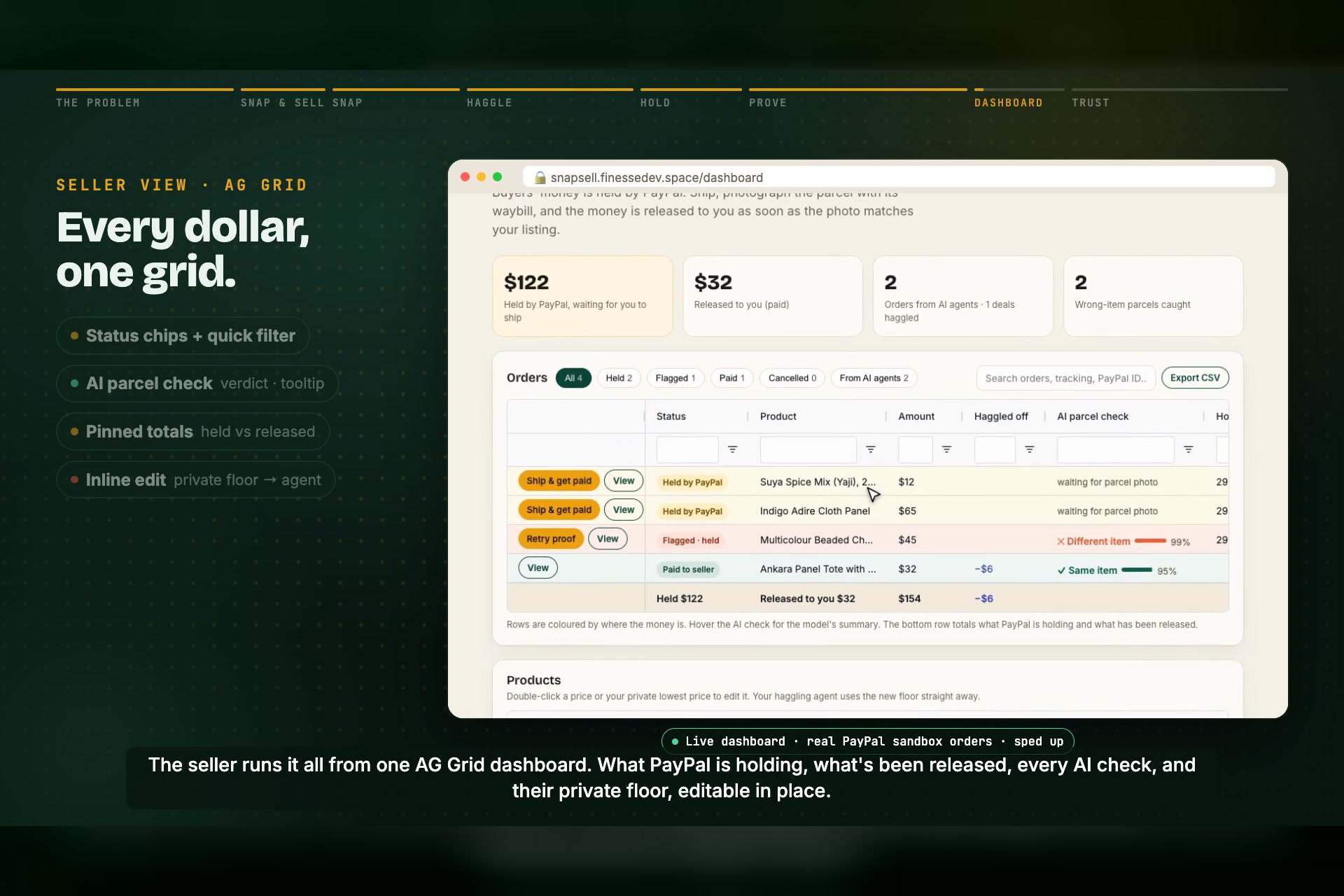
The seller's AG Grid dashboard: money held vs released, every AI parcel check, and private floor prices editable inline.
-
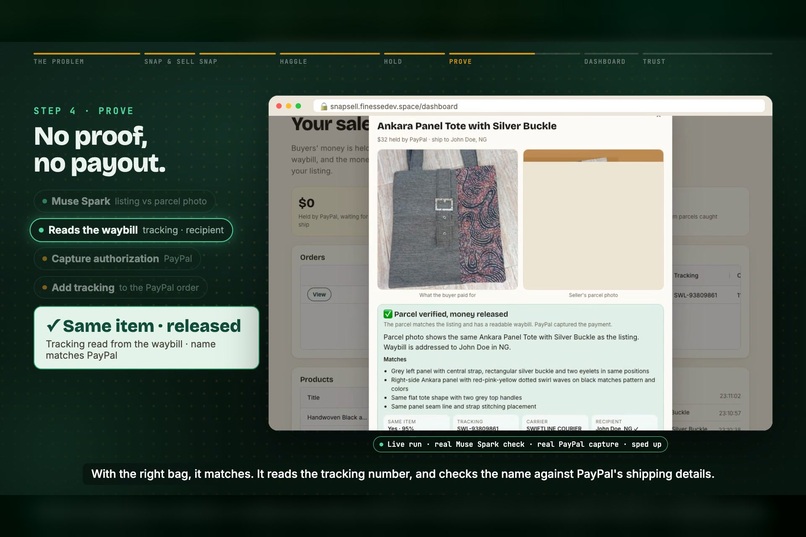
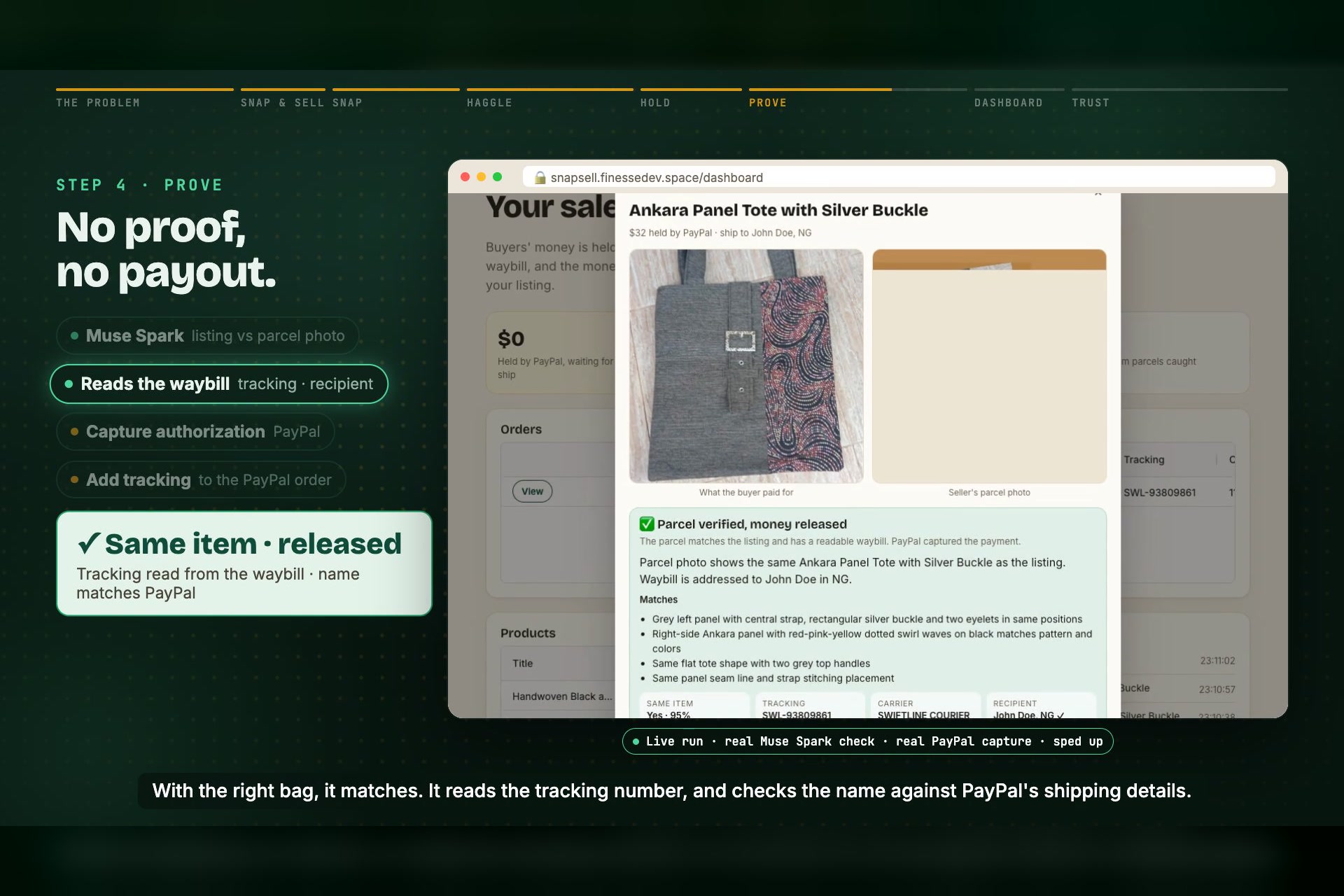
The right bag: Muse Spark matches it and reads the waybill, PayPal captures the payment and the tracking is added to the order.
-
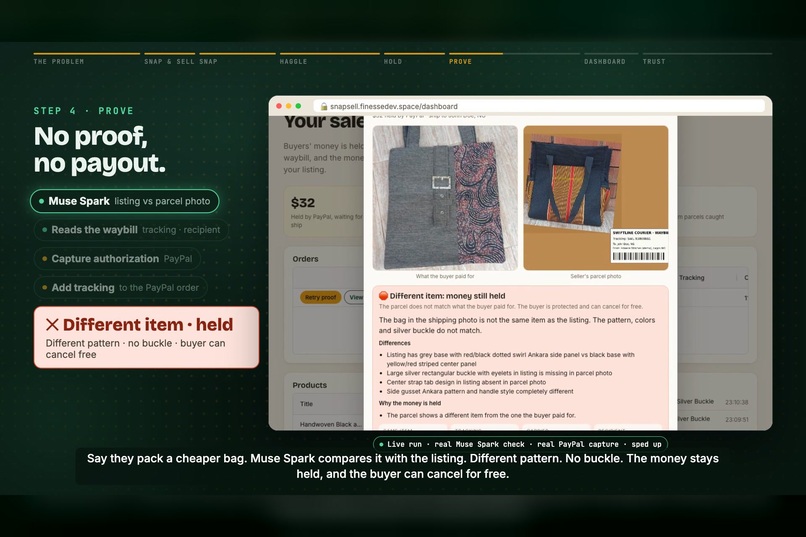
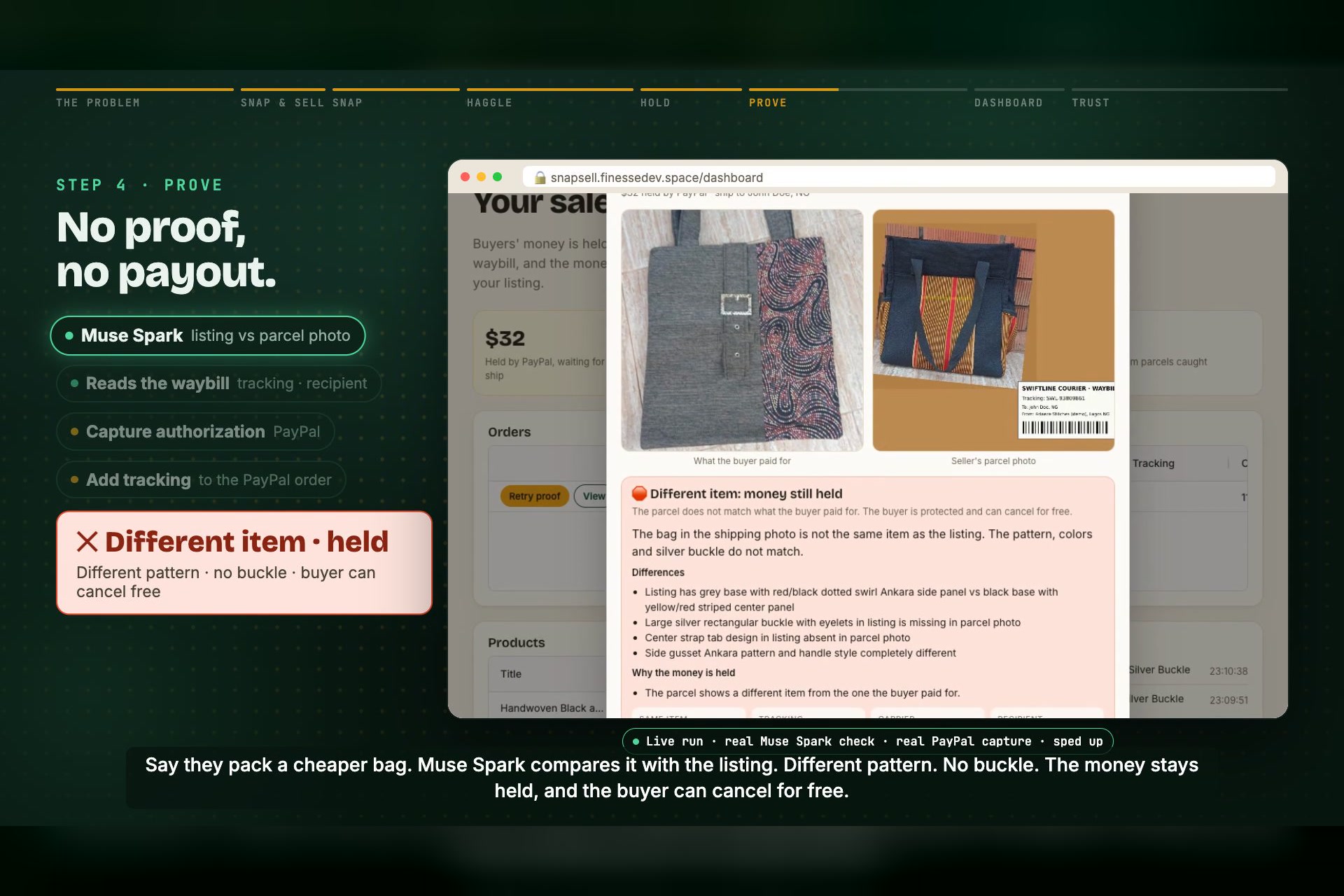
Seller packs a different bag: Muse Spark spots the mismatch, the money stays held, and the buyer can cancel for free.
Inspiration
For about 20 years, people in Nigeria could not receive PayPal payments. In January 2026 PayPal returned through Paga. Millions of tailors, bead makers and dye workers can now be paid from abroad, but a buyer in London has no reason to trust an unknown seller in Lagos, and the seller has no reviews, no online store and no idea how to price in dollars. Trust is the reason inbound payments were closed for so long. We wanted to build trust into every sale from day one, for buyers, for sellers, and for the AI agents that are starting to shop for people.
What it does
- Snap: the seller takes one photo. Muse Spark writes the listing and suggests a dollar price, with its reasoning.
- Haggle: the buyer's AI agent negotiates with the seller's AI agent, Lagos-market style, live on screen. The seller's lowest price stays private and is enforced in code: the seller's agent can't go below it and the buyer's agent can't go over budget.
- Hold: the buyer approves on PayPal, and PayPal holds the money (an authorization, not a capture).
- Prove: the seller photographs the packed item with its waybill. Muse Spark compares it with the listing photo, reads the tracking number and recipient, and checks the recipient against the buyer's PayPal shipping name.
- Release: if it matches, the payment is captured and tracking is added to the PayPal order. If the seller packed a different item, the money stays held and the buyer can cancel for free (the authorization is voided).
- Agent-ready: a manifest, an HTTP tool API and an MCP server let any AI agent search, haggle, check out and track orders. No tool can move money.
How we built it
- PayPal: Orders v2 with
intent: AUTHORIZE; authorize on approval; capture the authorization after proof of shipment; void to cancel; add tracking to the order; webhooks verified with the verify-webhook-signature API; JS SDK buttons with Venmo and Pay Later; the redirect approval flow for agents and QR codes; OAuth with token caching; idempotency keys. All in the PayPal sandbox. - AI: Meta's Muse Spark through the Responses API, used four ways: vision for photo-to-listing; two-image comparison plus waybill reading for proof of shipment; structured turns for the two haggling agents; and tool calling for the buyer's shopping agent, streamed live to the browser.
- Safety by design: the model reports what it sees; plain code decides whether money moves (confidence thresholds, readable tracking, recipient match). The haggling floor never reaches the buyer side, and every offer is clamped on the server.
- Seller dashboard (AG Grid Community): the escrow control room.
- Rows are coloured by where the money is: held, flagged, paid, cancelled.
- Status chips filter the orders (external filter), next to quick search and floating filters.
- An "AI parcel check" column shows the verdict and confidence, with the model's summary on hover.
- Columns for "haggled off" savings and a hold-expiry countdown.
- A pinned totals row shows money held vs released for whatever is filtered.
- CSV export.
- Price, private floor, haggling on/off and stock are edited inline in the products grid and saved to the server, so the seller's haggling agent uses the new floor straight away.
- Stack: Node.js, Express, sharp, zod, AG Grid Community, MCP SDK. Deployed on a VPS (Nginx, PM2, HTTPS). 13 end-to-end tests against imitations of the PayPal and Meta APIs.
Challenges we ran into
- Letting AI near money safely. We split "see" from "decide": Muse Spark only describes the photos, and a small set of fixed rules decides whether to capture, hold or flag.
- Keeping negotiations honest. A prompt alone can't stop an agent from going below the seller's floor or leaking it, so the server clamps every offer and never sends the floor to the buyer side.
- Live demos and slow networks. An occasional stalled model request could freeze the haggle, so every call has a hard timeout with fast retries.
Accomplishments that we're proud of
In our tests the parcel check caught a swapped bag that looked similar (same type of Ankara tote, different pattern and hardware) with 0.96 confidence, while releasing the genuine parcel. It read the tracking number and recipient correctly each time. A full agent haggle (search, four offers, deal) takes about 20 seconds.
What we learned
Trust in agentic commerce comes from boundaries more than clever prompts: money held until there is evidence, the model separated from the money decision, private limits enforced in code, and a visible trail for the buyer.
What's next for Snap & Sell
Courier tracking events before capture, Pidgin and Yoruba voice listing, PayPal Payouts for marketplace splits, seller accounts, and publishing catalogs to PayPal's agentic commerce channels.
Try it
- Live demo: https://snapsell.finessedev.space
- Code: https://github.com/muyiwah/snapandsell
- PayPal sandbox buyer (for judges):
[email protected]/0$Bn0cM; - Walkthrough: open Shop, tap 🤝 Haggle on a "Haggle-able" item and watch the two agents negotiate, then Buy and approve on PayPal (the money is held, not taken). In the Seller dashboard, choose Ship & get paid on that order and use the swapped item sample photo first (the money stays held), then the genuine one (the payment is captured and tracking is added to the PayPal order).
Built With
- ag-grid
- express.js
- mcp
- meta-muse-spark
- nginx
- node.js
- paypal
- paypal-js-sdk
- paypal-orders-api
- paypal-payments-api
- pm2
- venmo

