
Our inspiration and mission
No one likes a pushy server but no one likes poor service either. Both these problems can be explained by signal detection theory. Your server relies on their visual sense to see when you need help, which isn't perfect. They are either risk adverse and come around too often meaning making customers feel uncomfortable or they don't come around often enough, which is a missed opportunity for sales. Overflow replaces the need for the server to rely on visual cues to server drinks and instead introduces an IOT system to notify their server when a customer needs their glass filled. This helps to improve service as well as increase the wet to dry ratio of a restaurant improving its overall profit margins.
How/what we built
Snack overflow is a three-part IOT system that allows the user to connect a cup to the internet of things.
The first part is the smart cup. Our smart cup is embedded with a moisture system to detect when the cup is full. We placed the sensor at the bottom of the cup in a horizontal orientation to get a consistent reading across the moisture sensor when it is both full and empty. The sensor connects to a director board, which features an A-D converter to transmit digital and signals to reduce noise. Our data is then processed in the Arduino sketch to return either an F or an E to signify empty or full. During the testing phase, we calibrated the sensor and created threshold moisture for both empty and full these values are set every time with the empty threshold being the initial value and the full value being a change within +/- of the original value.
The second part of our project is the transmission of the data. We are using a Bluetooth 2.0 module to connect to an android application. The android sketch uses serial communication over wireless Bluetooth broadcasting services. The Android phone can then connect to the serial port broadcast system and we can use that data.
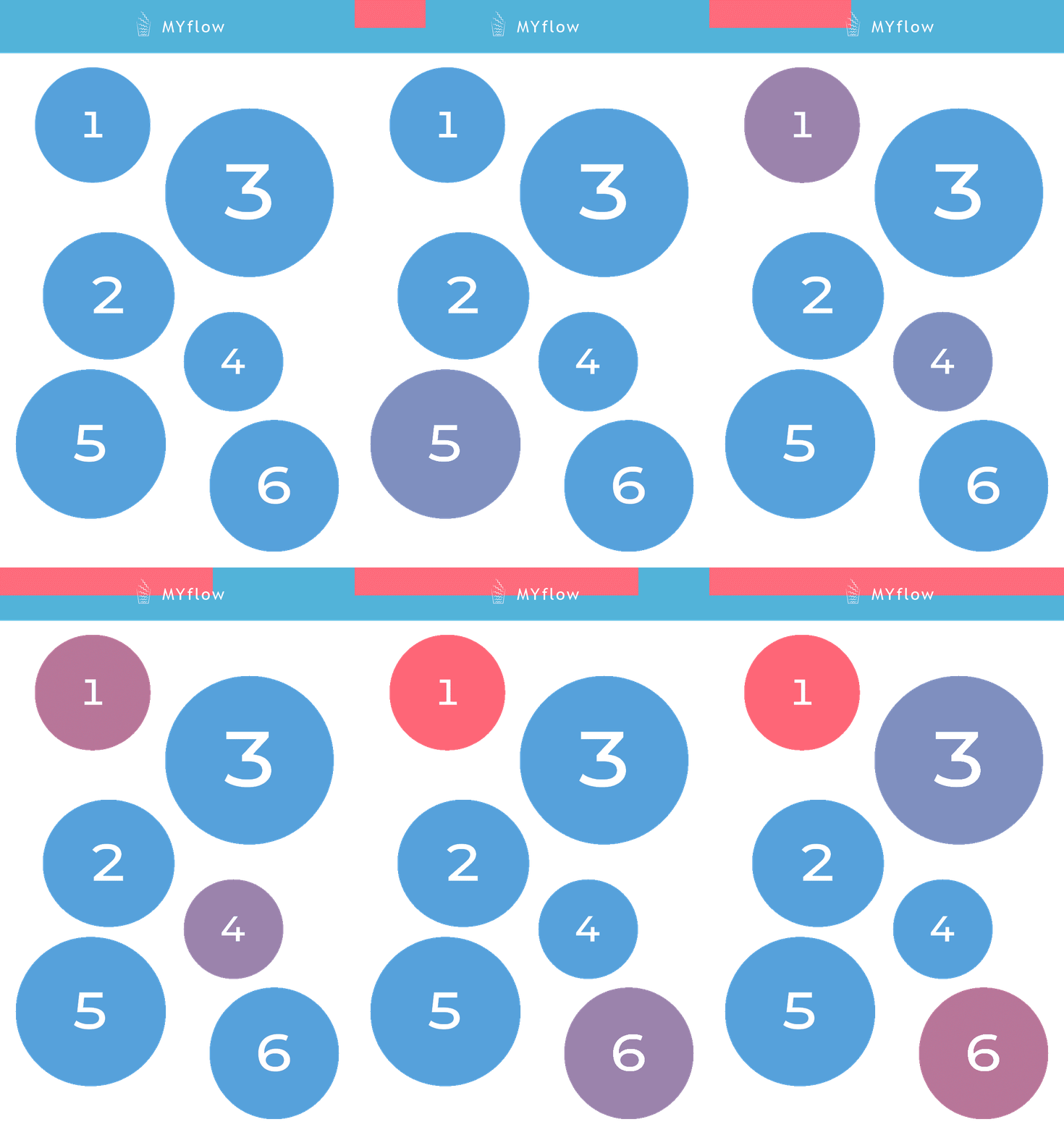
Lastly, we have our android application made in Android studios with assets made in Adobe suite. First, the user must connect to the Bluetooth cup on their cup and enter the password. Then the user can open the snack overflow app and will be prompted with a connect button. Upon pressing the connect button the user can then select the previously connected cup form the list of paired devices. Once connected we can process the data in a Java if statement and determine what to display to the user. If it is empty we display the table the cup belongs to as red and output the state to the user. If its full the table remains green. If time permits upon the change of full to empty the phone will buzz as an additional indicator to the server.
Challenges we faced
Our team is composed predominantly of web developers so our original plan was to use a wifi enable shield to send the data from the sensor to a web server. We could then make an ajax call to the server and build our app in react. Unfortunately at about 12:30 we discovered that our wifi shield which was a borrowed component from the Systems Design Nexus was broken. We then decided that we could try to get the data online using an Ethernet Arduino, but our Ethernet Arduino needed to connect via HDMI and we didn't have an HDMI cord. We then thought about connecting to a computer and then posting the data to fire-base and accessing that with cloud functions. This method worked but we wouldn't receive real-time data defeating the purpose of a live signal detection app. It was at this point we decided we would pivot one last time to our final Bluetooth system because the last piece of hardware we had was a blue tooth transceiver. This moved us from a web app to an android app, which was a relatively new process for most our group. Overall pivoting three times meant everyone got a chance to teach a little of what they knew and learn a lot of what they didn't which was stressful but rewarding.
Accomplishments that we're proud of
Like any hackathon, we’re proud of the things we’ve learned. Everyone on the team managed to step out of their comfort zone and try something different whether that’d be the hardware or the UI or android development. Secondly, we were able to create a project none of us could have imagined creating. With our very limited knowledge, we managed to create a functioning product that may actually benefit restaurants everywhere. We believe this product is capable of helping to better serve those in the food industry and integrate a new way for which IoTs are capable of helping food businesses. Mostly, we’re proud of the camaraderie and bond we managed to form through creating this project. For the majority of us, it was our first hackathon and building a functioning project within 24 hours doesn’t come easy with frustrations and stress dealing with the unknown. The mutual support and learning we were able to gain through this experience were incredible and absolutely invaluable.
Accomplishments that we're proud of
Like any hackathon, we’re proud of the things we’ve learned. Everyone on the team managed to step out of their comfort zone and try something different whether that’d be the hardware or the UI or android development. Secondly, we were able to create a project none of us could have imagined creating. With our very limited knowledge, we managed to create a functioning product that may actually benefit restaurants everywhere. We believe this product is capable of helping to better serve those in the food industry and integrate a new way for which IoTs are capable of helping food businesses. Mostly, we’re proud of the camaraderie and bond we managed to form through creating this project. For the majority of us, it was our first hackathon and building a functioning project within 24 hours doesn’t come easy with frustrations and stress dealing with the unknown. The mutual support and learning we were able to gain through this experience were incredible and absolutely invaluable.
What we learned
We learned how to assemble Arduino hardware and code using the Arduino sketch as well as communicating that data with our mobile app via Bluetooth. Alongside that, we learned how to adapt our app towards those constraints. While experimenting with different solutions, we also got to experiment with building a stdlib API, setting up Arduino wifi shield and ethernet shield.
What's next for Snack Overflow
SnackOverflow Ultimately we wish to refine the UI of our app and have the app be adaptable to different restaurant tables and environments to be flexible for all food industries as well as potentially integrating colors indicating how full someone’s cup is. We would also like it such that the sensor is capable of reading in data that was able to indicate how full the cup is instead of a simple boolean value. Finally, we would refine the design of the cup such that the prototype is entirely wireless and that the sensor blends in seamlessly with the design of the cup.
Built With
- adobe-suite
- android-studio
- ardunio-uno
- bluetooth-2.0
- java
- snackmanapi

Log in or sign up for Devpost to join the conversation.