-
-
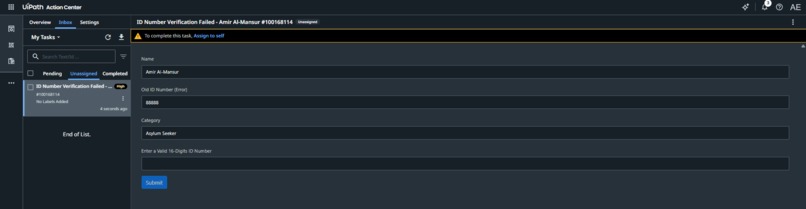
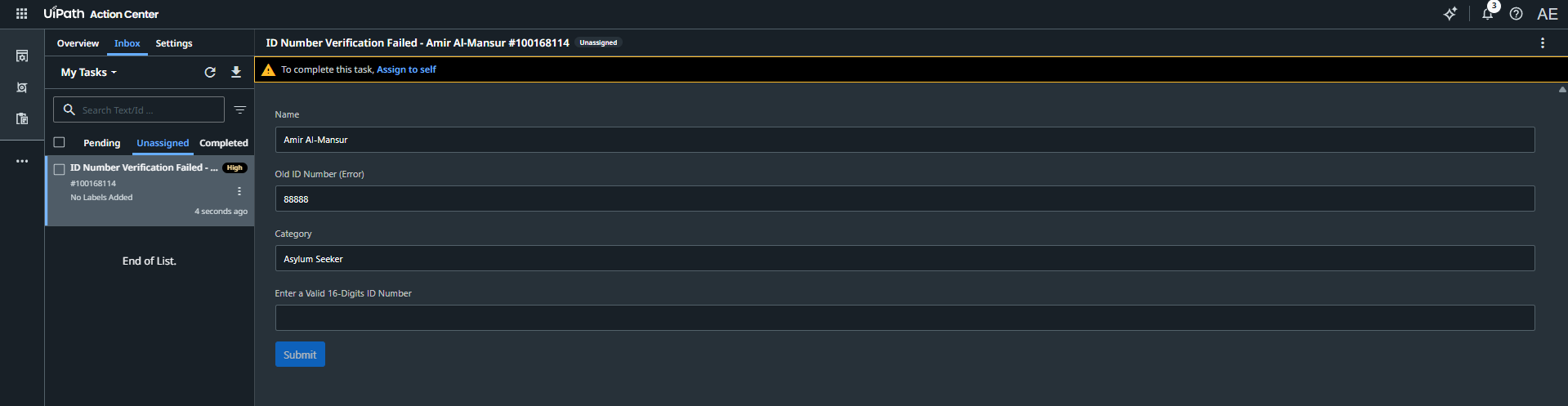
Open Form Design Action Center
-
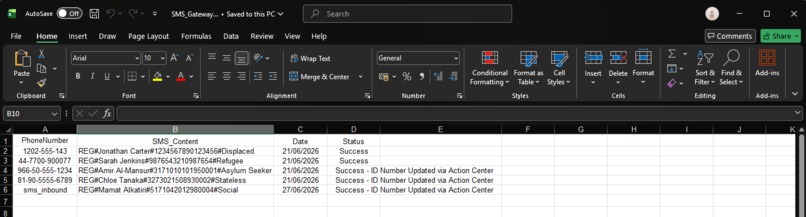
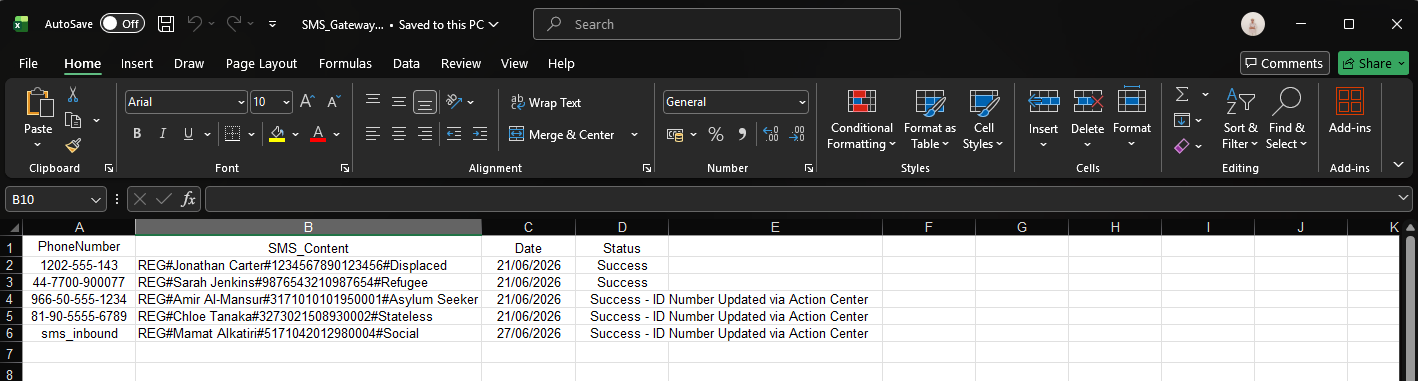
Output Files Excel
-
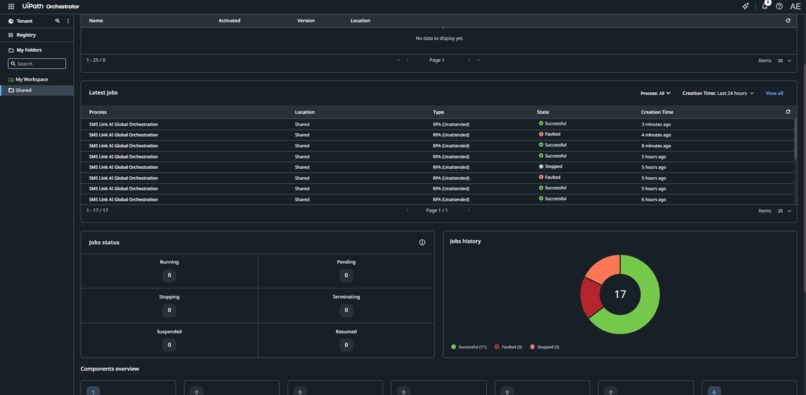
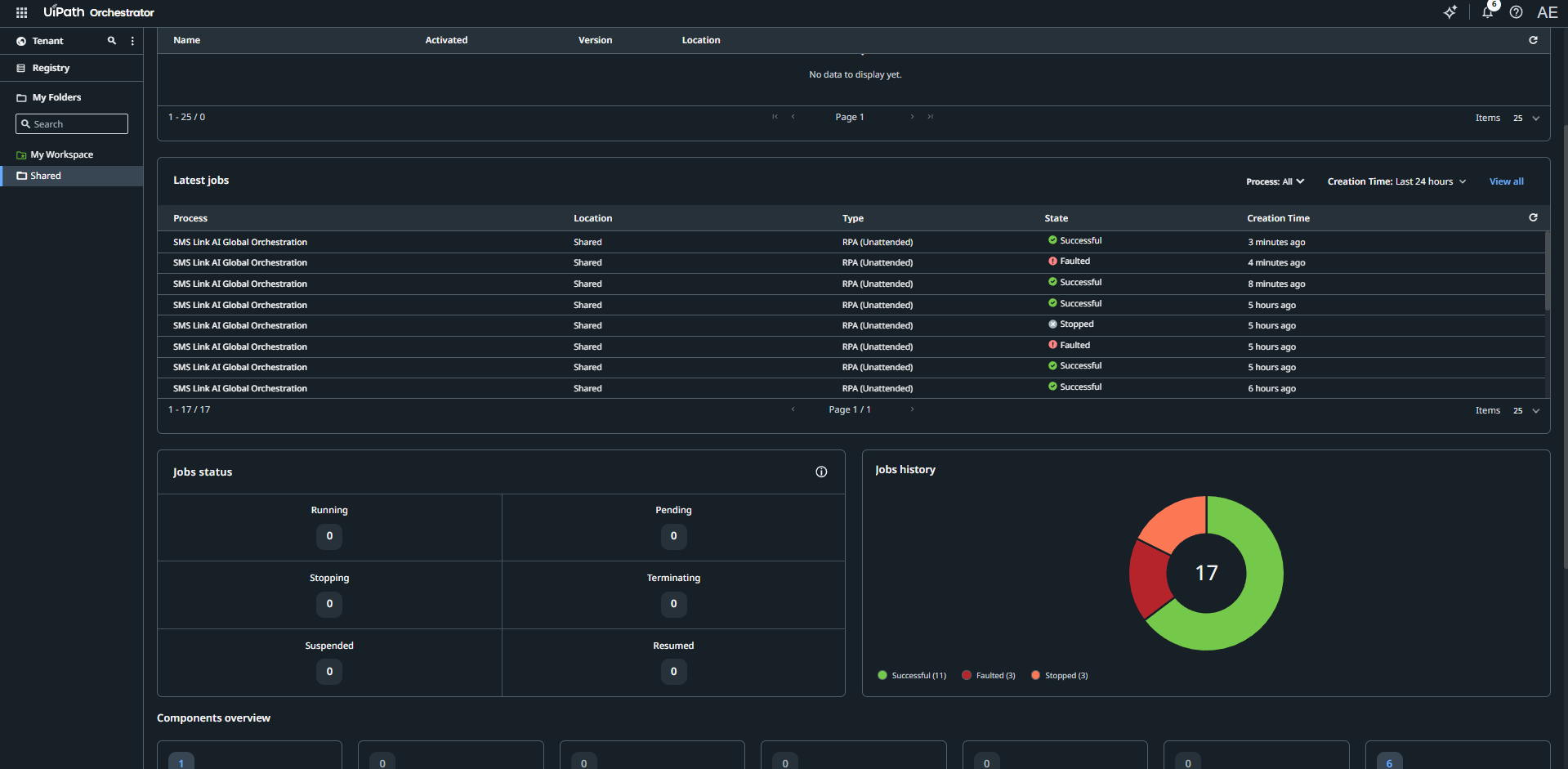
Dashboard Orchestrator
-
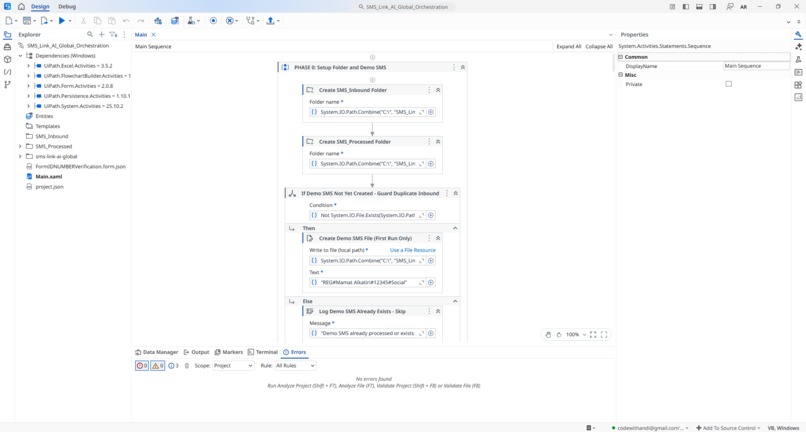
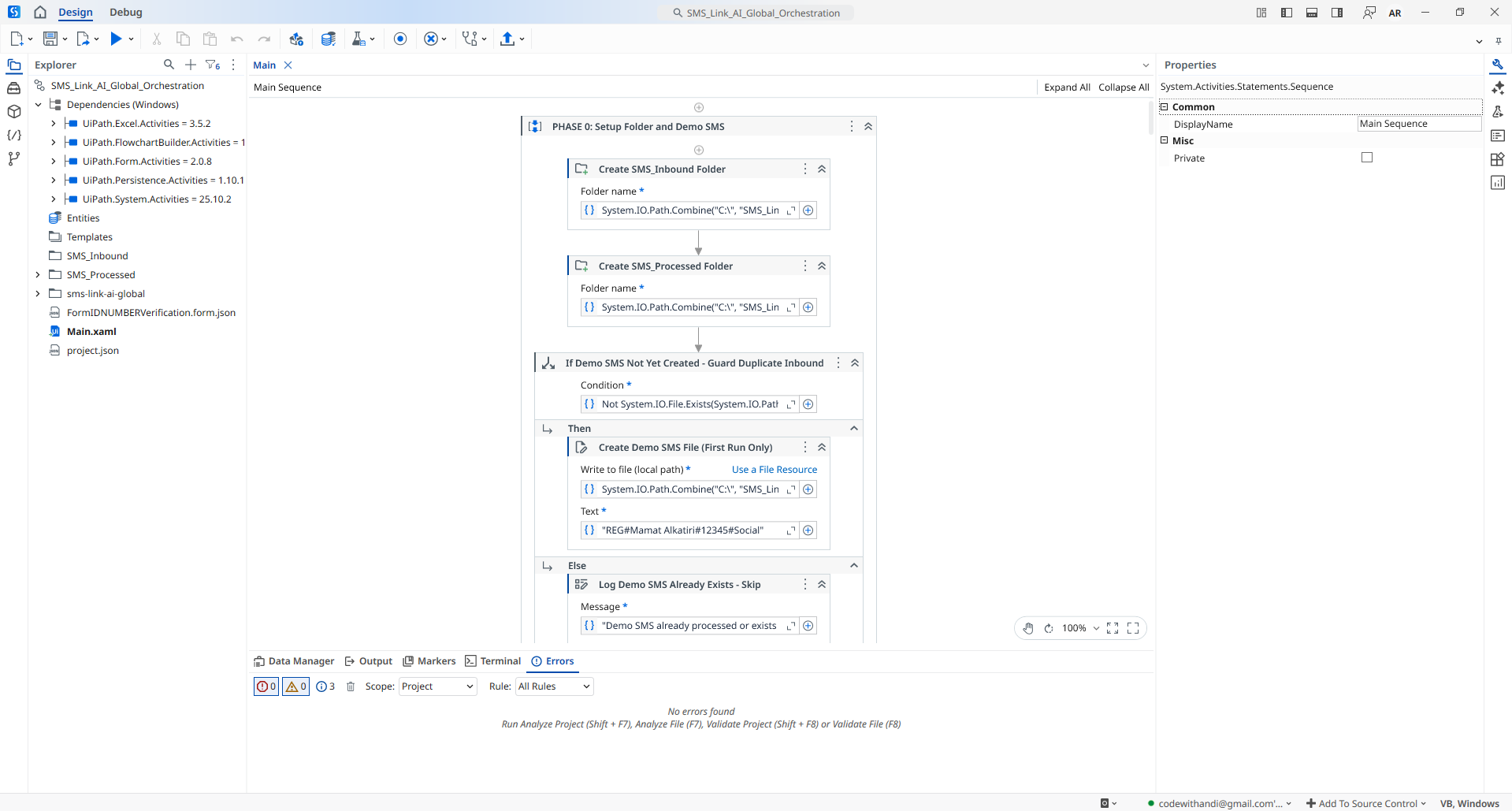
First Flow UiPath Studio
Inspiration
In an increasingly digitized world, we often take internet connectivity and smartphones for granted. However, in emergency crisis zones, conflict regions, and remote refugee camps, infrastructure is heavily compromised. Millions of displaced individuals trying to register for vital humanitarian aid — food, medicine, and shelter — do not possess smartphones. They rely strictly on basic mobile phones running on cellular networks.
Conversely, modern aid organizations operate primarily on structured, cloud-based portals for registration. This massive digital divide leaves the most vulnerable populations behind due to rigid system requirements or data-entry errors, such as mistyped National IDs.
We built SMS-Link AI Global to bridge this gap — treating low-tech SMS as a first-class citizen in advanced digital orchestration, powered by UiPath Maestro Case Management.
How We Built It
SMS-Link AI Global is architected as a multi-stage case management system, where each incoming SMS registration becomes a living, trackable Maestro Case that progresses through defined lifecycle stages — never losing state, never silently failing.
Stage 1 — Case Intake & Ingestion
A UiPath Studio robot acts as the ingestion gateway, continuously scanning incoming SMS payloads. Each message is parsed and immediately instantiated as a new Maestro Case, capturing registrant identity fields (name, location, National ID) into the case context. This ensures every submission — even from a \(2G\) feature phone — becomes a structured, auditable record.
Stage 2 — Automated Validation & Triage
An AI-powered validation agent evaluates each case autonomously:
- National ID strings are structurally validated using regex against strict formatting constraints (e.g., \(N\)-digit length criteria).
- Cases that pass validation are automatically advanced to Stage 3.
- Cases with anomalies are flagged with an exception and suspended — the Maestro Case retains full context while awaiting human resolution.
This triage mirrors real-world scenarios like insurance claim investigation, where not every submission can be auto-approved.
Stage 3 — Human-in-the-Loop Correction (Action Center)
For flagged cases, UiPath Action Center surfaces a structured web form
task to a human operator, powered by WaitForFormTaskAndResume (Persistence
Activities). The Maestro Case:
- Suspends execution without consuming machine runtime resources.
- Assigns the correction task to the appropriate human agent queue.
- Resumes automatically — exactly from suspension point — once the operator submits a corrected National ID.
This creates a true robot → human → robot handoff, a core pillar of Maestro Case orchestration.
Stage 4 — Resolution & Data Commit
Upon validation (automated or human-corrected), the case transitions to
Resolved. A final robot activity commits the verified record to a master
Excel ledger using robust append and write-back logic, protected by
multi-point Try/Catch exception handling.
$$ \text{Case Lifecycle} = \text{Intake} \rightarrow \text{Validation} \rightarrow \text{Exception Handling} \rightarrow \text{Resolution} $$
Challenges We Faced
True Idempotency at Scale: Building a production-grade workflow means ensuring that if the robot crashes mid-execution due to an unexpected failure, it will never duplicate records or corrupt the ledger on re-run. We solved this by validating every incoming file state against existing records before execution — guaranteeing consistency regardless of run frequency.
Graceful Case Suspension: Handling asynchronous human validation via Action Center without locking machine runtime resources was highly complex. Correct persistence configuration — including storage buckets and Orchestrator dependency wiring — was critical to keeping Maestro Cases alive across suspension boundaries.
Format Flexibility: Ensuring the parsing engine could adapt gracefully to minor messaging variances without throwing generic errors required designing multi-layered fallback
catchblocks — because in a crisis zone, a refugee cannot be asked to "try again with correct formatting."
What We Learned
Case-Oriented Thinking Beats Linear Automation: Traditional sequential robots break at edge cases. Designing around Maestro Cases — where each registration is a first-class, stateful entity with a lifecycle — made our system dramatically more resilient and auditable.
Human-in-the-Loop is Essential for Compliance: Fully autonomous systems fail when encountering human real-world edge cases — typos made under stress in crisis scenarios. Integrating human judgment via Action Center guarantees validation accuracy without burdening operators with routine data entry.
Designing for Accessibility Changes Everything: Technology is only impactful if it reaches its target user. Prioritizing basic SMS access forced us to shift our engineering mindset from building visual interfaces to building bulletproof backend case orchestration.
Resilience Over Speed: A fast automation that breaks under bad data is counterproductive in high-stakes environments. Meticulous
Try/Catcharchitecture is what differentiates a hackathon prototype from production-grade enterprise software.
Built With
- action-center
- agent
- claude
- code
- excel-activities
- maestro
- uipath-studio



Log in or sign up for Devpost to join the conversation.