-
-
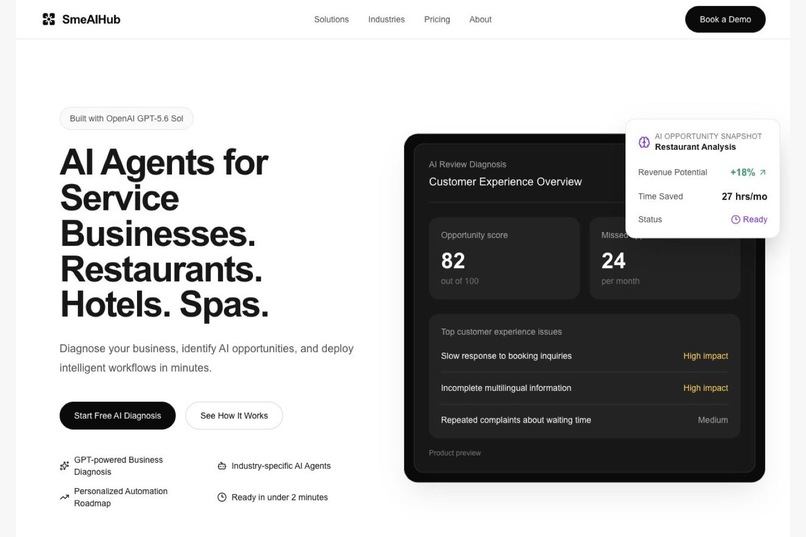
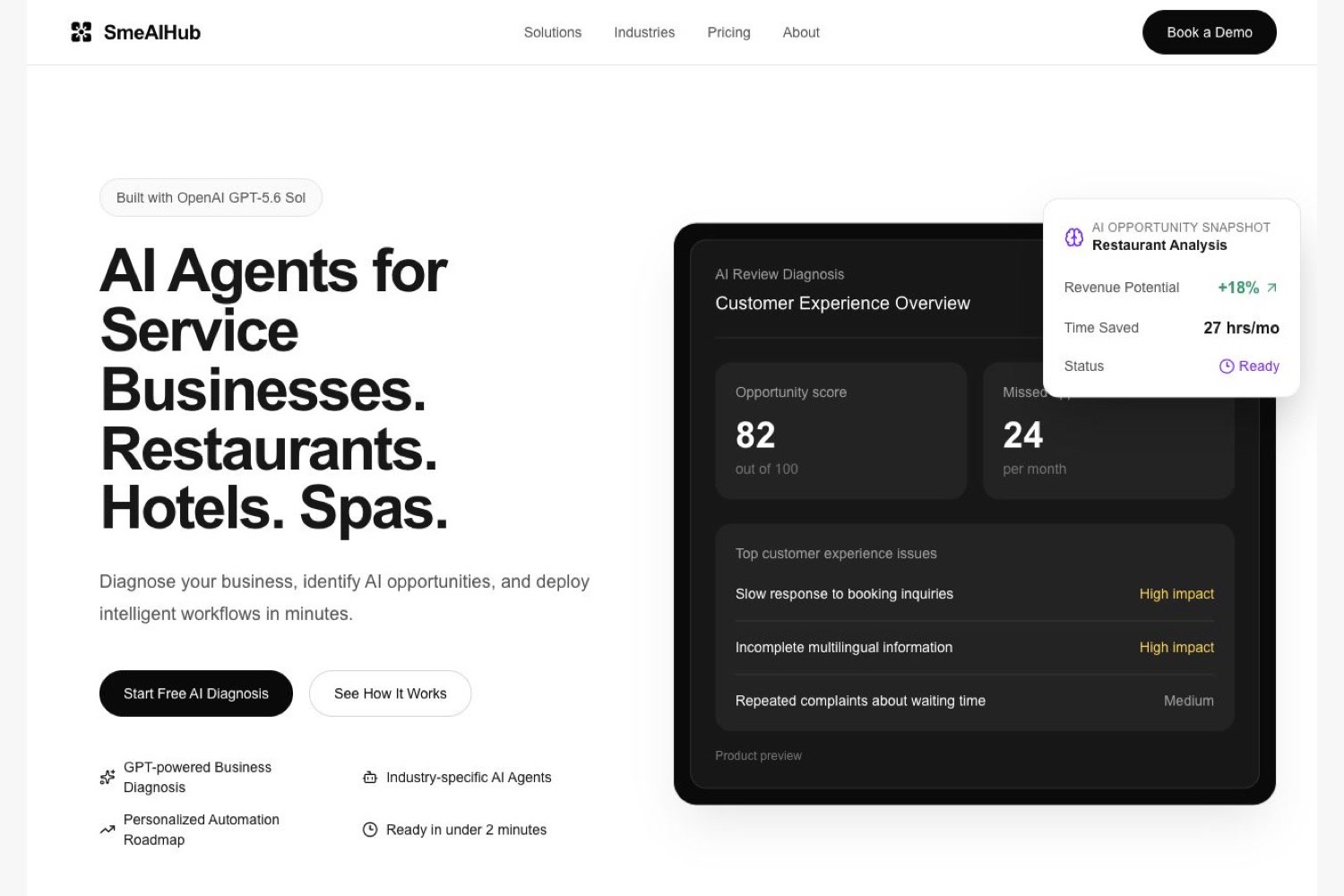
SmeAIHub homepage introducing AI agents and business diagnosis for restaurants, hotels, spas, and service businesses.
-
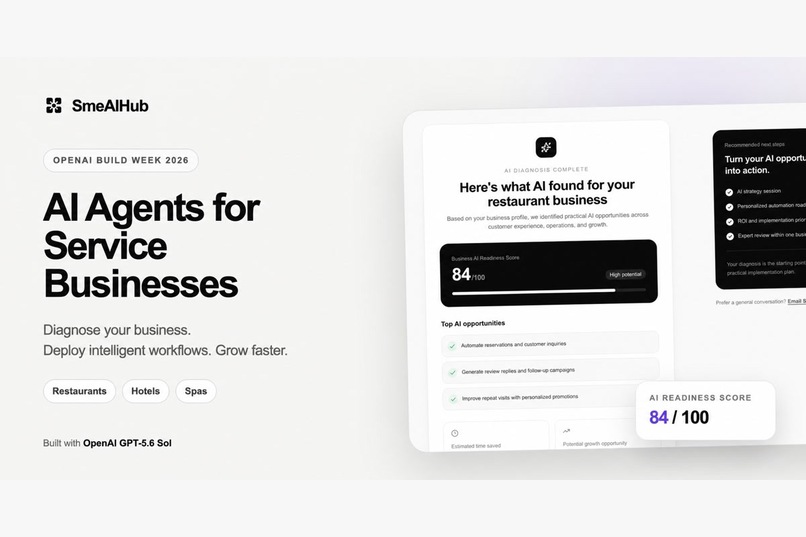
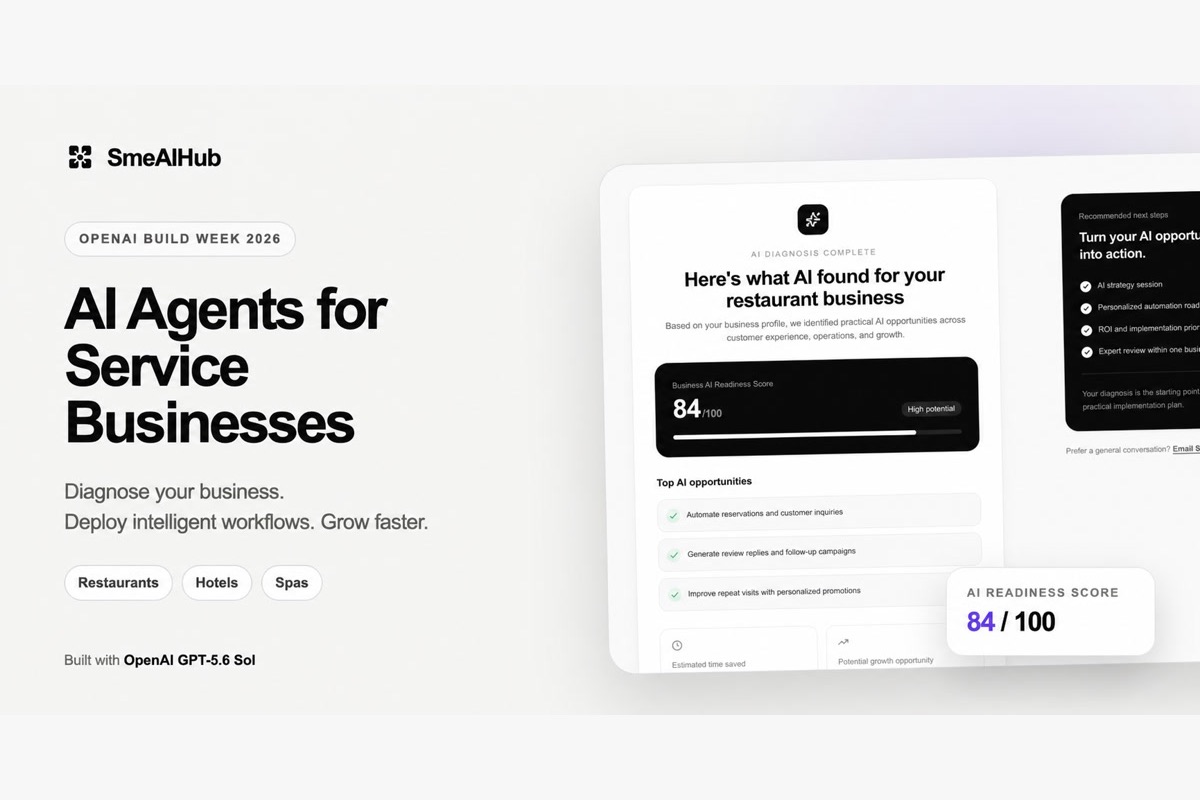
Industry-specific AI diagnosis results with readiness score, prioritized opportunities, time savings, and growth potential.
Inspiration
Small and medium-sized service businesses lose time and revenue to repetitive customer questions, fragmented booking workflows, inconsistent follow-up, and manual operations.
Most AI products begin with models, prompts, or integrations. That creates another layer of complexity for already-busy business owners. We wanted to reverse that experience: start with the business problem, identify where AI can create measurable value, and present the result as an understandable action plan.
SmeAIHub was created to help restaurants, hotels, spas, and other service businesses discover practical AI opportunities without requiring technical expertise.
What it does
SmeAIHub provides a complete AI Business Diagnosis experience:
- A business shares its industry, number of locations, biggest challenge, and improvement goal.
- A dedicated analysis state communicates the diagnosis workflow.
- SmeAIHub returns an industry-specific AI readiness score and prioritized automation opportunities.
- The report estimates potential time savings and growth impact.
- The visitor can book a strategy session or start another diagnosis.
The current prototype provides tailored results for restaurants, hotels, and spa and wellness businesses. Each industry receives different opportunity recommendations, readiness scores, time-saving estimates, and growth projections.
The experience also preserves the underlying lead-delivery workflow, so a successful diagnosis can securely notify the SmeAIHub team through email.
How we built it
SmeAIHub was built with Next.js 16, React 19, TypeScript, Tailwind CSS 4, Lucide React, Resend, and Vercel.
The marketing experience and metadata are server-rendered. The interactive diagnosis is isolated inside a focused Client Component boundary with distinct Form, Thinking, and Results states.
Diagnosis requests pass through:
- client-side validation;
- a same-origin server endpoint;
- server-side validation and payload limits;
- honeypot protection;
- HTML escaping;
- secure lead delivery through Resend.
Google Analytics and Microsoft Clarity load only after explicit user consent.
The current public diagnosis uses a deterministic, industry-specific recommendation layer. Submitted business information is not sent to an OpenAI model at runtime. This makes the prototype predictable, reviewable, and privacy-conscious while validating the complete product experience.
How we used GPT-5.6 Sol and Codex
The core SmeAIHub experience was designed and built with GPT-5.6 Sol through Codex as an active product and engineering collaborator.
Codex helped us:
- sharpen the positioning from a generic automation platform to “AI Agents for Service Businesses”;
- review the information architecture and first-screen product story;
- design the Form → Thinking → Personalized Results interaction model;
- divide complex work into small, independently testable milestones;
- implement and review responsive React and TypeScript components;
- diagnose state, validation, build, and browser issues;
- create the Hero, industry-specific results, supporting states, metadata, screenshots, README, and submission assets;
- maintain the roadmap, changelog, design reviews, and decision history;
- validate the production build and desktop/mobile experience.
We treated Codex as a persistent collaborator across product reasoning, implementation, verification, and documentation—not simply as a code-completion tool.
Challenges we faced
One major challenge was translating the broad idea of “AI automation” into a product story that a business owner could understand within seconds.
We also needed to introduce a convincing multi-state AI experience without breaking the existing API submission and email-delivery workflow. The result flow had to preserve validation, handle failure safely, work responsively, and provide different recommendations for each industry.
Another important challenge was communicating OpenAI’s role accurately. GPT-5.6 Sol and Codex accelerated the product’s design and development, while the current public diagnosis remains deterministic. We chose transparency instead of claiming a runtime model integration that does not yet exist.
Accomplishments that we're proud of
- Transformed a marketing form into a complete Form → Thinking → Personalized Results workflow.
- Created industry-specific readiness scores and recommendations for restaurants, hotels, and spas.
- Preserved API submission, email delivery, analytics consent, validation, and security protections.
- Added a results-aware sidebar and a restart path for repeated diagnoses.
- Built a responsive, production-ready site with a clean lint and production build.
- Produced a complete Build Week package with screenshots, cover artwork, README, captions, and a public demo video.
What we learned
The strongest AI product experience is not defined by how often it says “AI.” It is defined by how clearly it translates intelligence into a useful decision.
For service businesses, a prioritized opportunity, understandable impact estimate, and concrete next step are more valuable than a generic chatbot.
We also learned that Codex is most effective when it participates throughout the product lifecycle—from positioning and architecture to implementation, debugging, review, documentation, and launch preparation.
What's next for SmeAIHub
The next runtime milestone is an OpenAI-powered diagnosis service using:
- the OpenAI Responses API for live business analysis;
- Structured Outputs for reliable scores and recommendations;
- deterministic validation and guardrails around generated results;
- explicit data minimization and user control;
- traceable explanations for every recommended opportunity;
- streaming analysis progress;
- downloadable implementation roadmaps.
Longer term, SmeAIHub will become a workspace where service businesses can move from diagnosis to deploying and managing an intelligent AI workforce.
Built With
- analytics
- clarity
- codex
- gpt-5.6
- lucide
- next.js
- openai
- react
- resend
- sol
- tailwind
- typescript
- vercel

Log in or sign up for Devpost to join the conversation.