Inspiration:
This pandemic has taught us many things during the past 2 years, including the importance of our olfactory senses. Many of us that were diagnosed with Covid-19 experienced a temporary loss of smell during which all food, beverage, and everyday scents tasted and felt bland. Our team decided to develop a solution for people with anosmia, those that suffer the loss of smell because they are one of the most underrepresented groups in the context of accessibility. Due to the invisible nature of this disability, there is a shortage in medical research, academic studies, as well as accessibility attention to anosmic people today. Our team realized that anosmia takes away a significant portion of human joy that many of us take for granted, and immediately decided to design an experience that is geared towards embracing anosmic people and helping them experience something that they have always been barred from.
What it does:
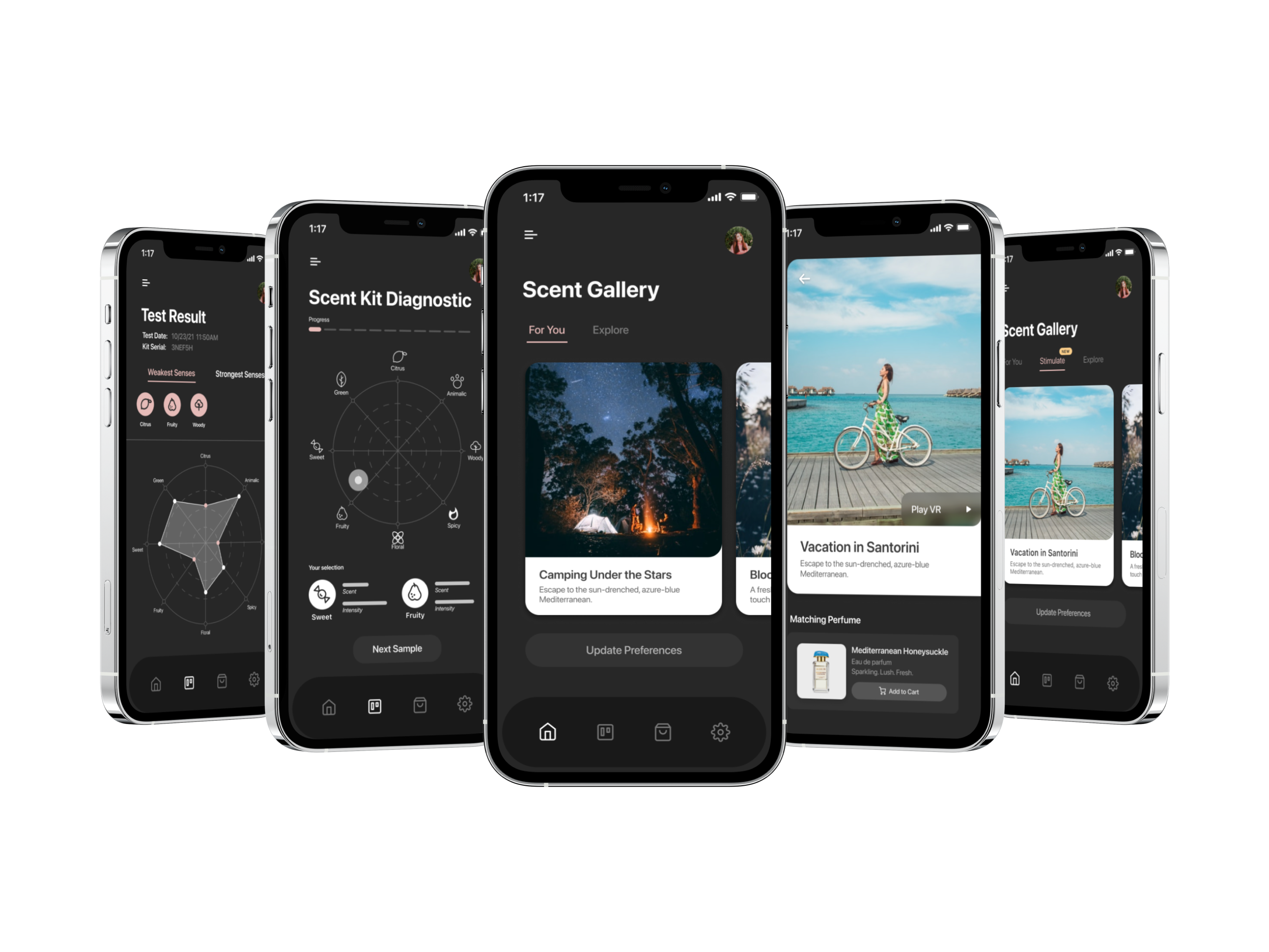
Sme11 aims to help anosmic people experience scents through visual, auditory, and spatial senses via immersive VR experience. We also designed our solution to help hyposmia people (those with partial loss of smell) regain their lost senses through diagnoses of weakened senses using a smell test kit and repetitive exposure to those scents through selected perfumes. Smell training is known as an effective method to restore senses, especially for those that are temporarily caused by COVID-19 or stress. Moreover, as smell disorders are early signs of Parkinson’s or Alzheimer’s disease, we also hope to enable early detections for expedited treatments.
How we built it
As our purpose was to develop a solution that can enrich the lives of those suffering from anosmia, the Sme11 team focused thoroughly on designing for an immersive experience that is also non-intrusive to those that are already inconvenienced by their disabilities. Using a design tool called Figma, we crafted the user flows and UIs with the goal of designing for seamless touchpoints between our software/hardware and users. All visual images and texts on the Sme11 app were carefully chosen to be empathetic and non-biased against those suffering from loss of smell.
Challenges we ran into
One of the biggest challenges was incorporating and streamlining our ideas into one solution. We invested the first half of our product development heavily in user research and problem definition to identify anosmic people’s major pain points. We focused on targeting the edge case while narrowing down our ideas to provide an inclusive experience to all anosmic people.
Accomplishments that we're proud of
One of the biggest hardships that people with disabilities face today is being left out and marginalized from the rest of our society. In that sense, anosmic people are even more vulnerable as anosmia is an invisible disability hidden from everyone else. We are proud to have developed a solution that addresses the needs of a sub-group that has been overlooked by society for a long time. Moreover, our intention was to design for a solution that benefits more than just the anomic population and also help those that are suffering from partial / temporary loss of smell. Through the use of a test kit that can diagnose one’s weakened senses and a curated list of perfumes that serve as stimulus to restore those senses, Sme11 can truly bring benefits to all people to better experience the joys of smell.
What we learned
We learned that not all disabilities have the same awareness levels. The lack of research and attention to olfactory-related disabilities demonstrates that there are still many opportunities to support disabilities that are less apparent and well-known. One finding was that some are quick to dismiss anosmia as less disability than others such as loss of sight or hearing but smell is as important
What's next for SME11
We truly believe that Sme11 can be productized and implemented to help people with anosmia and hyposmia. Our immediate step is to take our prototype and engage with actual end-users to refine our value propositions and uncover gaps that we may have missed.
Built With
- adobecc
- figma
- finalcutpro


Log in or sign up for Devpost to join the conversation.