-
-
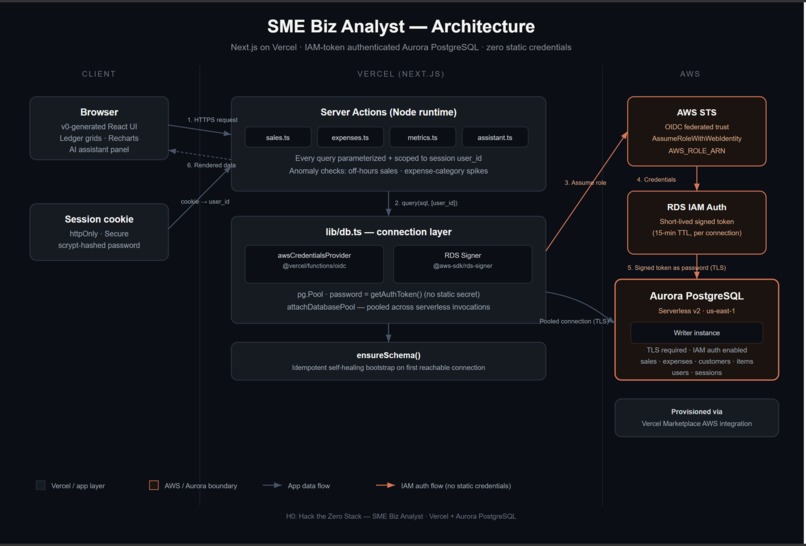
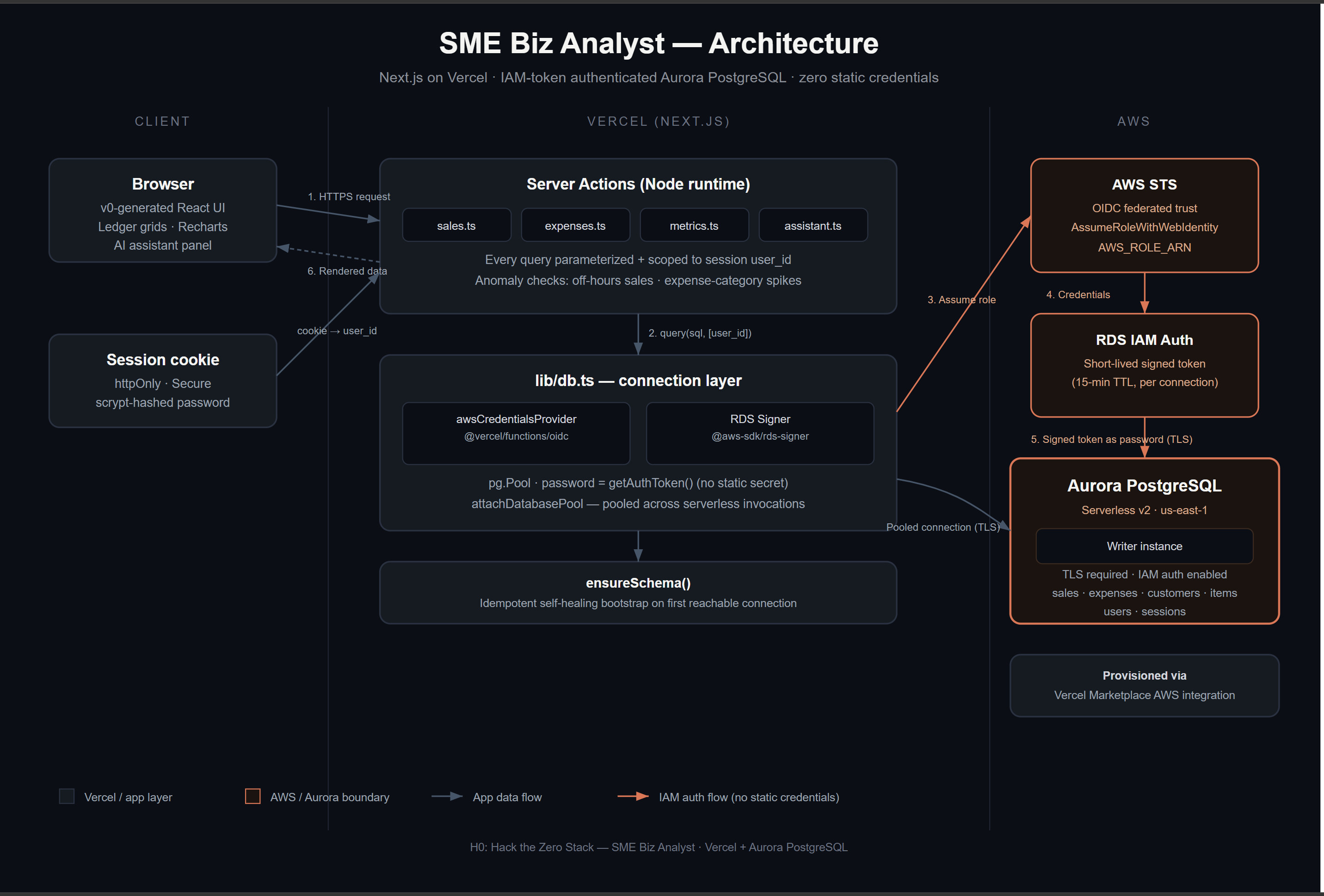
Architectural Diagram
-

Logo
💡 What It Does & The Problem Solved
SME Biz Analyst replaces the notebook-and-WhatsApp bookkeeping most small businesses run on with a real ledger: sales and expenses are recorded as structured, queryable transactions instead of scattered messages, and an on-screen assistant answers plain-English questions about the business — "who's my top customer," "what's my margin this month" — grounded in the owner's actual numbers, not guesses. Every sale's total is computed at the database level (a generated column, not application math), so the figures behind every chart are tamper-resistant by construction. Built for Track [B2B] — solo SME owners who can't afford a bookkeeper but need to know, daily, whether the business made money.
🗄️ Why We Chose Amazon Aurora PostgreSQL
A ledger has zero tolerance for inconsistent writes or downtime, so ACID compliance wasn't optional. We provisioned Aurora through the new Vercel Marketplace AWS integration, which handed us a live cluster and injected connection details (PGHOST, AWS_ROLE_ARN, etc.) straight into the project. Rather than store a database password, we use AWS IAM database authentication: every connection is signed with a short-lived token generated through @aws-sdk/rds-signer, fetched via Vercel's OIDC-federated AWS credentials. No long-lived secret exists anywhere in the app. Connections are pooled with Vercel's attachDatabasePool to behave correctly across serverless invocations, and the schema bootstraps itself idempotently on first successful connection — the app heals itself the moment Aurora becomes reachable, with no manual migration step.
⚙️ How It Was Built (The Integration Experience)
v0 scaffolded the ledger grids, the income-vs-expenditure chart, and the dashboard shell in minutes — the kind of UI iteration that would normally eat the first day of a hackathon. The AWS integration in the Vercel Marketplace took provisioning Aurora from a multi-step AWS console exercise down to one click, with zero manual VPC/security-group setup. On the data layer, every query is scoped to the session's authenticated user_id, enforced consistently at the query layer across sales, expenses, customers, and items — straightforward tenant isolation that maps cleanly to the row-level security model we'll move to at scale. Two real anomaly checks run against the live ledger today: transactions logged outside normal operating hours, and expense categories running 30%+ above their historical average — both flagged directly on the dashboard, not aspirational.
🏆 What We Achieved
In one day we shipped a working ledger on production-grade Aurora infrastructure, with computed/generated columns guaranteeing ledger integrity, IAM-token database auth with no static credentials, self-healing schema deployment, two functioning anomaly detectors, and a data-grounded Q&A assistant — architected so the rules-based logic can be swapped for an LLM (we have a detailed roadmap for Gemini-powered NL-to-SQL, fraud detection, and automated Telegram report delivery, documented in a 60+ page PRD) without touching the UI contract. This isn't a demo skeleton — it's a scoped MVP with a clear, already-designed path to the full vision.
Built With
- amazon-web-services
- v0
- vercel

Log in or sign up for Devpost to join the conversation.