-
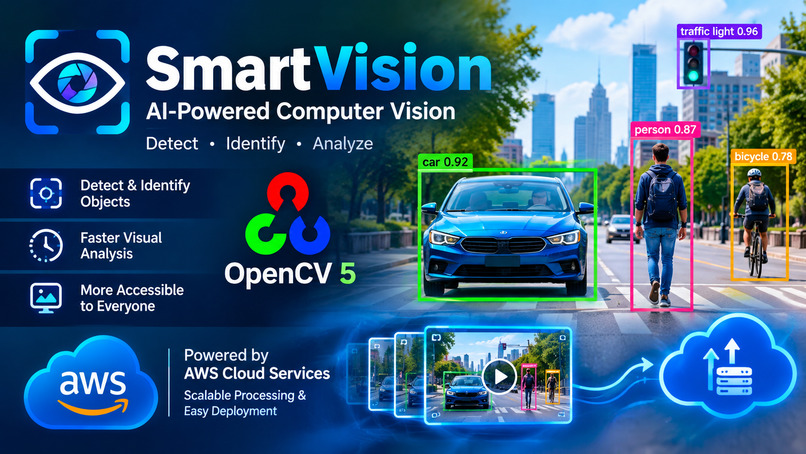
Smart Vision
Inspiration
SmartVision was inspired by the growing need for smarter, safer, and more efficient urban environments. Traditional traffic monitoring and surveillance systems often require manual observation, which can be time-consuming and inefficient. We wanted to explore how AI-powered computer vision could automatically detect, identify, and analyze objects in real time, helping make roads safer and traffic management more intelligent.
What it does
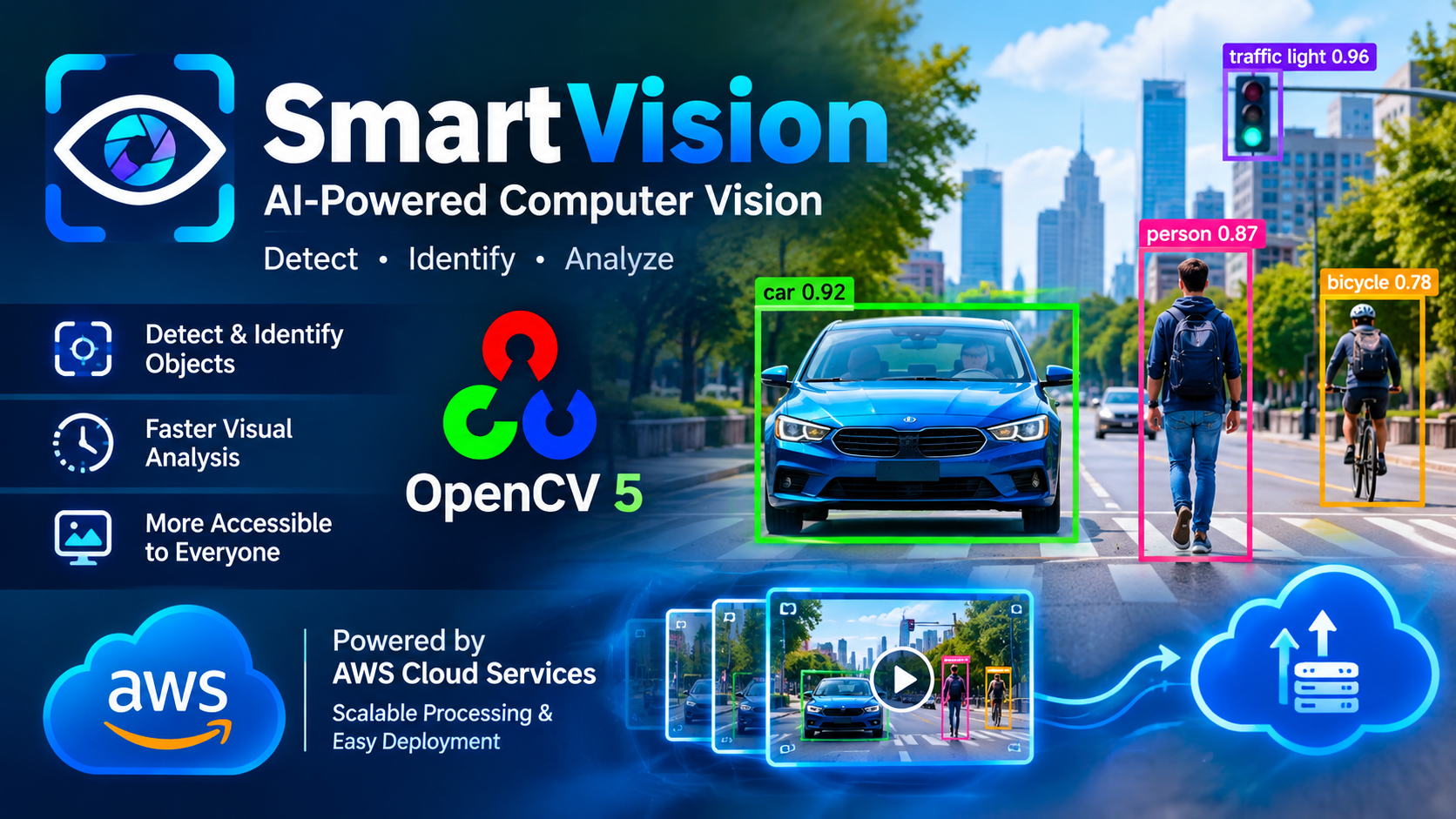
SmartVision is an AI-powered computer vision solution designed to detect and identify objects in street environments. It uses visual recognition to identify cars, pedestrians, bicycles, traffic lights, and other road objects, displaying bounding boxes and confidence scores for detected objects.
Key features include:
Real-Time Object Detection: Identifies multiple objects in street scenes.
Object Classification: Distinguishes between vehicles, pedestrians, bicycles, and traffic signals.
Visual Analysis: Displays detection results through bounding boxes and confidence scores.
Cloud Integration: Uses AWS Cloud Services as a scalable deployment and processing option.
Accessible Computer Vision: Leverages OpenCV to support image processing and computer vision workflows.
SmartVision aims to support intelligent traffic monitoring, urban mobility analysis, and future smart-city applications.
How I built it
SmartVision is designed around a computer vision pipeline that processes visual data and identifies objects in street scenes.
OpenCV: For image processing, frame handling, and computer vision operations.
AI Object Detection Model: To classify and localize objects such as cars, people, bicycles, and traffic lights.
Python: As the primary language for implementing the detection and processing pipeline.
AWS Cloud Services: As a potential cloud infrastructure layer for scalable processing and deployment.
Visual Detection Interface: To present detected objects using colored bounding boxes, labels, and confidence scores.
The workflow involves receiving an image or video frame, processing it through the detection model, identifying objects, and displaying the results in an easy-to-understand visual format.
Challenges I ran into
One of the main challenges was designing a detection workflow that could identify multiple objects in a busy street scene while keeping the results clear and understandable.
Other challenges included:
Distinguishing objects that appear close together or partially overlap.
Balancing detection accuracy with processing speed.
Selecting appropriate confidence thresholds to reduce false detections.
Making detection labels and bounding boxes visually clear.
Considering how cloud infrastructure could support future scaling and deployment.
These challenges highlighted the importance of reliable detection models, efficient image processing, and careful performance evaluation.
Accomplishments that I'm proud of
I am proud of the SmartVision concept because it brings together AI-powered object detection, computer vision, and cloud scalability in a practical smart-city use case.
Key accomplishments include:
Creating a clear visual concept for multi-object street detection.
Demonstrating how cars, pedestrians, bicycles, and traffic lights can be represented with detection labels and confidence scores.
Designing a workflow around OpenCV and AI-based visual analysis.
Identifying opportunities to extend the solution toward cloud deployment and intelligent traffic monitoring.
SmartVision represents a foundation for building more advanced, AI-driven computer vision applications.
What I learned
Working on SmartVision helped me understand how computer vision can transform visual data into meaningful information. I explored the importance of object detection, confidence scores, image processing, and the relationship between model accuracy and inference speed.
I also learned that a practical AI solution requires more than a detection model. It needs a clear user interface, an efficient processing pipeline, reliable testing, and a deployment strategy that can support future growth.
What's next for SmartVision: AI Object Detection
The next phase of SmartVision will focus on improving accuracy, expanding functionality, and making the system more practical for real-world applications.
Planned enhancements include:
Live Video Detection: Process real-time camera feeds and traffic footage.
Object Tracking: Track vehicles, pedestrians, and bicycles across video frames.
Traffic Analytics: Estimate vehicle counts, traffic density, and pedestrian movement.
Enhanced Traffic-Light Recognition: Improve signal-state detection and road-scene understanding.
Performance Optimization: Reduce inference latency and improve processing efficiency.
AWS Deployment: Explore scalable cloud-based inference and storage.
Smart-City Integration: Investigate applications in traffic monitoring, road safety, and urban planning.

