-
-
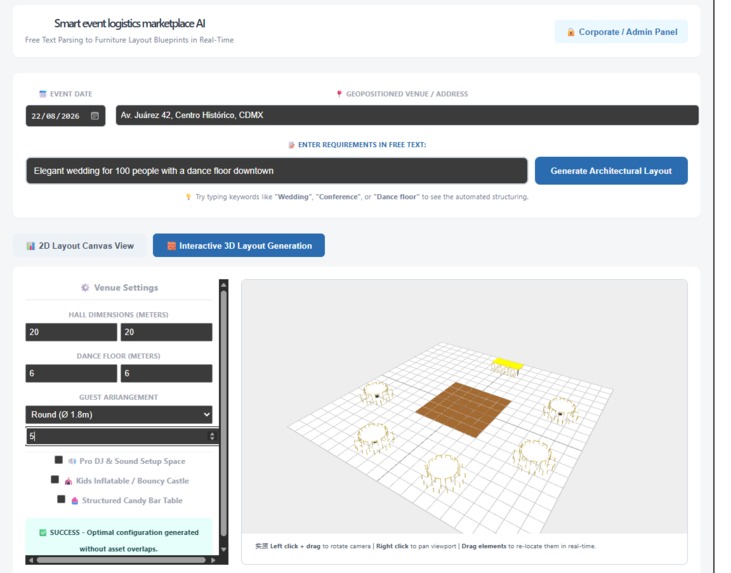
Interactive 3D Layout Generation
-
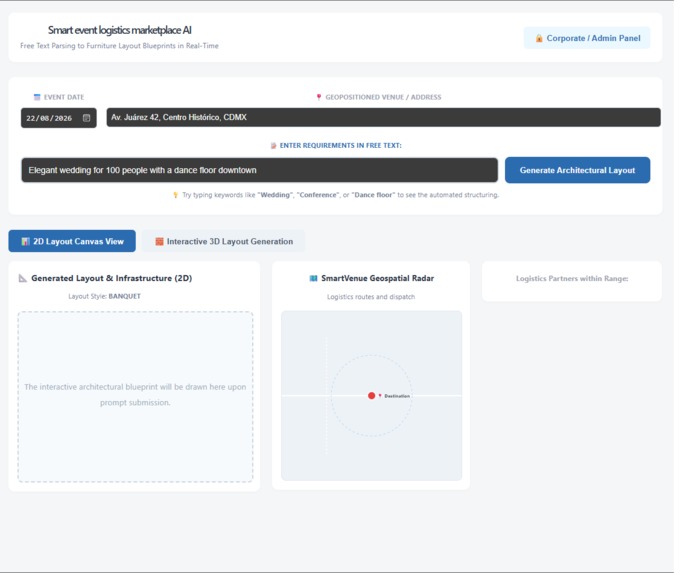
Smart event logistics marketplace AI
-
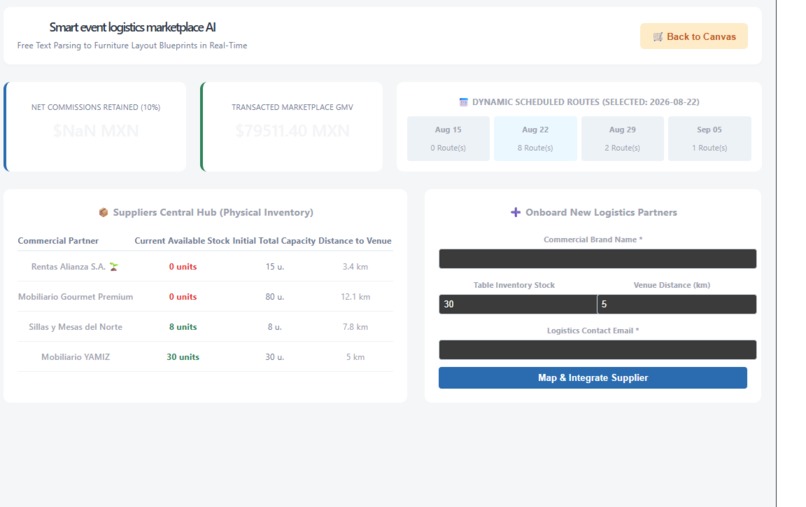
Administrator view
-
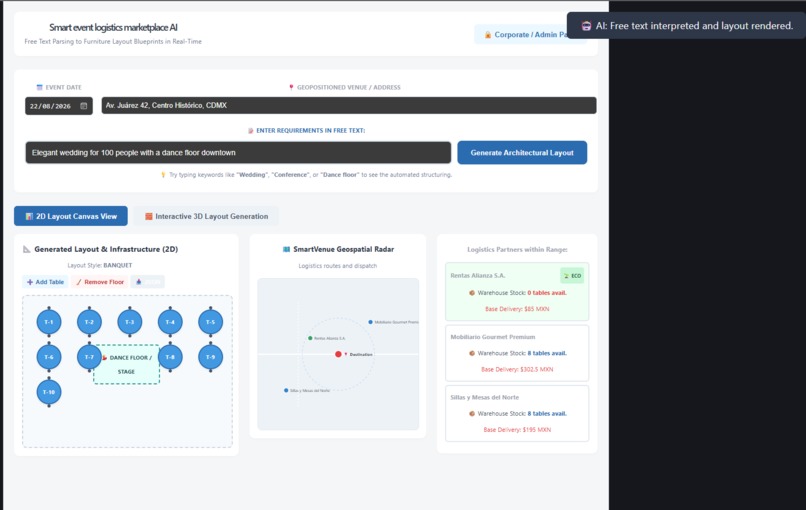
Generate Architectural Layout
-
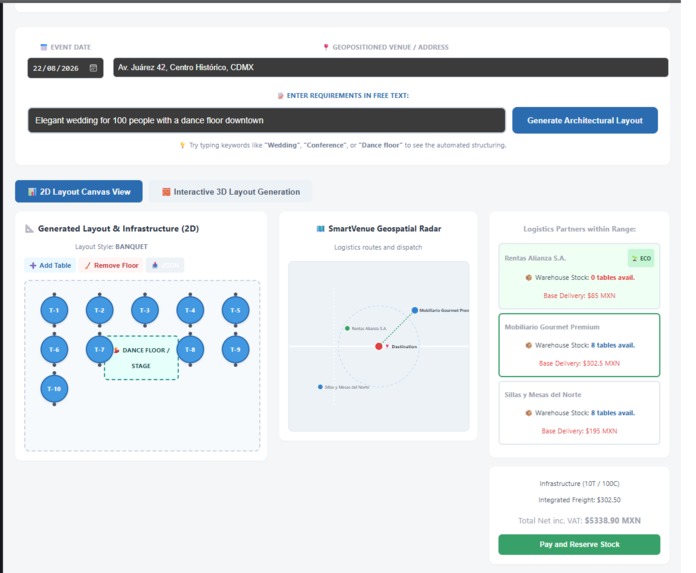
SmartVenue Geospatial Radar
-
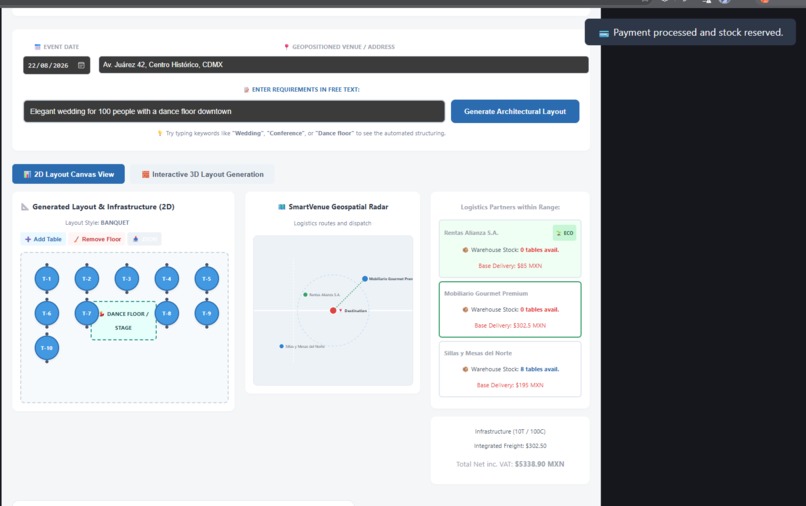
Pay and Reserve Stock
-

Login Admin

Inspiration
My inspiration was born from the intersection between a traditional business model and the ambition for digital scalability. My goal has always been to found a physical furniture rental business, but understanding from day one that traditional analog operations limit growth and consume the entrepreneur's time. I wanted to break glass ceilings for local businesses through intelligent automation.
The project is consolidated into three pillars:
The Democratization of Advanced Logistics: Small and medium event providers waste hours calculating quotes and risking overbooking. I wanted to bring the predictive power of large supply chains to local businesses, where inventory is managed effortlessly based on time coordinates.
Customer Conversion through Visual Certainty: Traditional clients struggle to visualize spatial layouts. By combining generative AI with real-time 3D rendering, we give clients immediate visual confirmation of their setup, drastically reducing sales cycles and friction.
Passive and Smart Cash Flow Generator: A platform that works for the entrepreneur, not the other way around. By automating payment gateways, stock allocation by date, and procedural design, the business processes orders and secures revenue 24/7 unattended.
What it does
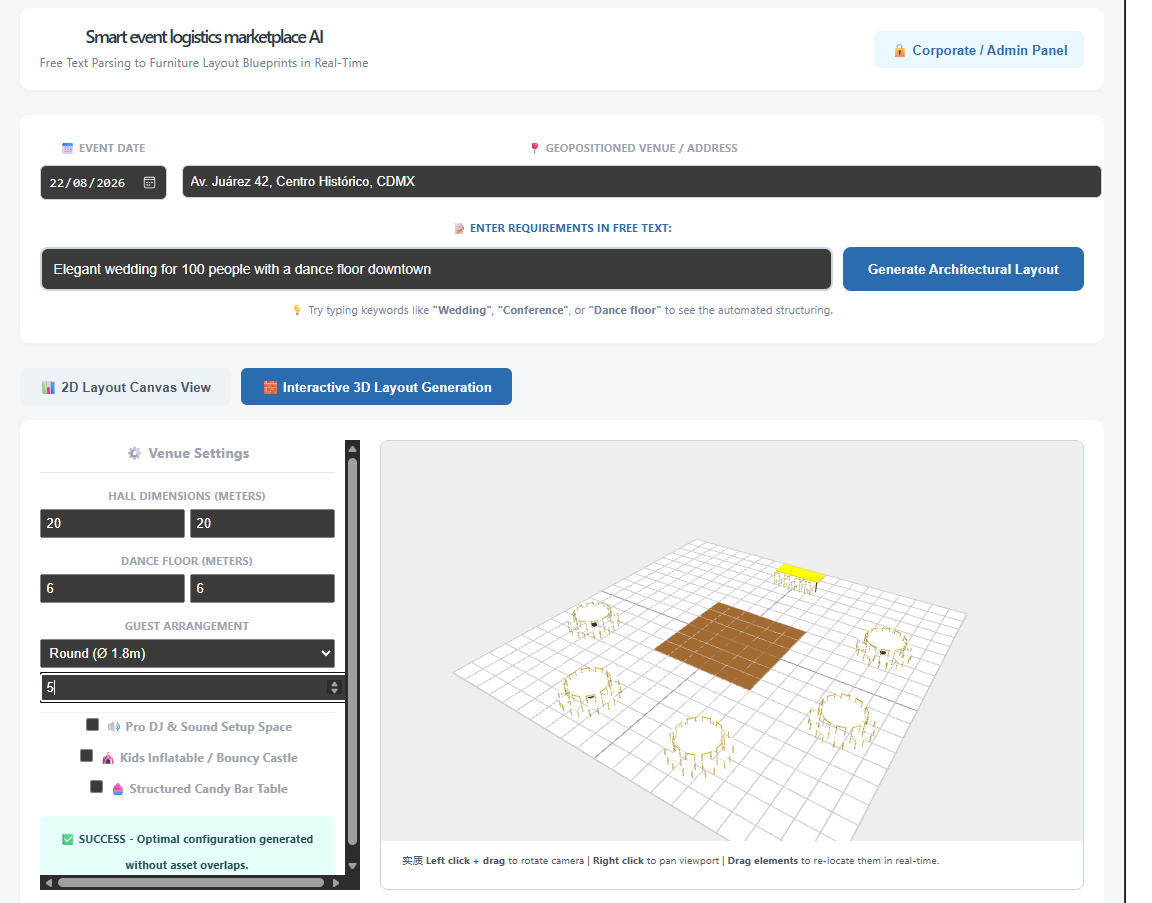
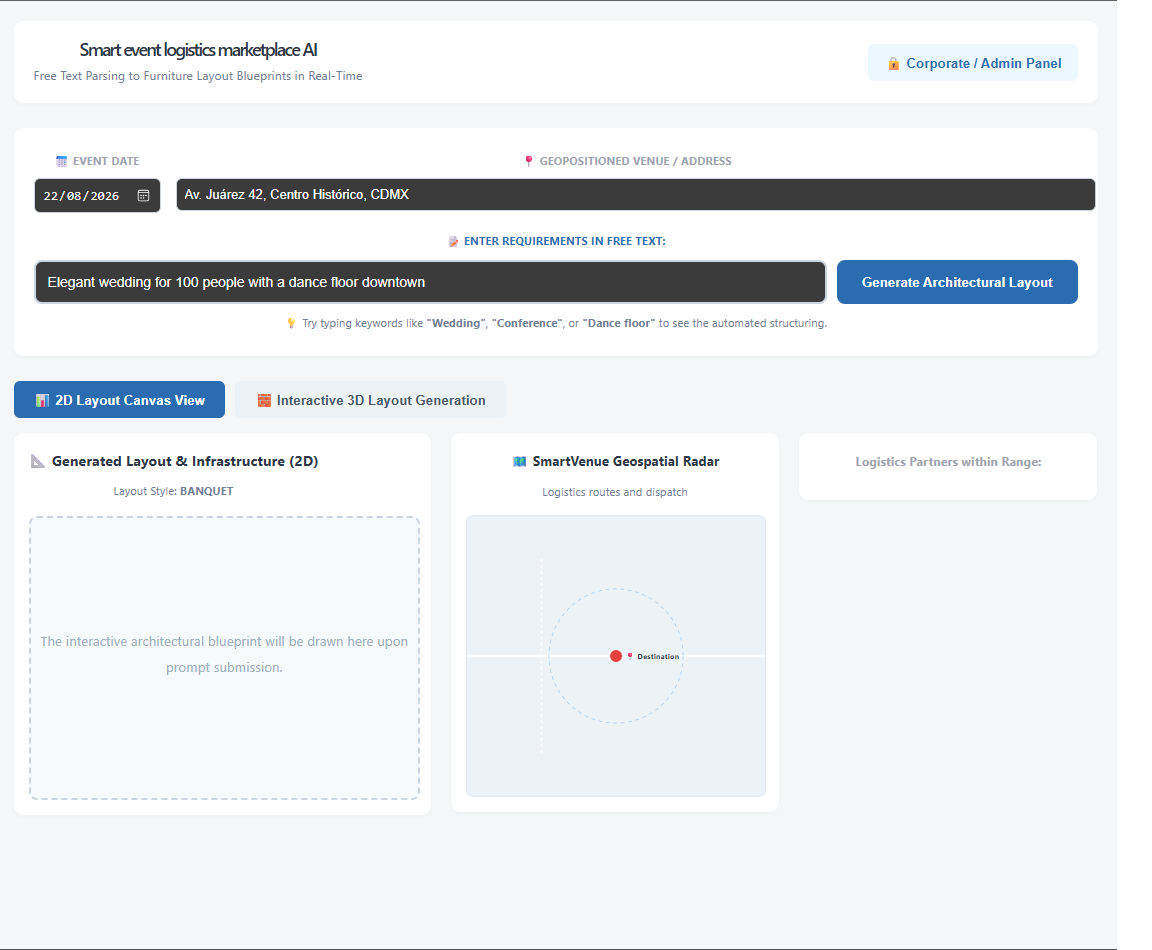
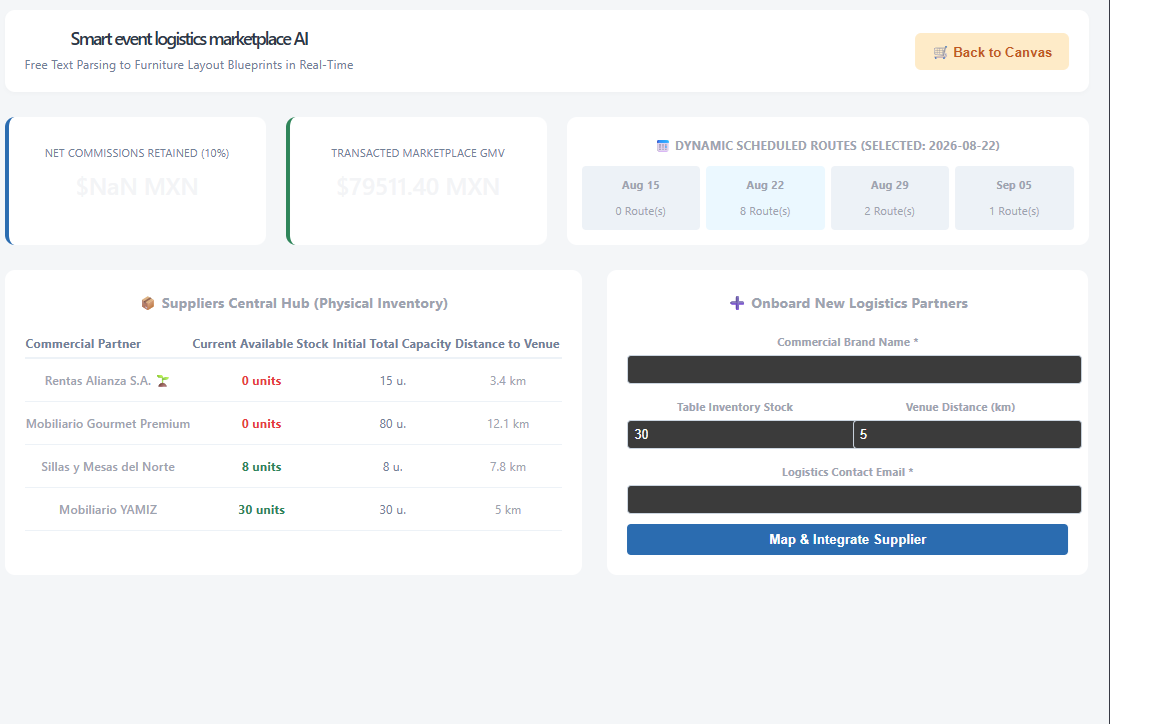
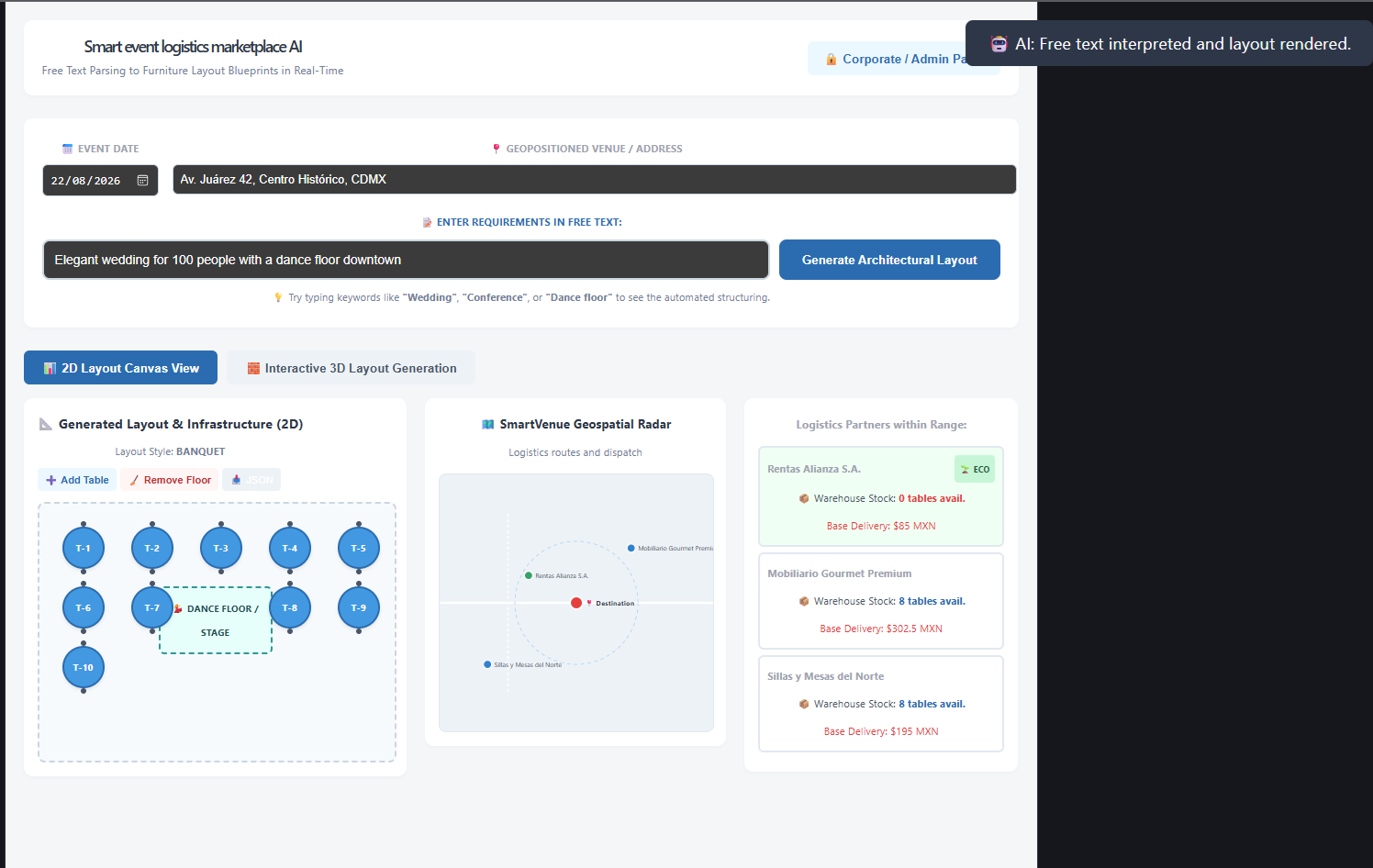
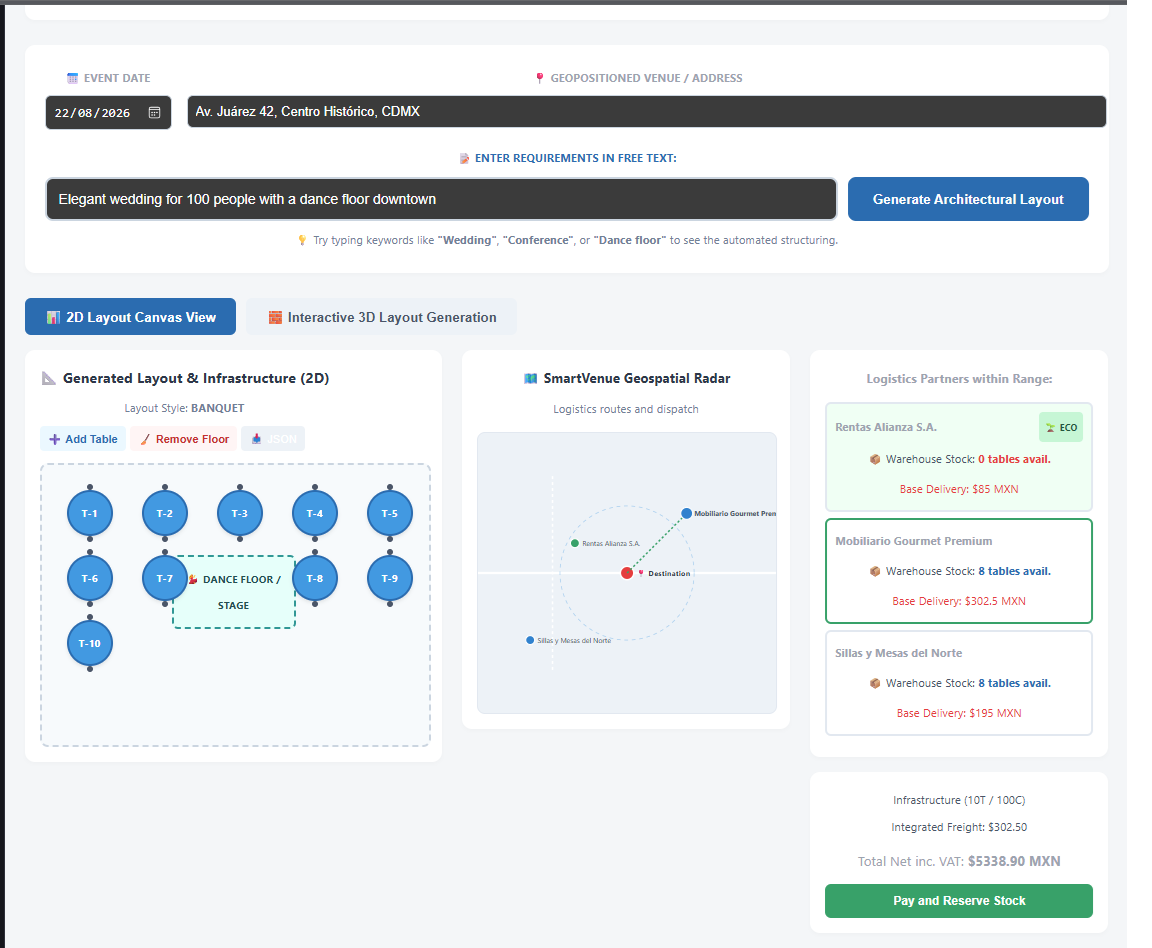
Smart Event Logistics Marketplace AI is a multifaceted SaaS marketplace that optimizes commercial event logistics using native AI and geolocation. The platform enables planners to translate natural language descriptions into interactive 3D architectural layouts. Concurrently, the system links the design to real-time inventory from nearby suppliers based on the event date, automating quotes, per-kilometer freight costs, and secure payment processing.
How we built it
The platform operates under a Unified Component model with External Dependency Injection divided into four main layers:
AI Spatial & Orchestration Layer (Powered by Gemini 1.5 Pro): We do not use AI as a cosmetic chat widget. Gemini 1.5 Pro acts as our core spatial compilation engine. Using advanced System Instructions, Gemini interprets the semantic ambiguity of the user's natural language request (e.g., "A romantic wedding for 100 people with a cozy layout") and strictly returns structured, typed JSON data containing viable 3D spatial coordinates ($x, z$). Additionally, the model processes guest affinity vectors (Seating Chart AI) to seat people strategically by relational groups without saturating the context window.
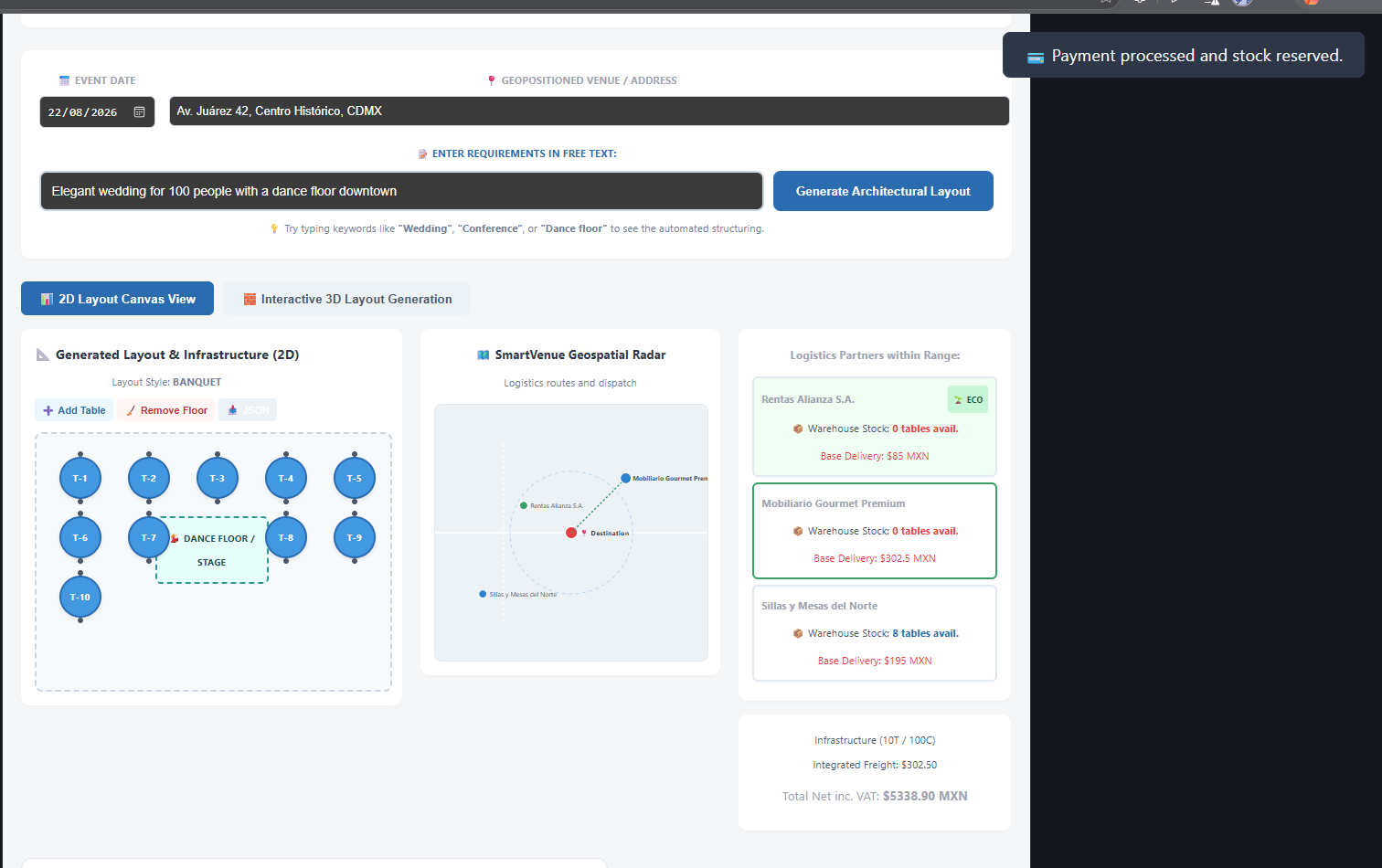
Business Logic & Predictive Inventory Layer:Deterministic Scaling: Converts guest volume into furniture assets via Math.ceil(numGuests / 10) ensuring exact table-to-chair ratios.Predictive Stock Filter (getAvailableStockForDate): A recursive algorithm that intercepts global order history indexed by dates, dynamically calculating available stock exclusively for the selected day by subtracting confirmed blocks.
Strict 3D Graphic Rendering Layer (Three.js):Lifecycle Isolation: Uses React useRef containers to isolate the imperative WebGL context from React’s declarative Virtual DOM, preventing memory leaks.Procedural Geometries: Renders tables as procedural cylinders (CylinderGeometry) or cubes (BoxGeometry) based on the layout JSON generated by Gemini.Trigonometric Scattering: To prevent object collision at coordinates $(0,0)$, we designed a scattering algorithm based on Archimedes' spirals using Sine and Cosine functions to distribute furniture in concentric, equidistant rings.
Controls & Persistence Layer:Uses OrbitControls.js for camera navigation and DragControls.js with axis-blocking (position.y = 0) to allow real-time manual refinement without floating assets.LocalStorage API: Implements persistence hooks to retain booking states and layout structures directly in the user's browser.
Challenges we ran into
The Paradigm Conflict: React (Declarative) vs. Three.js (Imperative):
The Challenge: Switching tabs caused black screens or duplicated WebGL contexts because React unmounted DOM nodes while Three.js kept objects active in GPU memory.
The Solution: We implemented a strict garbage collection routine during the component unmount lifecycle, explicitly calling .dispose() on all geometries, materials, and textures stored in our useRef cache, reducing RAM consumption to 0% when inactive.
Multidimensional Data Synchronization:
The Challenge: Event logistics depend on a time coordinate (the date). Syncing real-time inventory availability with live 3D rendering updates while the user typed parameters caused frame drops.
The Solution: We decoupled calculation logic from graphical rendering. The algorithmic stock validation runs asynchronously in the background, preemptively managing UI states (like the payment button) while feeding the 3D engine only with clean, verified data.
Accomplishments that we're proud of
AI-Driven Layout Automation: Eliminating hours of manual CAD blueprinting by converting raw human text into interactive 3D layouts in seconds.
Triple-Bottom-Line Sustainability: By calculating automated freight per distance and routing nearby supplier inventory, the platform actively reduces last-mile $CO_2$ emissions.
Validated B2B Monetization Engine: A scalable infrastructure ready to capture a platform fee (e.g., 10%) per automated transaction via Stripe Connect.
What we learned
We mastered the optimization of Gemini 1.5 Pro structured JSON outputs. Designing bulletproof schemas for spatial distribution proved that LLMs can go beyond text generation and act as reliable data-translation layers for graphics engines. We also learned how to balance AI creativity with deterministic mathematical constraints (like our spiral distribution) to build a stable enterprise application.
What's next for Smart event logistics marketplace AI
AI-Driven Autonomous Supply Chain: Moving beyond local inventory checkouts to let Gemini autonomously communicate via APIs with regional transport fleets, optimizing routes based on predictive traffic models.
Text-to-Full 3D Scene Multimodality: Upgrading from object coordination to full environment generation, enabling users to state: "Design an Art Deco gala maximizing bar access," generating immersive textures and real-time WebGL Ray Tracing.
Circular Predictive Logistics: Integrating Machine Learning models to predict food/asset waste and optimize reverse logistics to completely eliminate empty vehicle return trips.
IoT Digital Twins: Merging computer vision with the 3D layout to scan real venues during setup, alerting planners if physical tables deviate even by centimeters from the Gemini-optimized blueprint.
Built With
- algorithms.io
- api
- client-side
- javascript
- react
- state
- storage
- three.js
- web
- webgl


Log in or sign up for Devpost to join the conversation.