-
-
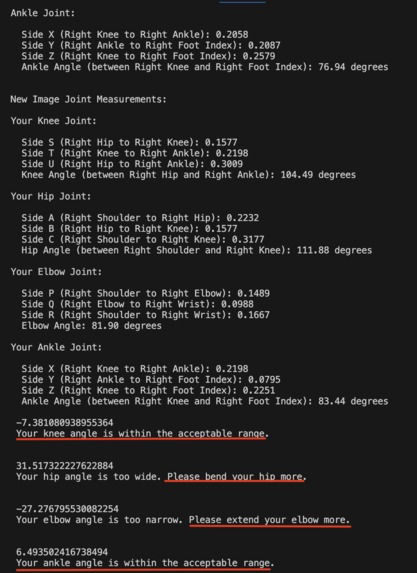
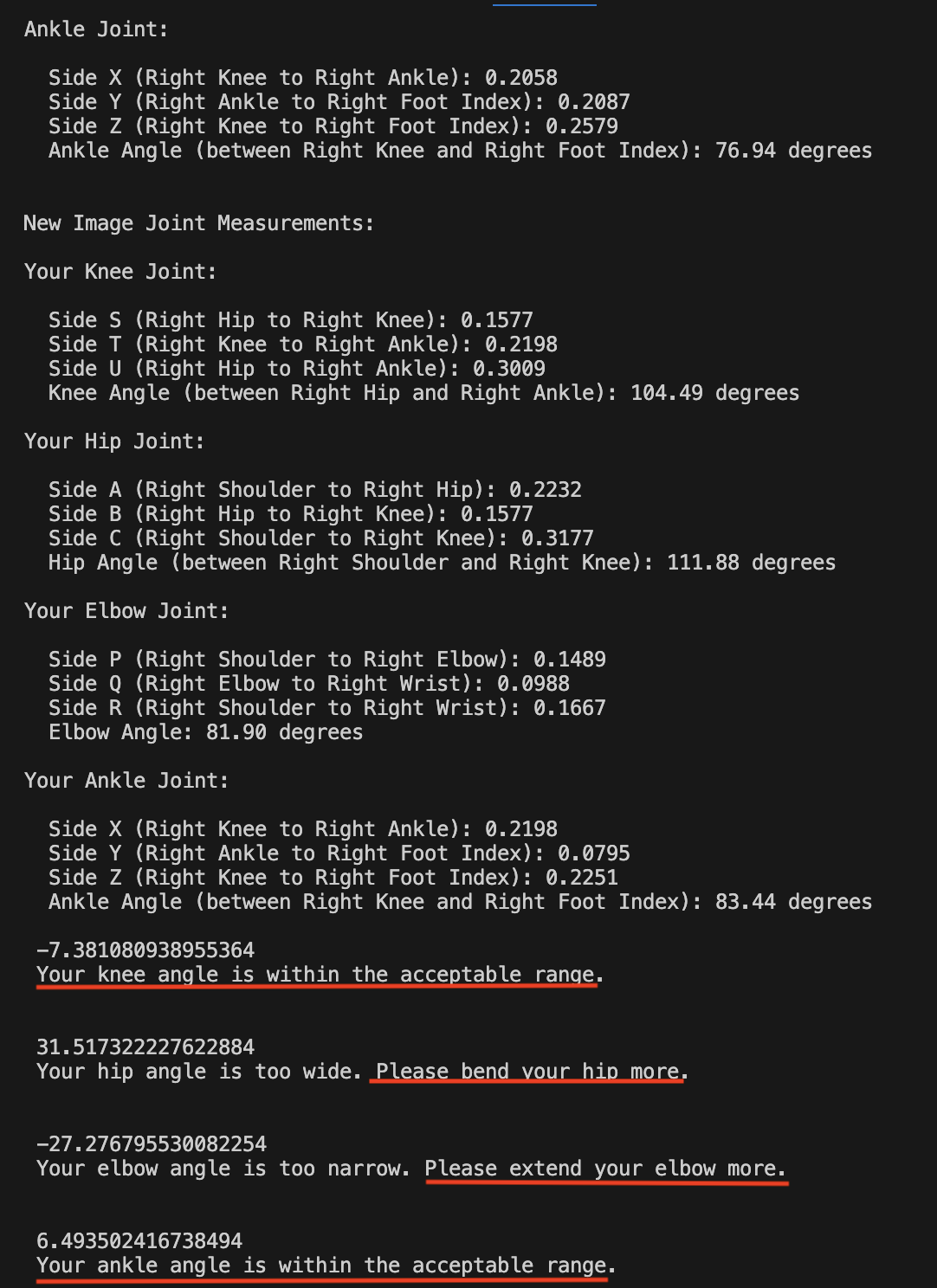
Output. The lines underlined in red are for the user and the rest are for me to debug and etc.
Inspiration
The inspiration for SmartTennis came from the challenge of accessing consistent tennis coaching. As a tennis player, I could only meet with a coach once per week, leaving many practices and matches without professional feedback. Recognizing that technique improvement relies heavily on analyzing each shot and position, I wanted to create a way for players to receive instant, actionable feedback anytime and anywhere. Existing solutions like SwingVision focus mainly on ball placement and provide feedback only after a session ends, which is less useful during matches. My goal was to make advanced, real-time tennis feedback accessible to a broader audience, helping players improve on the spot without needing a coach present.
What it does
SmartTennis uses AI-powered pose estimation technology to analyze a player’s body position and strokes from video inputs. It compares the player’s joint angles and posture against professional reference data using distance and angle calculations to detect deviations. Based on this comparison, the system provides immediate, easy-to-understand feedback that can be delivered audibly. This allows players to adjust their technique during practice or matches, making continuous improvement possible regardless of coach availability.
How I built it
I built SmartTennis by leveraging existing AI pose estimation APIs like Saiwa AI, which integrates OpenPose and MediaPipe frameworks to detect full-body joint positions from images and videos.I used the JSON output of body joint locations to calculate 3D distances and angles relevant to tennis posture using Euclidean distance formulas and the law of cosines. By comparing these measurements from a player’s new input to those of a professional reference image, I quantify how closely the player’s form matches ideal technique, with an acceptable 10-degree buffer. Feedback generation is handled through a Python backend that processes these calculations and outputs recommendations in real time, which can then be delivered via audio or a display interface. I don't have the API Key in my code as I have ran out of uses for the next few months. The code is modified to work without it and is adapted to process the computer vision pose mapping after I upload the image.
Challenges I ran into
One major challenge was implementing an accurate and user-friendly pose estimation system. OpenPose, though powerful, was difficult to install and integrate, leading us to adopt Saiwa AI’s online service for easier access to pose data. Another challenge was determining which joints and angles are most critical for tennis technique, especially for foundational positions like the ready stance. Calculating 3D joint relationships precisely and comparing them meaningfully required careful mathematical modeling and programming. Additionally, delivering feedback instantly and ensuring it is simple for players to understand and act upon proved to be an important design consideration.
Accomplishments that I am proud of
I successfully developed a working prototype that automatically processes video input to extract player joint positions and compares them to professional standards. The system can calculate relevant distances and joint angles in 3D space and determine deviations in technique with a buffer for natural variation. We implemented a clear feedback mechanism that translates these deviations into actionable advice for players. The integration with Saiwa AI simplified pose estimation without compromising accuracy. Overall,I built an effective tool that bridges the gap between coaching sessions by enabling continuous, real-time technique improvement.
What I learned
Through this project, I gained deep insights into AI pose estimation technology and its practical application in sports performance analysis. I learned how to process and interpret complex 3D joint data and apply mathematical concepts like Euclidean distance and the law of cosines for angle calculation. I also improved our skills in integrating third-party APIs and handling JSON data outputs efficiently. From a product perspective, I learned the importance of delivering timely, actionable feedback that players can easily use. The project reinforced the value of adapting technical tools to real-world user needs in sports coaching.
What's next for SmartTennis
Future development for SmartTennis includes expanding feedback to cover more tennis strokes beyond the ready position, such as serves and forehands, to provide comprehensive technique analysis.I plan to enhance real-time capabilities and explore delivering feedback through wearable devices like headphones for uninterrupted play. Further improvements may involve machine learning models tailored to individual player styles and skill levels for personalized coaching. Integrating ball tracking and match analytics could also add valuable insights. Ultimately, the goal is to make SmartTennis broadly accessible, affordable, and intuitive for players of all levels seeking continuous improvement.

Log in or sign up for Devpost to join the conversation.