Inspiration
The idea for this project came from real-life personal finance challenges that many individuals and families face daily. Even when people have a regular monthly income, it is often unclear how money is actually being distributed and spent across different needs such as electricity bills, food, travel, subscriptions, recharges, and personal expenses.
In many cases, money is spent without a clear structure. Expenses like restaurant visits, online purchases, or recurring payments such as DTH and mobile recharges happen automatically, but there is no system that actively evaluates whether these expenses align with current priorities or financial goals. This often leads to situations where people want to buy something important—like a laptop or a device within a few months—but later realize that savings were not planned properly.
Another strong motivation was the lack of visibility and understanding within families. Often, family members do not have a clear picture of how money is being allocated or whether spending is balanced across essential and non-essential categories. This can create confusion and poor financial decisions, even when the total income is sufficient.
The project was inspired by the idea of treating money like a structured system. Each expense category—such as bills, food, entertainment, savings, and goals—should have a planned allocation. Spending should be guided by activities and priorities, not random decisions. At the same time, users should receive intelligent suggestions on where they can optimize spending, adjust category limits, or accelerate progress toward a financial goal if needed.
This led to the vision of building an AI-driven personal finance assistant that not only tracks expenses, but actively helps users plan, monitor, and improve how their money is used—both individually and, optionally, at a family level—while keeping the system simple, transparent, and practical.
What it does
The application helps users manage their personal finances in a structured and goal-oriented way. Users can record their monthly income and create separate spending categories such as electricity bills, food, travel, subscriptions, entertainment, and savings.
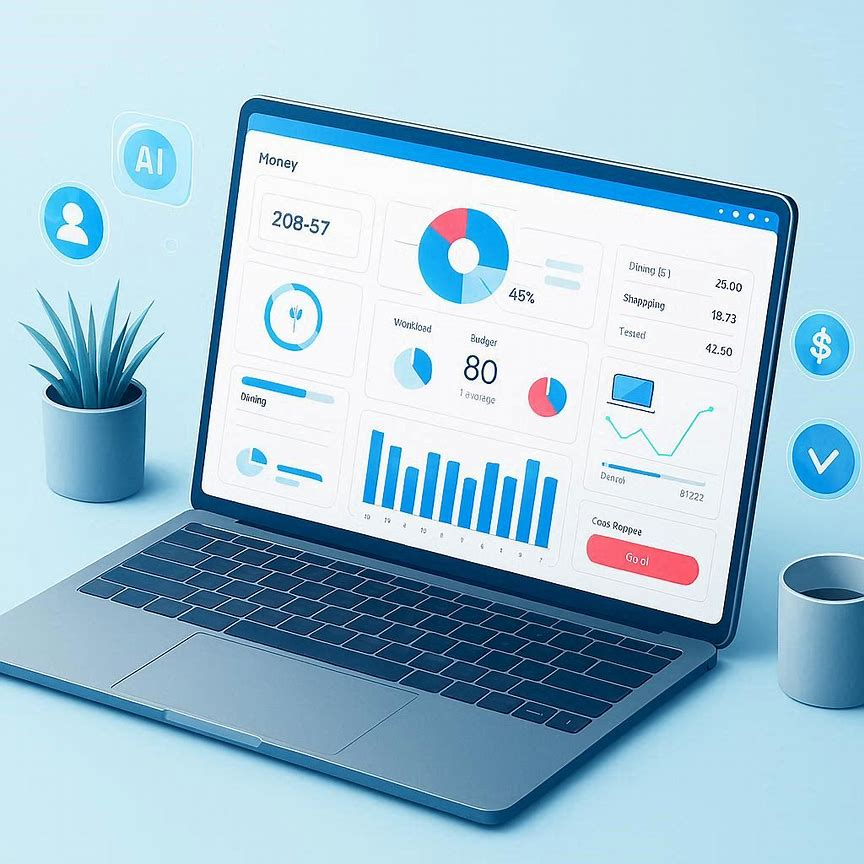
Each category is assigned a planned budget, and expenses are tracked based on daily activities. The system monitors how money is being used across categories and visualizes spending patterns over time. Users can also set short-term financial goals, such as purchasing a laptop within a fixed time period, and track progress toward those goals.
Using basic AI-driven analysis, the platform provides insights and suggestions on how spending can be optimized. This includes identifying overspending areas, recommending adjustments to category budgets, and suggesting ways to accelerate goal achievement. Optional family-level visibility allows shared understanding of expenses while keeping user consent and control.
How we built it
The project was built as a web application with a simple and clean user interface to ensure ease of use. The front end was developed using standard web technologies, while the backend was implemented in Python.
Expense and income data are stored securely and processed using data analysis libraries. Basic machine learning logic is used to analyze spending behavior, detect patterns, and generate recommendations. The system was designed to be modular, allowing features such as automation and advanced AI models to be added in future versions.
Challenges we ran into
One of the main challenges was designing a flexible budgeting system that could adapt to different user habits and spending categories. Balancing detailed financial tracking with simplicity was also challenging, as the application needed to remain beginner-friendly.
Another challenge was addressing privacy and transparency together. Family-level financial visibility had to be optional and clearly controlled by the user to ensure trust and ethical data sharing.
What we learned
Through this project, we gained a deeper understanding of personal finance workflows and how technology can support better financial decision-making. We learned how to structure a fintech application, apply basic AI logic to real-world data, and design features that prioritize usability and responsibility.
The project also strengthened our skills in web development, data analysis, and system design under time constraints.
What's next
Future improvements include integrating more advanced machine learning models for predictive budgeting, automating recurring expenses such as recharges and subscriptions, and adding notifications for spending alerts.
Additional plans include role-based family access, long-term financial planning features, and mobile application support to make the system more accessible.
SIR/MAM THIS IS VERY BASIC FOR NOW .BUT I AM STILL IMPROVING AND WORK IS IN PROGRESS.I AM CURRENTLY LEARNING AND IMPROVING MY SKILLS DAY BY DAY AND WILL UPDATE THE PROJECT MORE .I HAVE BIG VISION AND SO MUCH TO ADD IN THIS .

Log in or sign up for Devpost to join the conversation.