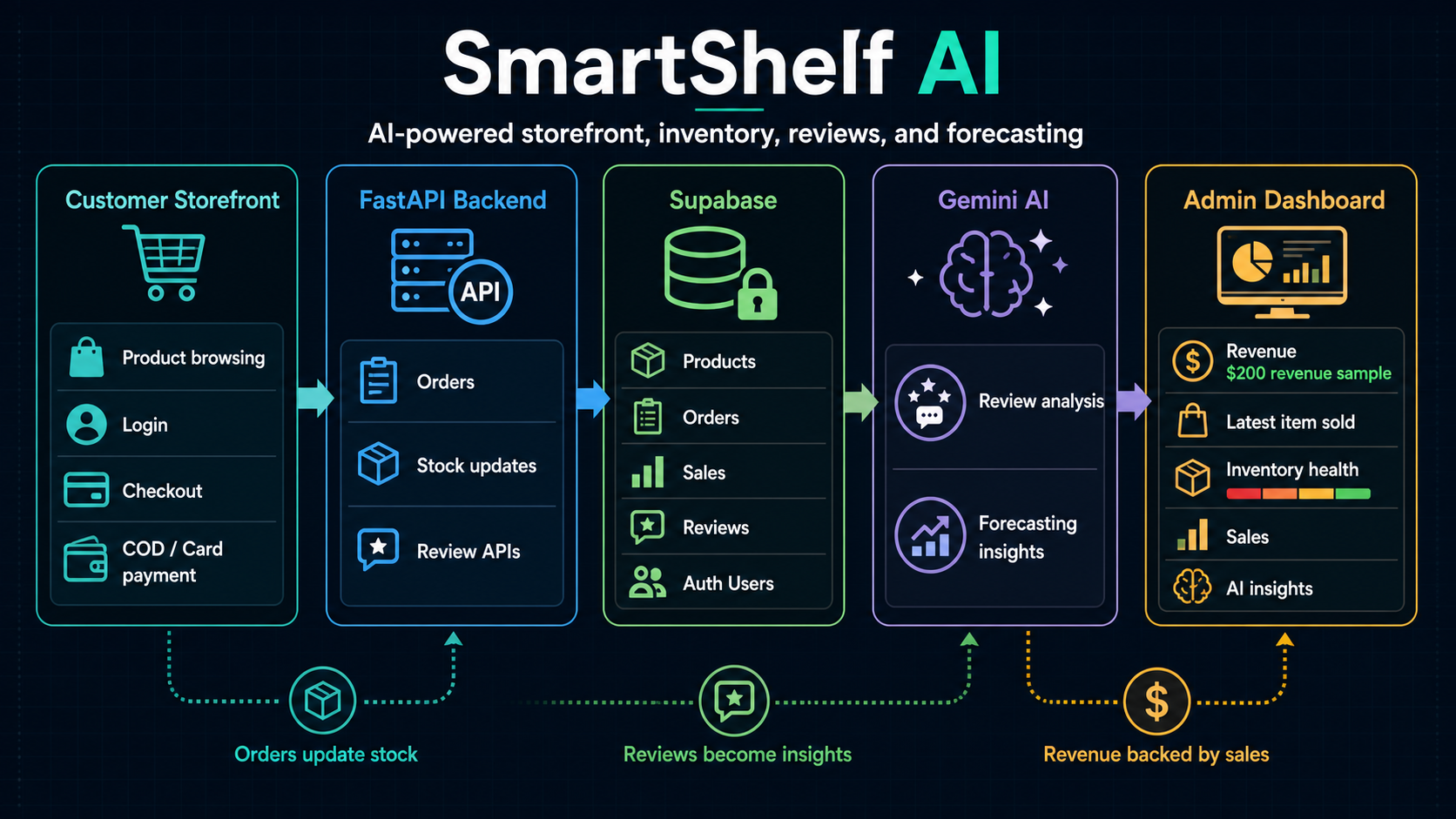
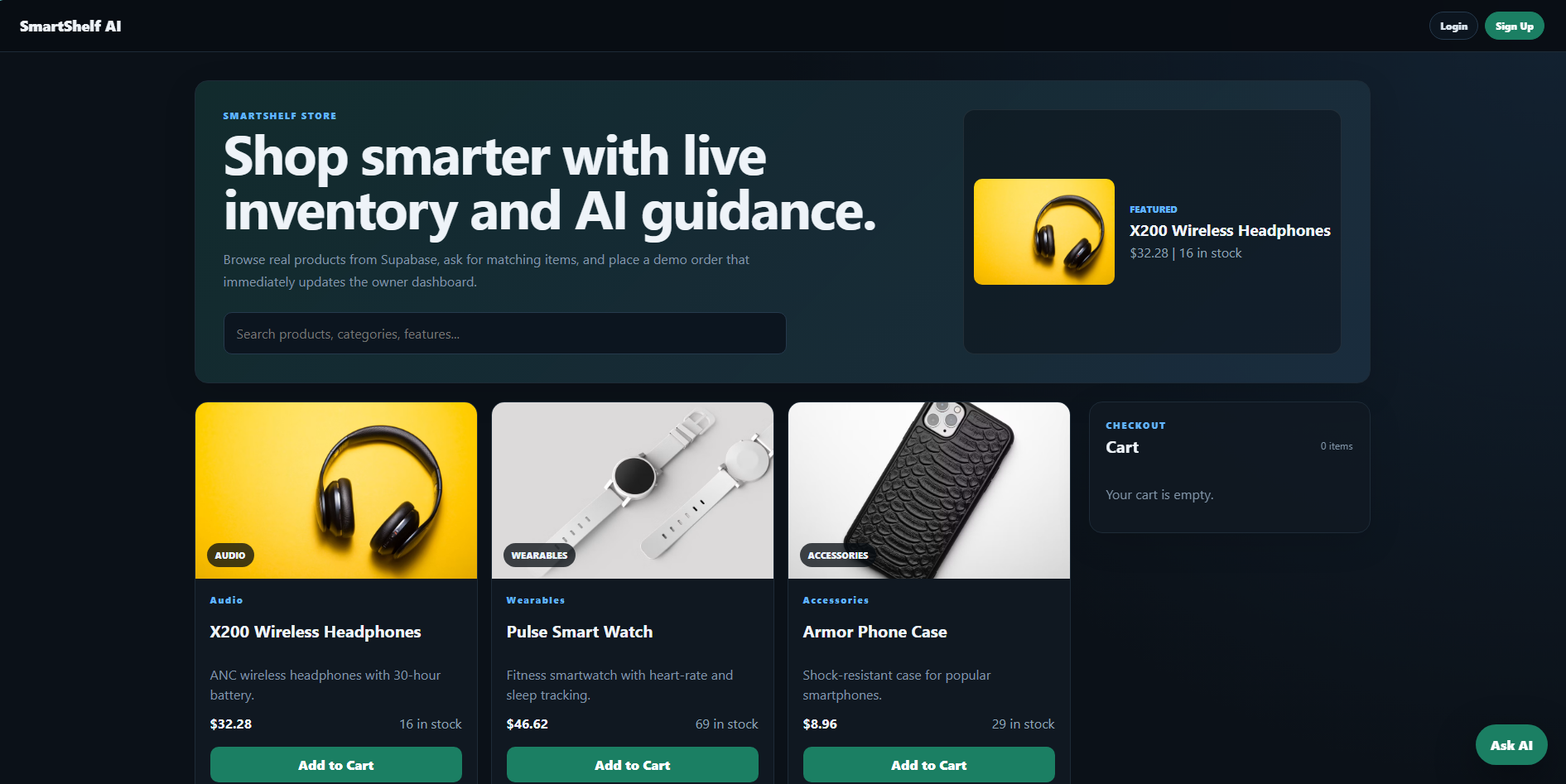
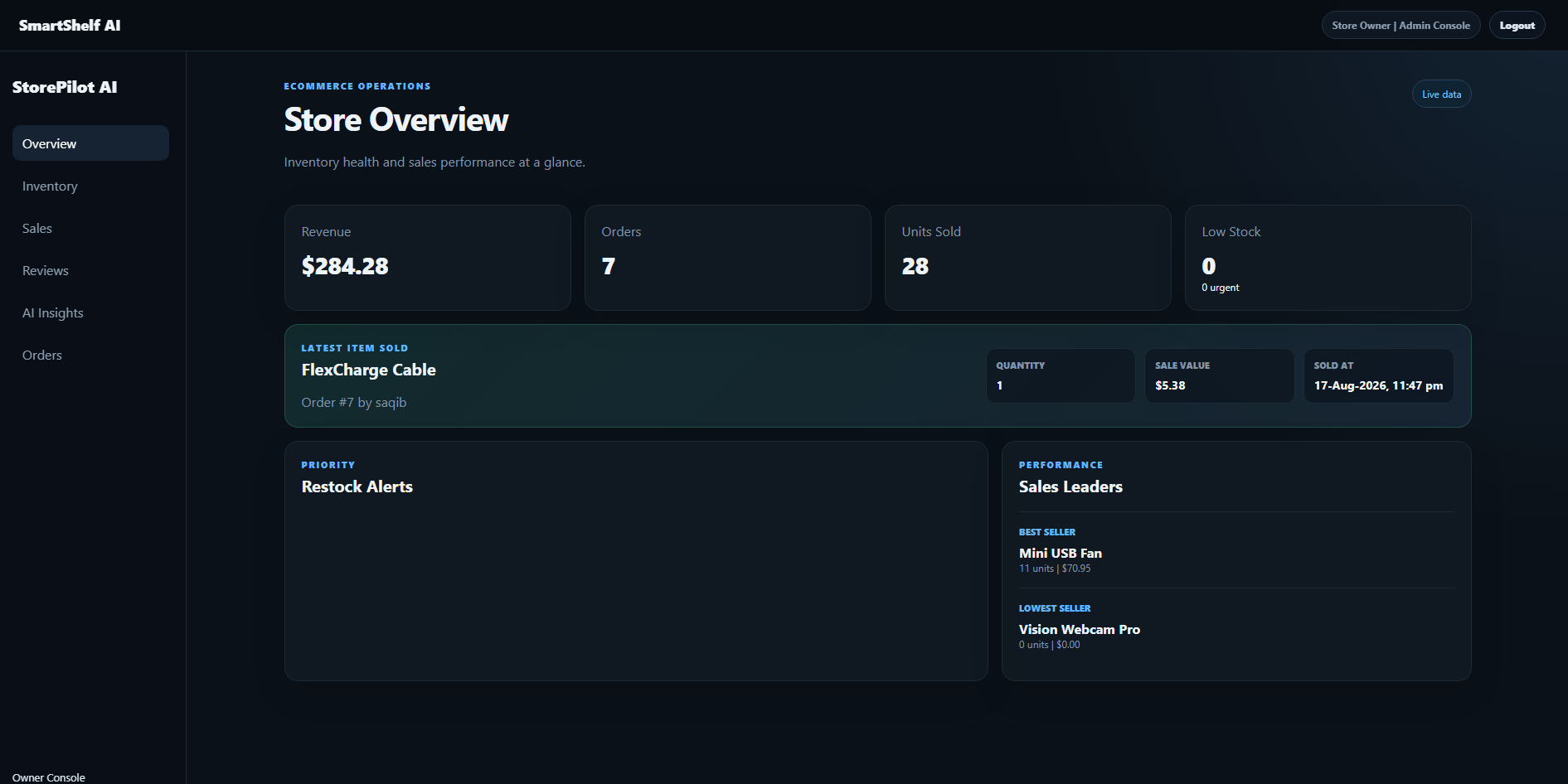
Inspiration Small online stores often have product data, orders, reviews, and inventory records, but they do not always have a clear way to turn that data into decisions. We wanted to build something that helps a store owner answer simple but important questions: What is selling? What is running low? What are customers unhappy about? What should I do next? SmartShelf AI was inspired by the idea of giving small ecommerce sellers an affordable, AI-powered operations dashboard. What it does SmartShelf AI is a full-stack ecommerce and admin system. Customers can browse a storefront, view product details, add products to cart, sign up or log in, enter delivery details, choose cash on delivery or demo card payment, and place orders. The admin panel shows live business data, including revenue, total orders, units sold, latest item sold, inventory health, sales performance, customer reviews, and AI insights. When a customer places an order, the backend records the order, stores the sold items, updates revenue, and reduces product stock. The demo data is backed by real order and sales rows, so revenue is calculated from actual transactions rather than being hardcoded. Gemini is used for AI-powered review analysis and forecasting insights. It helps summarize customer feedback, detect complaints, and recommend actions based on stock levels, sales velocity, supplier lead time, and revenue. How we built it We built the frontend using React with Vite. The app has two separate experiences: a customer storefront and an admin dashboard. The backend is built with FastAPI. It exposes API routes for products, orders, reviews, inventory health, sales, and AI insights. Supabase is used for the database and customer authentication. Product data, orders, sales, and reviews are stored in Supabase tables. Customer signup and login use Supabase Auth, so users must actually exist before they can place an order. Gemini API is connected through the FastAPI backend, not directly from the frontend. This keeps the API key private and allows the backend to send structured store data to Gemini for review summaries and forecasting. The main stack is React, Vite, FastAPI, Supabase, and Gemini API. Challenges we ran into One challenge was making the frontend and backend communicate correctly during local development. We had to make sure FastAPI was running on the right port and that the frontend used the correct API URL. Another challenge was authentication. At first, customer login was too simple and allowed fake users. We changed it to use Supabase Auth so only real signed-up users can log in and place orders. We also had to make the admin data realistic. Revenue could not just be displayed as a fixed number. It needed to be backed by real orders and sales rows, so the database seed data was updated to make the total revenue equal to a real transaction total. Another challenge was AI performance. Calling Gemini too many times made some routes slow, so the backend was adjusted to batch AI analysis and keep fallback logic available if the AI request fails. Accomplishments that we're proud of We are proud that SmartShelf AI is more than a static dashboard. The storefront and admin panel are connected through real backend logic. When an order is placed, the system updates stock, sales, revenue, latest sold item, and the admin order table. Reviews also flow into the admin panel and can be summarized into useful insights. We are also proud of the separation between customer and admin experiences. The storefront feels like a real ecommerce site, while the admin panel focuses on business operations. What we learned We learned how to connect a React frontend with a FastAPI backend and Supabase database. We also learned how important it is to protect secret keys by keeping them in the backend instead of exposing them in the browser. We learned how to use Supabase Auth for real customer accounts, how to structure order and sales tables, and how generated revenue should come from actual transaction rows. We also learned that AI features need careful design. It is not enough to simply call an AI model; the app needs good prompts, structured data, fallback behavior, and performance-aware backend routes. What's next for SmartShelf AI Next, we want to add real payment processing with Stripe or another payment provider instead of demo card fields. We also want to improve forecasting with more historical sales data, seasonal trends, supplier performance, and demand prediction. Future improvements could include supplier management, email alerts for low stock, customer order tracking, admin role permissions, and deployment on Google Cloud Run with Firebase Hosting.
SmartShelf AI
SmartShelf AI runs your store's operations with AI — forecasting stockouts, recommending restocks, analyzing reviews, and helping customers shop, all powered by Gemini on Google Cloud.
Updates

Leave feedback in the comments!
Log in or sign up for Devpost to join the conversation.