-
-
-
Analysis screenshot
Inspiration Every developer has experienced the anxiety of making a seemingly small code change, only to discover it broke something unexpected in production.This fear often leads to overly cautious development, slow refactoring, and accumulating technical debt. I wanted to solve this problem by giving developers a tool that could predict the impact of their changes before they even write a line of code.
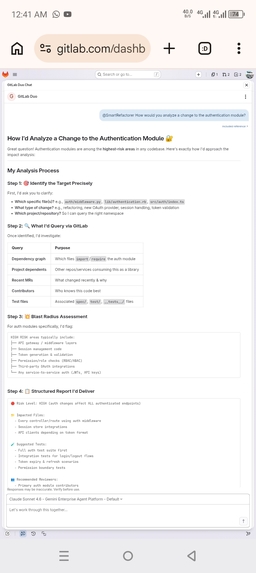
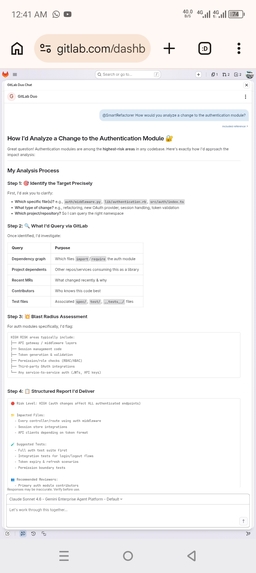
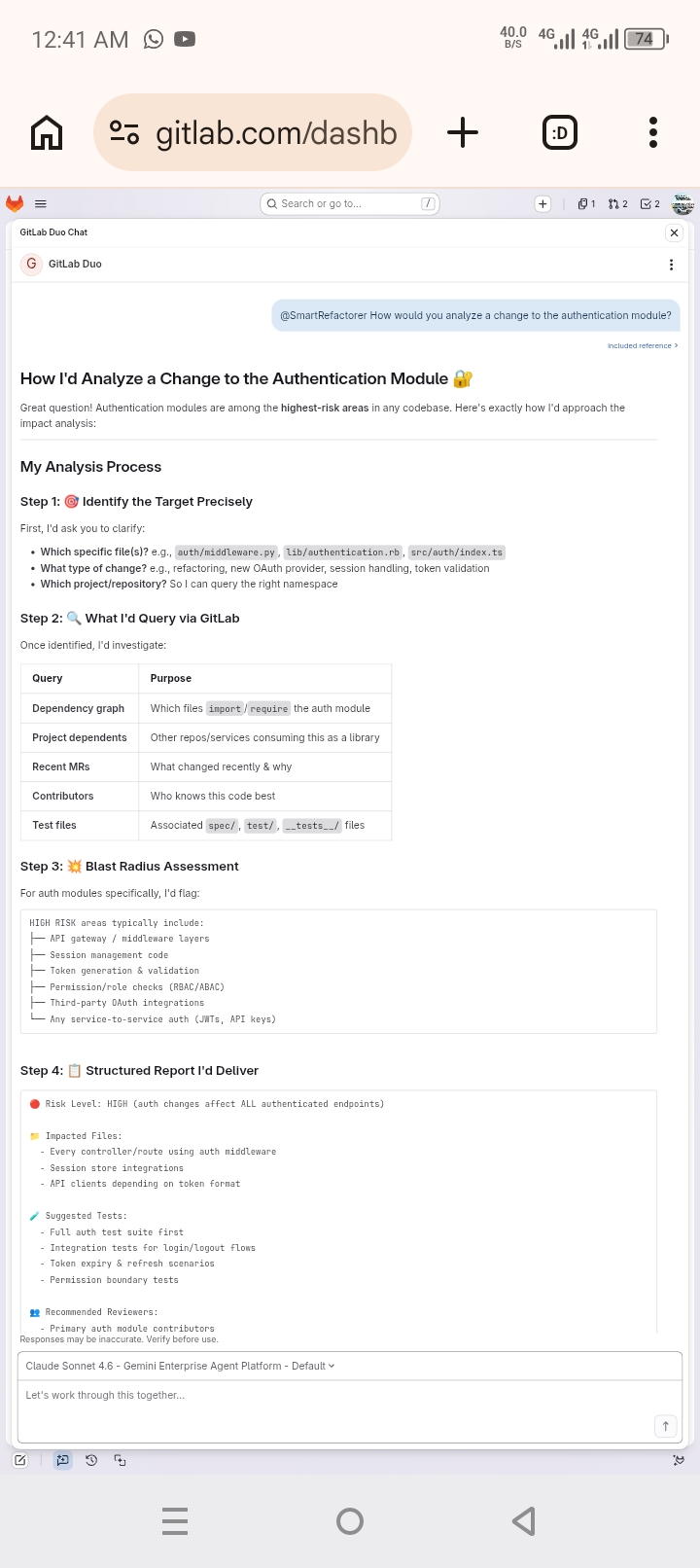
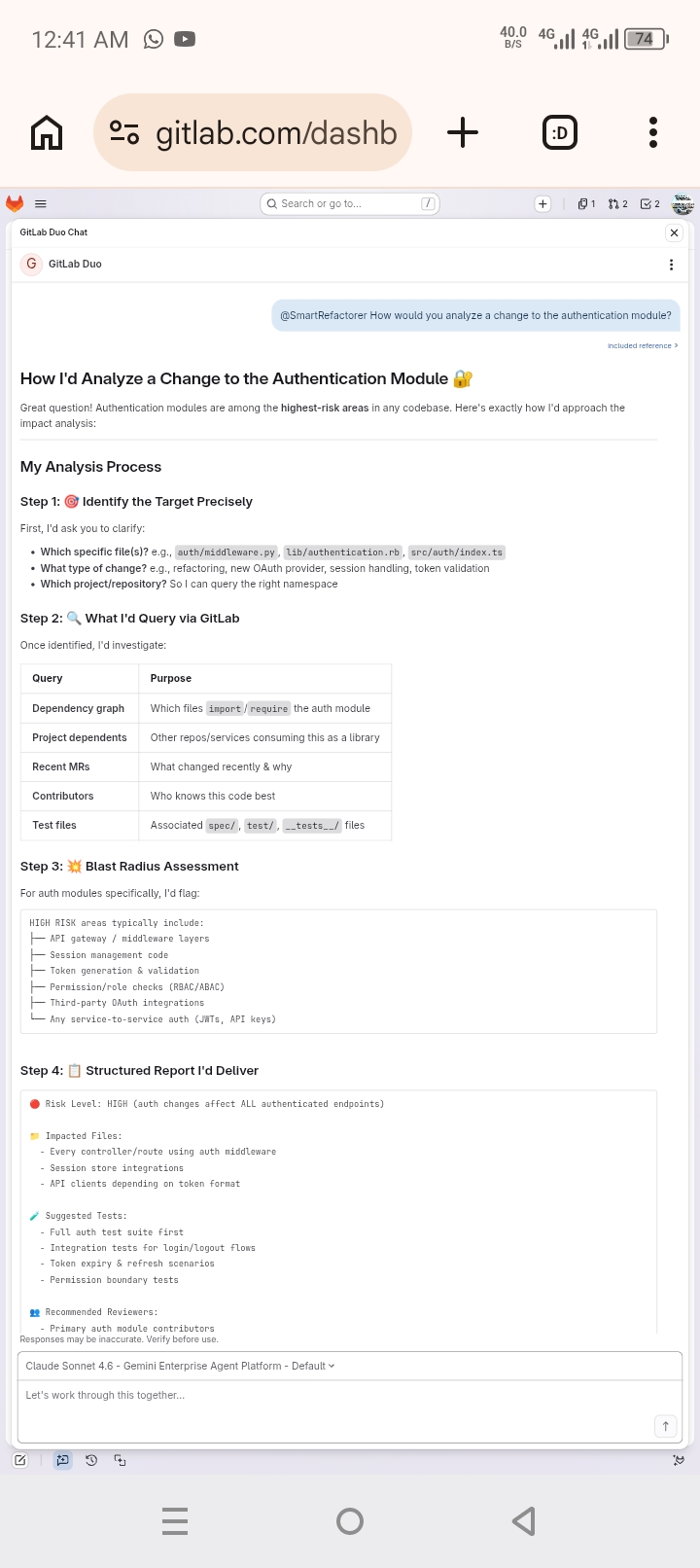
What it does SmartRefactorer is an AI agent that uses GitLab Orbit's structured knowledge graph to analyze the "blast radius" of any code change. When a developer asks about modifying a file, module, or function, SmartRefactorer:
- Identifies the target- Clarifies exactly what needs to change
- Queries GitLab Orbit - Finds all dependencies, importing files, recent merge requests, and contributors
- Analyzes the Blast Radius- Determines which files have the highest risk of breaking
- Provides a structured report - Delivers risk level, impacted files, suggested tests, recommended reviewers, and precautionary steps The agent transforms developer intuition into data-driven confidence, making large-scale refactoring safer and more predictable. How we built it
Technologies Used:
- GitLab Orbit - The core knowledge graph that provides structured, queryable access to the codebase
- GitLab Duo Agent Platform - The framework for creating and hosting custom AI agents
- GitLab Duo Agentic Chat - The interface where developers interact with SmartRefactorer
- Termux (Android) - The development environment used to build and test the agent Development Process:
- Set up the development environment on an Android device using Termux
- Installed the GitLab CLI (
glab) to access GitLab Orbit via the terminal - Authenticated with GitLab and tested Orbit connectivity
- Created a custom agent in the GitLab AI Catalog with a carefully crafted system prompt
- Designed the system prompt to guide the agent through a structured analysis workflow
- Published the agent as Public in the AI Catalog
- Tested the agent with real queries on the
eco-scanproject Key Design Decisions: The system prompt was the most critical component. I structured it to: - Define the agent's role as an expert software architect
- Provide clear, step-by-step instructions for analysis
- Emphasize the use of GitLab Orbit for real data
- Deliver actionable, structured reports (not just generic advice) Challenges we ran into Technical Challenges:
- Installing
glabon Termux - The package wasn't initially available in the default repositories. I had to use theglab-clipackage and ensure proper authentication. - Orbit Accessibility - Testing Orbit queries required the right permissions and scopes. I had to generate a personal access token with
apiandread_apiscopes. - Agent Response Formatting - Getting the agent to produce structured, consistent output required iterative refinement of the system prompt.
- Large Project Analysis - When analyzing large codebases like
gitlab-org/gitlab, Orbit queries could take significant time to return results. Resource Constraints: - Building and testing entirely on an Android device using Termux
- Limited screen space for development and testing
- Managing multiple browser tabs for GitLab, Devpost, and documentation Accomplishments that we're proud of ✅ Created a fully functional AI agent*that meaningfully uses GitLab Orbit ✅ Published the agent as Public in the GitLab AI Catalog ✅ Demonstrated real-world impact by analyzing an actual project (eco-scan) ✅ Built the entire project on an Android phone - proving that hackathons are accessible to everyone ✅ Designed a professional system prompt that delivers structured, actionable reports ✅ Successfully integrated with GitLab Orbit - showing the power of knowledge graphs for software development ✅ Created a solution that solves a genuine developer pain point What we learned Technical Takeaways:
- GitLab Orbit is incredibly powerful for understanding codebase relationships
- The knowledge graph approach (nodes and edges) makes complex queries intuitive
- AI agents are only as good as their system prompts - clear instructions yield better results
- Building on mobile devices is viable with the right tools (Termux + GitLab CLI) Soft Skills:
- The importance of storytelling in hackathon submissions
- How to demonstrate value through structured responses
- The value of focusing on a specific, well-defined problem GitLab Platform Insights:
- The AI Catalog makes agent discovery and publishing seamless
- Duo Agentic Chat provides a natural interface for developers to interact with agents
- Orbit's schema covers all the essential entities for software development analytics What's next for SmartRefactorer Feature Enhancements:
- Visualization Dashboard- Create a web interface showing dependency graphs and blast radius reports visually
- CI/CD Integration - Automatically run SmartRefactorer on every merge request to flag high-risk changes
- Custom Reports - Support for generating specific reports like "Security Impact" or "Test Coverage Impact"
- Visualization - Integrate with the GitLab UI to highlight impacted files directly in merge requests
- Team Insights - Provide metrics on code ownership and expertise to suggest reviewers Expansion Plans:
- Multi-Project Analysis - Extend to analyze cross-project dependencies in GitLab groups
- Historical Analysis - Learn from past changes to improve risk predictions
- IDE Integration- Build plugins for VS Code and other IDEs
- Team Insights - Provide metrics on code ownership and expertise to suggest reviewers Community Goals:
- Open Source- Share the agent template so other developers can create similar tools
- Contributor Friendly - Add documentation to help others contribute
- Hackathon Submissions - Use SmartRefactorer to help other hackathon participants understand their codebases

Log in or sign up for Devpost to join the conversation.