-
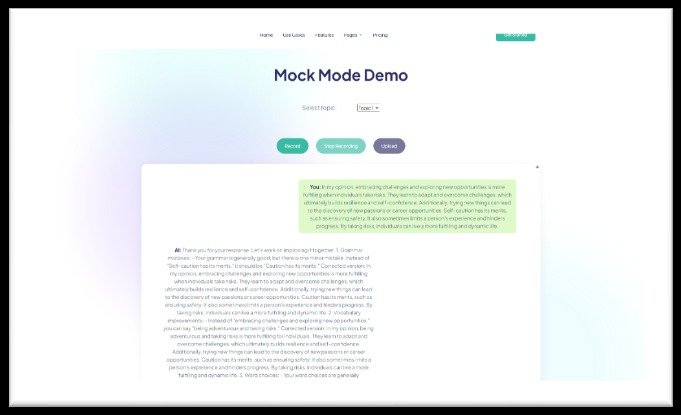
Our Mock Mode Page
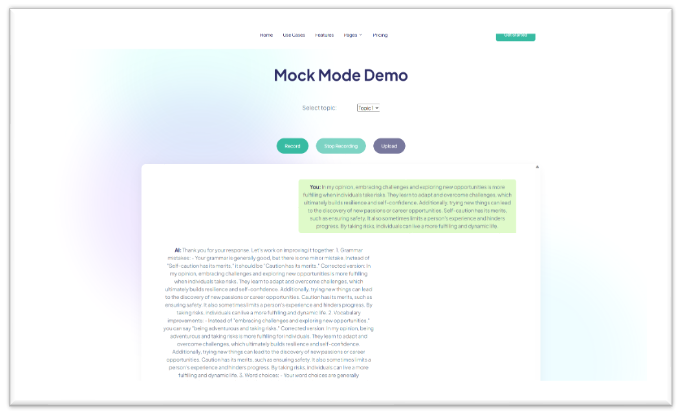
Inspiration
Every international student faces the following challenges:
When preparing for the TOEFL exam, they are often forced to sit through large classes where they have to listen to content they already know, and there's no personalized help for their specific questions.
On the other hand, expensive small group classes are not affordable for many, and a significant amount of time is wasted on mechanical exercises. For example, after answering a speaking question, the teacher grades it and provides feedback, which takes up a substantial portion of the time.
However, this practice part can be completely replaced by the world's best "person" for English—the large language model.
What it does
That's why we developed SmartPrep—a TOEFL speaking test tutor based on a large language model. It helps users practice speaking, provides corrective feedback in six dimensions such as accent, vocabulary, and grammar, and simulates real English conversations to improve listening skills and fluency. Additionally, after the practice session, students can engage in multi-round conversations with the tutor to further address their questions.
How we built it
We have leveraged the classic combination of React, HTML, CSS, JavaScript, and AWS to create a clean and feature-rich dynamic web interface that closely replicates the format and experience of the TOEFL exam. For the backend, we have integrated ChatGPT as the prototype for our tutor. Through prompt engineering techniques, we have endowed it with the abilities of a TOEFL speaking teacher. Additionally, we have utilized tools such as LangChain and Speech-To-Text conversion to enhance its conversational capabilities, making it capable of delivering realistic and logical interactions.
Challenges we ran into
Integration complexity: Integrating multiple technologies and platforms, such as React, HTML, CSS, JavaScript, AWS, ChatGPT, langchain, and speech-to-text conversion, required careful coordination and troubleshooting. Ensuring seamless compatibility and smooth communication between these components was a significant challenge.
Modeling the TOEFL exam experience: Replicating the structure and experience of the TOEFL exam within our web interface required extensive planning and attention to detail. We had to design and implement various question types, time limits, scoring mechanisms, and user interfaces to create an authentic exam simulation.
Prompt engineering for ChatGPT: Tailoring ChatGPT's responses to mimic those of a TOEFL speaking teacher posed a challenge. We had to fine-tune and optimize the prompts to ensure accurate and helpful feedback, considering factors such as language proficiency, grammar, vocabulary, and pronunciation.
Accomplishments that we're proud of
Integration of ChatGPT as a TOEFL speaking tutor: We have successfully integrated ChatGPT into our platform, leveraging prompt engineering techniques to transform it into a virtual TOEFL speaking teacher. This required careful fine-tuning of prompts and feedback generation to provide accurate and personalized responses to user inputs.
Realistic and logical dialogue generation: We are proud of our achievement in developing a system that can generate coherent and contextually relevant responses. Through the use of langchain and speech-to-text conversion tools, we have enhanced the conversational abilities of our tutor, allowing for more realistic and meaningful interactions.
Alpha test user satisfaction: During our alpha testing phase, we received positive feedback from users who expressed their appreciation for the functionality and effectiveness of our product. Their positive response has confirmed that we have successfully addressed the pain points of TOEFL exam preparation, reinforcing our belief in the value and potential of our platform.
What we learned
Importance of prompt engineering: Fine-tuning the prompts used with ChatGPT was crucial in achieving accurate and relevant responses. We learned that carefully crafting and optimizing prompts can significantly improve the quality of the generated feedback and make the tutor more effective in providing personalized assistance.
User-centric design: Developing a user-friendly interface that closely resembles the TOEFL exam experience was a significant learning experience. We learned the importance of understanding our target users' needs, preferences, and pain points, and incorporating their feedback throughout the design process. This user-centric approach helped us create a more effective and engaging learning platform.
What's next for Smartprep.ai
We realize that the same educational model can be applied to any field because there's a unified learning process behind acquiring any knowledge. The tutor we've created is, in fact, an educational agent. This model of a teacher developing an agent to teach students is what we believe is the future of education. It provides students with a 1-on-1 learning experience anytime, anywhere, while avoiding the repetitive tasks for teachers.
Therefore, we aim to build a platform where users can create, purchase, and utilize educational intelligent agents. For all those seeking education, we can offer expert agents covering all knowledge and skills, enabling users to experience personalized 1-on-1 teaching. They can try and choose the agent that best suits their needs, finding the educational model that works for them.
For education providers, we allow them to effortlessly create educational intelligent agents without any coding and deploy them on our platform to earn revenue. These agents embody the creator's teaching philosophy and exclusive materials, acting as the creator's AI counterpart to provide personalized 1-on-1 teaching and generate income.
Built With
- amazon-web-services
- chatgpt
- langchain
- react


Log in or sign up for Devpost to join the conversation.