-
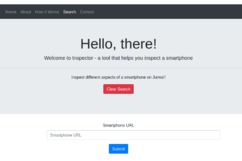
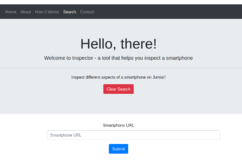
URL Input page
-
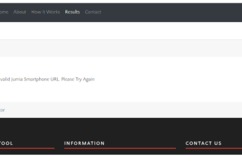
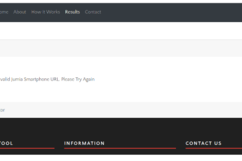
Error Feedback
-

Registration Page
-

Login Page
-
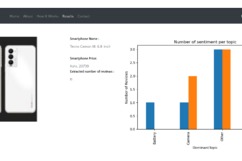
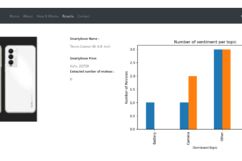
Results Page - Graph & Details Section
-
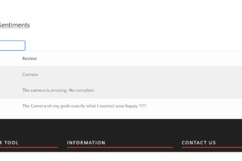
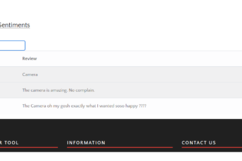
Results Page - Table Section
-
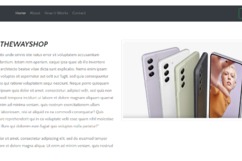
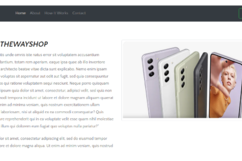
Home - Landing Page


Inspiration
The project draws inspiration from widespread e-commerce customer dissatisfaction, particularly the common disparity between customer expectations and the actual products received. This disconnect, often highlighted in the popular "What I Wanted vs. What I Got" social media trend, serves as the foundation for our project.
This tool addresses SDG 12: Responsible Consumption and Production by helping customers make informed choices and reduce waste. Smartphones, being top online purchases, serve as an ideal case study. Our tool provides in-depth insights into products, aiding in better purchasing decisions and minimizing overconsumption and financial waste.
What it does
The SmartPick Insight revolutionizes online shopping by using sentiment analysis to enhance product understanding. Users input the URL of a smartphone product page (e.g., from Jumia), and the tool provides:
Detailed Product Information: Key specifications and features of the smartphone.
Aggregated Reviews: A comprehensive collection of customer feedback.
Sentiment Analysis: A visual chart categorizing sentiments as positive, negative, or neutral based on the reviews.
This tool helps buyers make informed decisions by offering clear insights into product performance and user satisfaction, bridging the gap between expectations and reality in e-commerce.
How we built it
The SmartPick Insight was developed in a sequential manner, with each module dependent on the completion of the previous one:
Data Collection and Preparation: Review Scraping: Reviews were extracted from Jumia using BeautifulSoup.
Data Storage: The reviews were organized into a DataFrame.
Text Cleaning: The reviews underwent preprocessing to:Convert text to lowercase, Remove punctuation and extra whitespace, Eliminate stopwords using NLTK libraries
Topic Modeling: Reviews were categorized into topics such as battery, camera, screen, feel, and storage. Clustering was based on keyword occurrences defined by a specific dictionary.
Sentiment Analysis: A pre-trained model classified reviews into positive, neutral, or negative sentiments for different aspects.
User Interface: The final tool was integrated into a user-friendly interface using the Django framework. The front-end was designed with Bootstrap, CSS, and HTML for a cohesive and responsive experience. This structured approach ensured a seamless integration of data collection, analysis, and presentation, resulting in a comprehensive tool for analyzing smartphone reviews
Challenges we ran into
The key challenge was being able to build the system in such a way that the topic modeling will communicate with sentiment analysis bit in a coordinated manner to bring the expected results to the user.
Topic modeling was also a new field in machine learning that we were trying to figure out. While it is a unsupervised model, I had to tweak it to be a supervised model in order to meet the requirements of the tool i.e classifying the reviews into the already defined aspects.
Accomplishments that we're proud of
The system works just fine. It gives appropriate feedback if the user has not entered a valid URL i.e a smartphone on Jumia platform only.
We were able to successfully bring the two ideas into one product.
What we learned
Topic modeling as a field in machine learning, it was an eye-opener.
Beyond the development bit, we were able to reach out to key experts in the natural language processing space and provided key insights on the way forth in regards to the project. That really showed me how mentorship is important.
What's next for SmartPick Insight
The logic of this system can enable a developer to develop a system that compares sentiments of different aspects of different products on the e-commerce platforms.
The system can also be improved by increasing the number of supported e-commerce platforms to give the users more options of the desired platform they wish to shop from. The incorporation of more e-commerce platforms should be dependent on the legality of crawling the sites.
Moreover, metrics on the user’s interactions can be included in to assess their attitude towards the system and later incorporating a review section where users can see the reviews of other users which will also increase their confidence levels when using the system


Log in or sign up for Devpost to join the conversation.