-
-
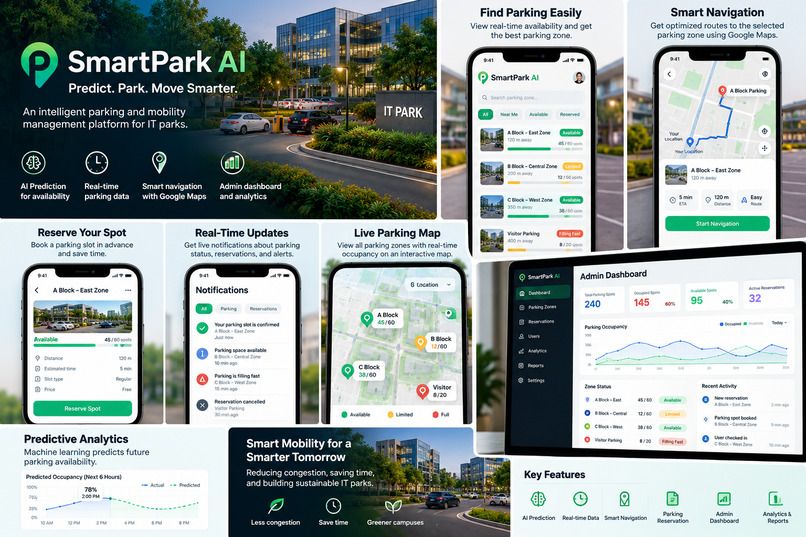
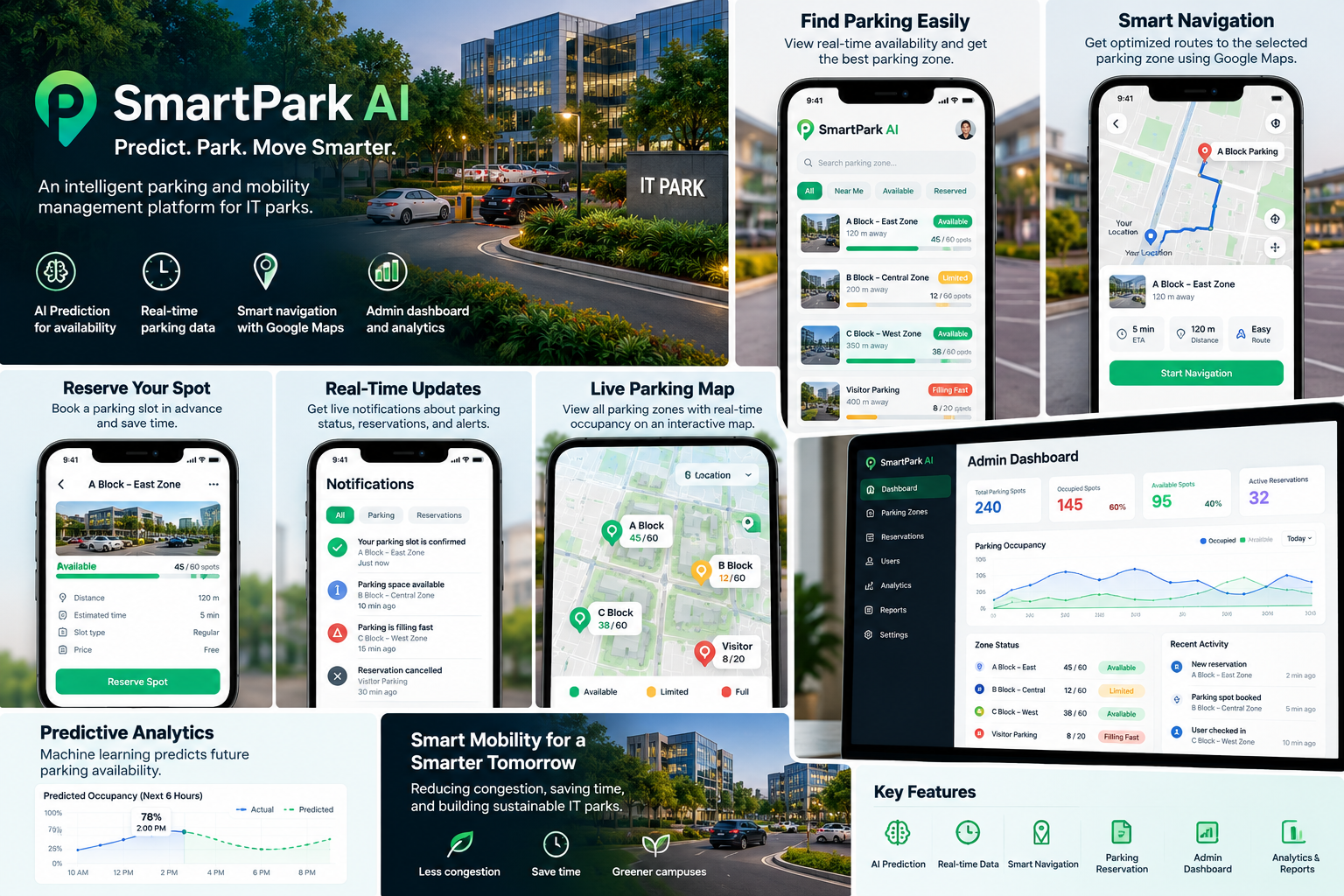
SmartPark AI: Predictive parking, real-time availability, smart navigation, and analytics.
Inspiration
Finding parking in large IT parks can be frustrating, especially during peak hours. Employees often spend valuable time searching for available spaces, while administrators struggle to get a clear real-time view of parking occupancy. This inspired us to build SmartPark AI — a smarter way to predict, find, and manage parking.
What We Learned
Through this project, we learned how to combine AI/ML, real-time data, mobile development, cloud/backend technologies, and maps into one practical system. We explored how machine learning can be used to predict future parking availability rather than simply displaying the current status.
We also learned the importance of designing a system that works reliably in real-world situations, including changing parking conditions, network issues, location permissions, and real-time updates.
How We Built It
SmartPark AI combines a mobile application for users with a management dashboard for administrators.
The system collects real-time parking information and uses machine learning to predict future occupancy. Based on availability, distance, congestion, and estimated arrival time, the system recommends the most suitable parking zone.
Users can view parking availability, make reservations, receive updates, and use Google Maps for navigation. Administrators can monitor occupancy, reservations, parking trends, and operational alerts through the dashboard.
Our architecture combines React Native, Node.js, Express, MongoDB, Socket.IO, machine learning, and Google Maps APIs to create an integrated parking management platform.
Challenges We Faced
One of our biggest challenges was integrating multiple technologies into a single reliable system. Real-time synchronization between the mobile app, backend, and dashboard required careful handling of live updates.
Building a meaningful ML prediction system was another challenge because parking availability changes throughout the day. We had to identify useful features and design the prediction workflow so that the system could support future availability estimation.
We also faced challenges with location services, map integration, API communication, dependency configuration, and creating a responsive mobile interface that works smoothly across different screens.
The Outcome
SmartPark AI transforms parking from a simple availability-checking system into a predictive and intelligent mobility platform. Instead of asking users to search for parking, it helps them anticipate availability, choose a suitable zone, and reach it efficiently.
Our goal is to make parking more predictable for users and more manageable for organizations.

Log in or sign up for Devpost to join the conversation.