-
-
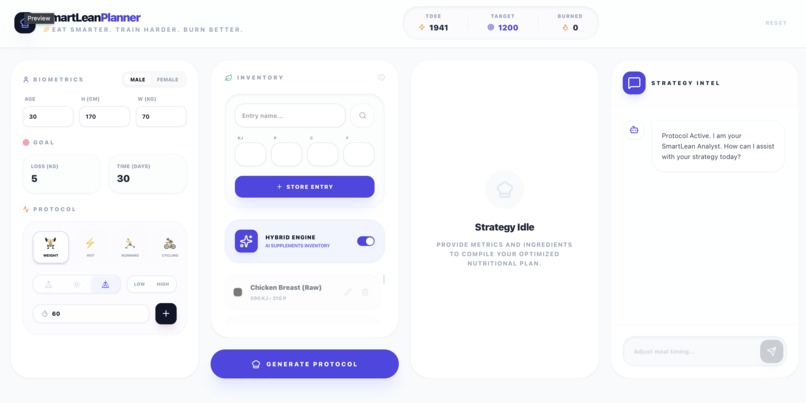
screenshot of the website
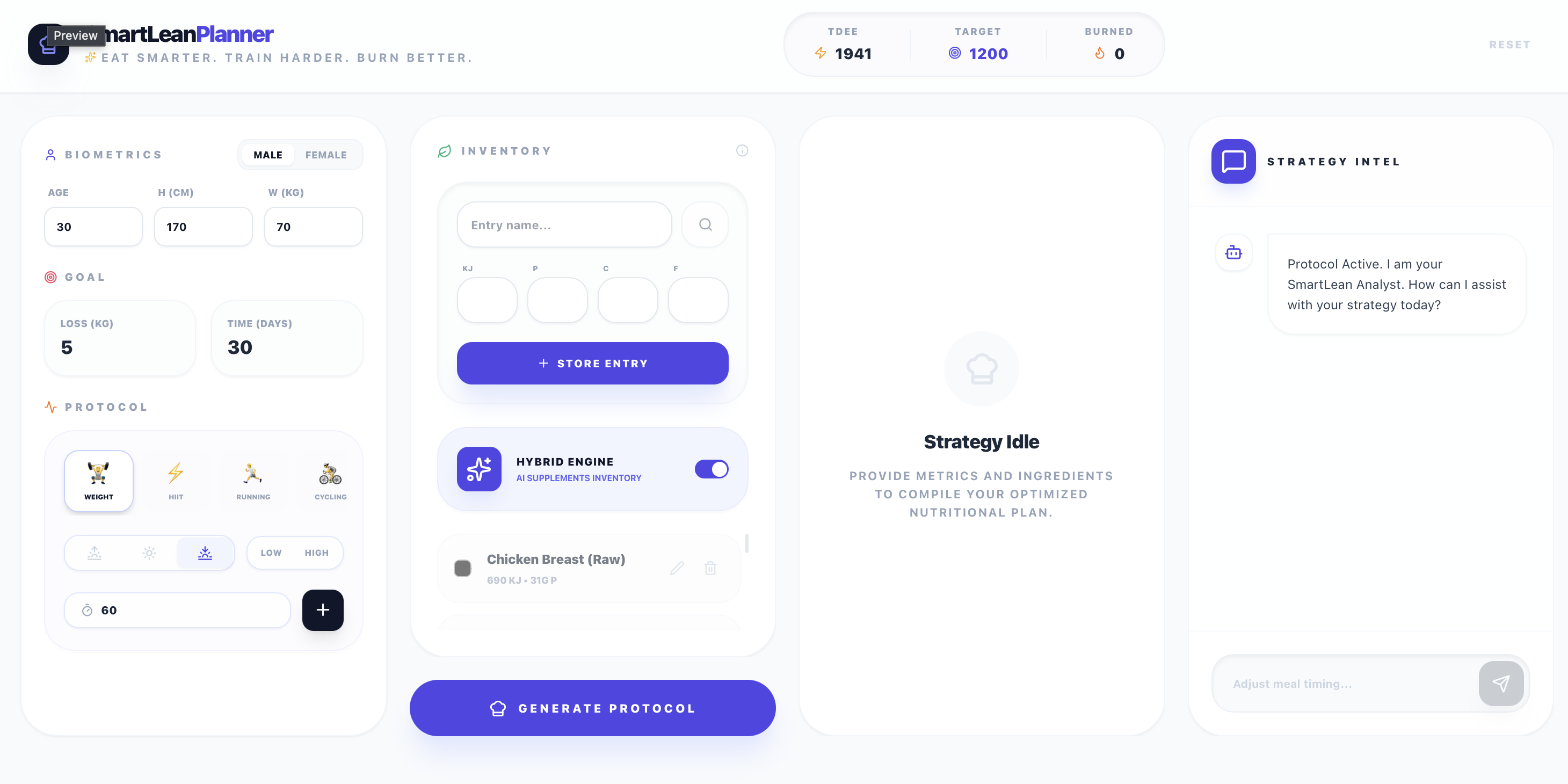
SmartLean Planner — Precision Deficit Architecture
Inspiration
Traditional fat-loss tools are built around static calorie targets or one-time TDEE calculations. However, real human metabolism is dynamic and influenced by behavioral adherence, recovery quality, and physiological cycles.
We were inspired to rethink fat loss as a control system problem instead of a static calculation problem. In engineering terms, fat loss is not about hitting a single number — it is about maintaining a stable energy deficit signal over time.
Instead of telling users to eat a fixed calorie number, we wanted to build a system that helps users maintain a stable deficit band that is physiologically sustainable.
What We Built
SmartLean Planner is an AI-assisted metabolic planning system that combines:
- Precision deficit calculation
- Behavioral feedback interpretation
- Adaptive daily target guidance
- AI-generated coaching recommendations
At the core, the system models daily energy balance:
Daily Deficit Formula
D = TDEE - Intake
Where:
| Variable | Meaning |
|---|---|
| D | Daily calorie deficit |
| TDEE | Total Daily Energy Expenditure |
| Intake | Daily calorie intake |
Estimated Fat Loss Formula
Fat Loss ≈ Total Deficit / 7700
Where:
| Variable | Meaning |
|---|---|
| Total Deficit | Sum of daily calorie deficits over time |
| 7700 | Approximate kcal stored in 1 kg of body fat |
But real fat loss depends on stability and adherence, so we extend this into a stability-based signal model:
Deficit Stability Model
DSI = f(deficit_variance, adherence, recovery, physiological_modifiers)
Where:
| Variable | Meaning |
|---|---|
| DSI | Deficit Stability Index |
| deficit_variance | How much daily deficit fluctuates |
| adherence | How consistently user follows the plan |
| recovery | Sleep quality, stress level, recovery status |
| physiological_modifiers | Hormonal or metabolic factors |
DSI measures whether a fat loss plan is sustainable long-term rather than just mathematically valid.
How We Built It
Frontend
We built a zero-build modern web interface using:
- React 19 for reactive UI architecture
- TailwindCSS for fast, consistent design system implementation
- Recharts for metabolic and deficit visualization
- Lucide React for clean system iconography
- Inter font for scientific dashboard aesthetic
The UI follows a mobile-first vertical dashboard design optimized for high data density with low cognitive load.
AI Layer
We integrated Google Gemini via the GenAI SDK to enable:
- Natural language metabolic explanation
- Behavioral pattern interpretation
- Nutrition and deficit adjustment suggestions
- AI coaching generation
The AI is designed as a decision-support copilot, not an autonomous controller.
What We Learned
- Stability is more important than aggressiveness in metabolic outcomes
- Visualization dramatically improves adherence behavior
- AI is most effective when translating data into human-understandable guidance
- Users trust systems that explain why, not just what
Challenges
Scientific Accuracy vs Usability
Metabolic modeling can easily become too complex for daily use. We had to compress multi-variable biological signals into intuitive UI indicators.
AI Personalization Boundaries
Over-automation can reduce user agency. We intentionally designed AI to recommend rather than decide.
Data Visualization Density
Fat loss is a longitudinal process, which creates large data surfaces. We iterated heavily to balance scientific fidelity with clean visual design.
Future Directions
- Wearable signal integration (HRV, sleep, recovery)
- Physiological cycle adaptive deficit planning
- Reinforcement learning personalization
- Long-term metabolic adaptation detection
- Multi-goal body recomposition optimization
SmartLean Planner represents a shift from calorie counting tools to adaptive metabolic control systems, combining AI reasoning with physiological modeling to help users maintain sustainable fat loss trajectories.
Built With
- esm.sh
- google-gemini-api
- ingredient-estimation
- lucide-react
- mifflin-st-jeor-equation
- react-19
- tailwind-css
- typescript
- web-storage-api


Log in or sign up for Devpost to join the conversation.