INSPIRATION
We've all been there — you walk into your house and the "smart" lights are still on, two apps are fighting over the thermostat, and somewhere a door sensor is screaming into the void with no one listening. The promise of a smart home often collides hard with the chaos of reality.
We asked ourselves a bold question: What if your home didn't just follow commands — what if it actually understood them?
That spark led us to build SmartHome Guardian — a system designed not just to automate, but to reason. The real breakthrough was the "DeployTechnician" concept. We realized the gap no one was addressing wasn't between devices; it was between machines and humans. When safety protocols collide with convenience, the system shouldn't guess. It should know its limits, flag the ambiguity, and hand the wheel to a human.
WHAT IT DOES
SmartHome Guardian is a next-generation intelligent home management dashboard that acts on data, thinks about it, and knows when to ask for help.
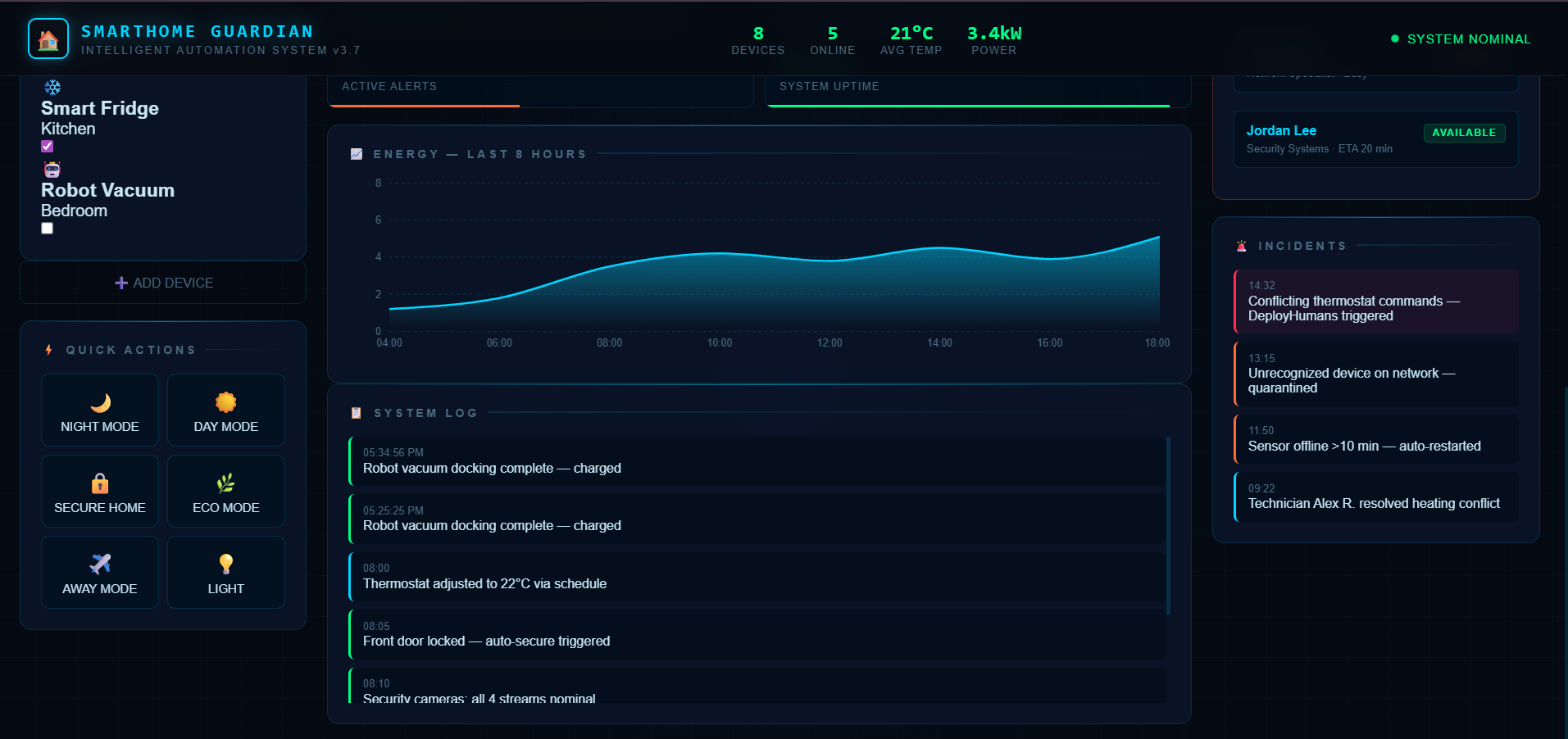
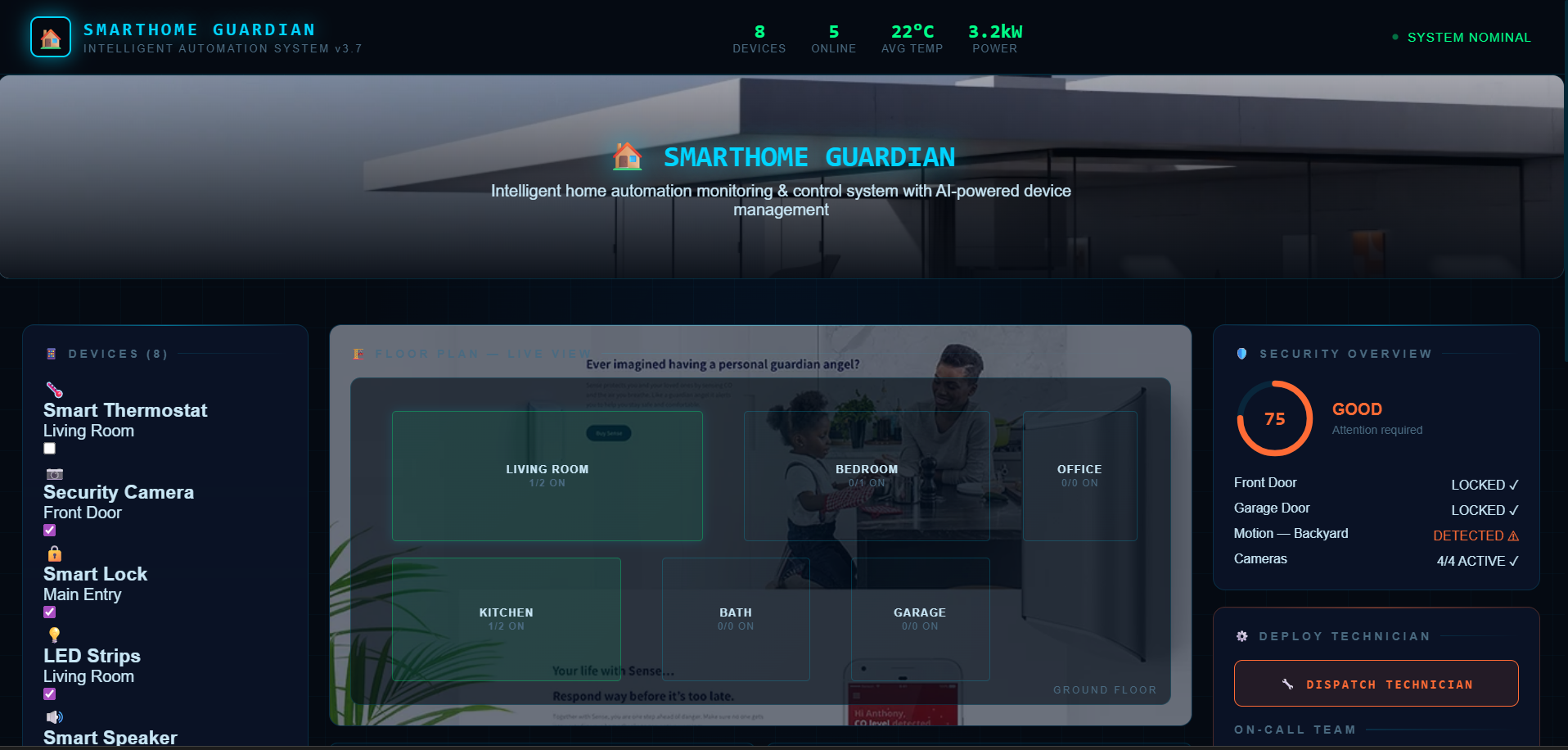
🗺️ Live Interactive Floor Plan: A visual, clickable map showing every connected device by room with real-time status indicators.
🛡️ Dynamic Security Score: A continuously recalculated safety rating (0–100) that responds to real events like unlocked doors or flagged incidents.
📈 8-Hour Energy Trend Chart: A beautiful area chart revealing consumption patterns and flagging usage spikes in orange.
🧠 Intelligent Conflict Detection Engine: When two automations disagree, the system stops, flags the conflict in plain language, and escalates it.
🔧 DeployTechnician Dispatch System: When a conflict is beyond automated resolution, the system matches the issue to the best available on-call technician by skill set and ETA.
🎛️ One-Tap Scene Modes: Intelligently toggles devices for Night, Day, Eco, Away, Guest, and Secure Home modes.
📋 Live System Log & Incident History: A real-time audit trail of every action, alert, and resolution.
HOW WE BUILT IT
SmartHome Guardian is a React + Vite single-page application engineered for speed and extensibility. Our architectural choices included:
Plain CSS with Custom Properties: No UI framework. We used CSS Grid and Flexbox for layout and CSS variables for a custom cyberpunk theme system.
Recharts: Used for fluid, data-driven energy visualizations.
@dnd-kit: Implemented for natural drag-and-drop device management.
Realistic Simulation Engine: We built an auto-loop that fires randomized log events, fluctuates energy readings, and triggers conflict scenarios to make the dashboard feel alive without real hardware.
Conflict Classifier: Logic that identifies unresolvable states (e.g., safety protocol collisions) and generates human-readable explanations.
CHALLENGES WE RAN INTO
Building the features was the easy part; the hard parts were all about judgment.
Escalation Thresholds: Defining when to "cry wolf." Too sensitive, and the system is annoying; too lenient, and real conflicts slip through. We built a nuanced rule set to distinguish between normal toggling and genuine deadlocks.
Simulating Reality: Making a dashboard feel "live" required careful tuning. We iterated on timing until the fluctuating energy and log cadences felt organic rather than like a broken ticker.
Information Hierarchy: A security dashboard can become anxiety-inducing. We designed a hierarchy—critical alerts in red, informational logs in subtle scrolls—to allow users to triage at a glance.
ACCOMPLISHMENTS THAT WE'RE PROUD OF We shipped a product that feels like a polished reality, not just a prototype:
The DeployTechnician System: A genuinely novel approach to handling automation conflicts with human escalation.
Plain English Feedback: Replacing cryptic error codes (e.g., "Error 0x4F") with "Alexa routine (18°C) vs manual override (26°C)."
Zero Backend Architecture: The entire experience—persistence, simulation, and dispatch logic—runs entirely client-side.
Visual Cohesion: The Orbitron typography and neon-on-dark cyberpunk aesthetic create a high-intelligence feel.
WHAT WE LEARNED
The biggest insight: the hardest UX problem in smart home tech isn't control — it’s trust.
Users abandon systems when they stop trusting them. A thermostat that silently picks the wrong temperature erodes confidence faster than any bug. Rebuilding that trust means being radically transparent about what the system knows and what it doesn't. We also learned that simulation is a legitimate design tool; it helped us catch dozens of UI edge cases before a single real device was ever connected.
WHAT'S NEXT FOR SMARTHOME GUARDIAN
🔌 Real Device Integration: Matter/Thread protocol support and Zigbee bridge compatibility.
🤖 AI-Powered Resolution: Using behavioral modeling to suggest the most likely intended state during a conflict.
🏢 Multi-Floor Support: Expanding the floor plan to handle gardens, basements, and detached structures.
📉 Predictive Maintenance: Using energy anomalies to flag devices before they fail.
👥 Role-Based Access: Distinct views and permissions for homeowners, guests, and technicians.
Built With
- css
- grid
- html
- javascript
- native
- reactevite
- recharts
- typescript
- vibecoding

Log in or sign up for Devpost to join the conversation.