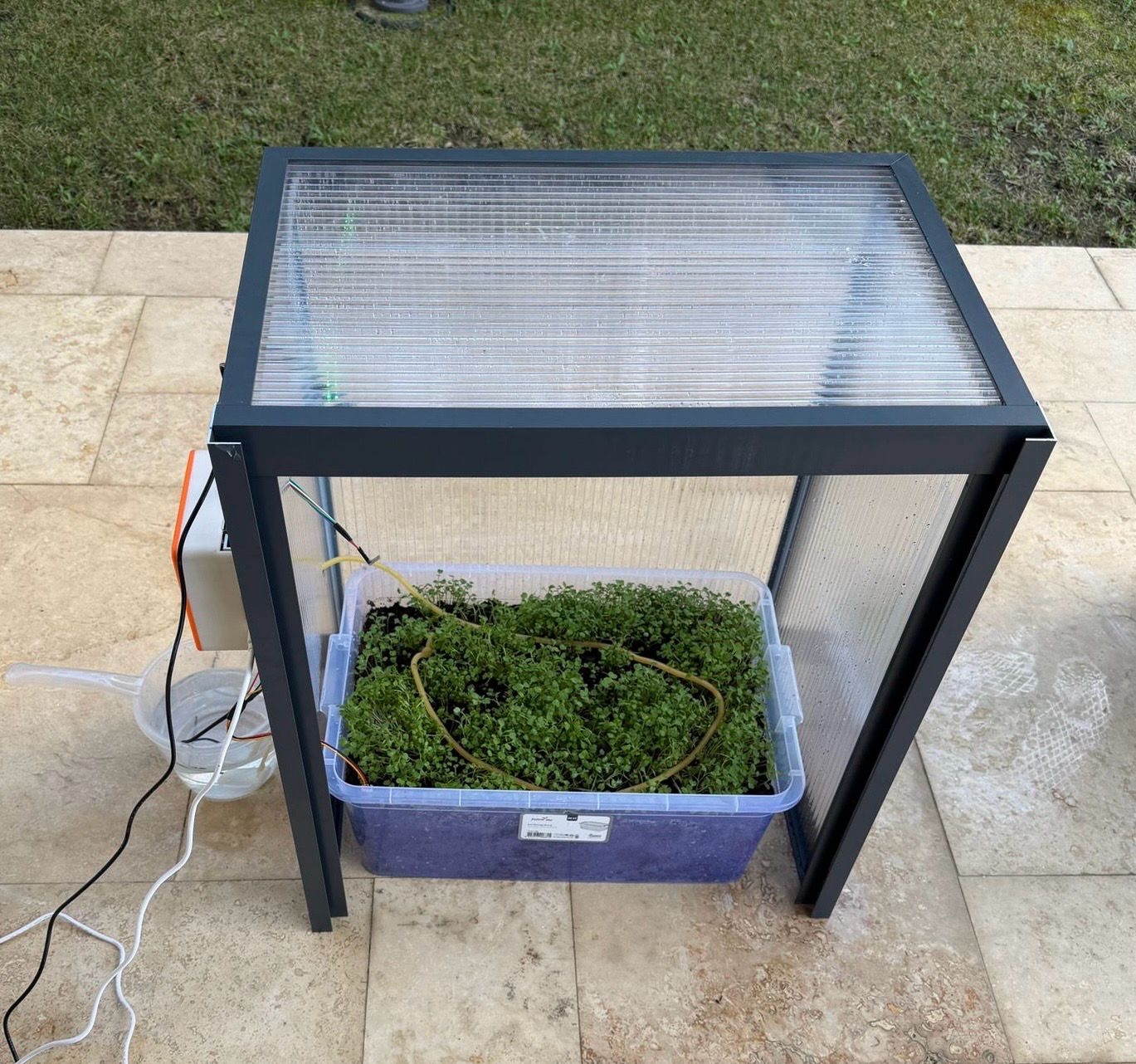
Inspiration
Global agriculture wastes immense amounts of water through inefficient, rigid timer-based irrigation. Seeing small-scale greenhouse operators struggle with rising water costs and a lack of smart tools inspired me to create SmartGreenify. I am currently developing this project to build an affordable, open-source, and fully autonomous greenhouse system that uses local AI to optimize watering schedules without relying on expensive proprietary hardware or cloud subscriptions.
What it does
SmartGreenify automates greenhouse management by bringing predictive intelligence directly to the edge. Operating completely offline, the system:
Monitors Environmental Data: Tracks soil moisture, temperature, air humidity, barometric pressure, and ambient light levels in real-time.

Logs Securely: Saves calibrated data every 5 minutes into thread-safe, corruption-proof local CSV files.

Predicts Moisture Depletion: Uses a local machine learning model to analyze environmental trends and forecast exactly when the soil will dry out.

Automates Irrigation: Intelligently triggers a 5V relay and DC water pump to execute precise, adaptive watering cycles (such as automated night waterings) based on AI predictions rather than rigid timers.
How we built it
SmartGreenify is designed around a modular, three-layer architecture built for offline reliability:
Sensor & Actuator Layer: A Raspberry Pi 5 acts as the central hub, collecting real-time data from a BME280 sensor (temperature, air humidity, pressure), an ADS1115 ADC with a capacitive soil moisture sensor, and an LDR for day/night tracking. A 5V relay module automates the DC water pump.

Data & Storage Layer: To ensure data integrity, the system uses thread-safe Python structures and atomic file writes, logging calibrated environmental data into local CSV files every 5 minutes.

Local Machine Learning Layer: Instead of utilizing cloud APIs, a local Scikit-learn Linear Regression model runs directly on the Raspberry Pi. It is programmed to retrain automatically every 7 days, analyzing variables like previous moisture levels, temperature, humidity, and the time of day to predict exactly how fast the soil is drying and determine the optimal watering windows.
Challenges we ran into
Hardware Calibration: Getting consistent, accurate readings from the capacitive moisture sensors and managing I²C/SPI communication protocols required independent hardware debugging before the main automation logic could be written.
Thread Safety: Ensuring that the real-time sensor logging loops and the localized machine learning training routines run concurrently without clashing requires strict multi-threading practices and careful memory management.
Accomplishments that we're proud of
100% Local Execution: Successfully building an entire IoT and AI pipeline that runs completely on-device without relying on external cloud APIs or internet connectivity.
Robust Thread Management: Implementing a multi-threaded architecture that allows real-time sensor reading, data logging, and local ML training loops to run concurrently without clashing or dropping data.
Hardware-Software Synergy: Overcoming initial hardware noise and communication hurdles to get stable, actionable data flowing from multiple sensors straight into our predictive model.
What we learned
Edge AI Implementation: Understanding how to train and deploy lightweight machine learning models directly on resource-constrained hardware.
Concurrent Programming: Gaining hands-on knowledge of Python's multi-threading capabilities, thread safety (RLock), and atomic file writing to prevent data corruption.
Low-Level Hardware Debugging: Mastering I²C and SPI communication protocols, calibrating analog sensors through an ADC, and troubleshooting physical hardware components independently from software logic.
What's next for SmartGreenify
Long-Term Field Testing: Deploying the current prototype into a physical environment to gather continuous data and evaluate real-world hardware reliability.
Local Dashboard Integration: Building a self-hosted, local web interface to visualize real-time analytics and environmental trends easily.
Model Optimization: Fine-tuning the predictive algorithm with more historical data to further increase its accuracy across different plant types.
Built With
- bme280
- css3
- csv
- flask
- html5
- iot
- javascript
- json
- machine-learning
- ntfy.sh
- pandas
- plotly
- pwa
- python
- raspberry-pi
- sckitt-learn
- socket.io
- websocket

Log in or sign up for Devpost to join the conversation.