-
-
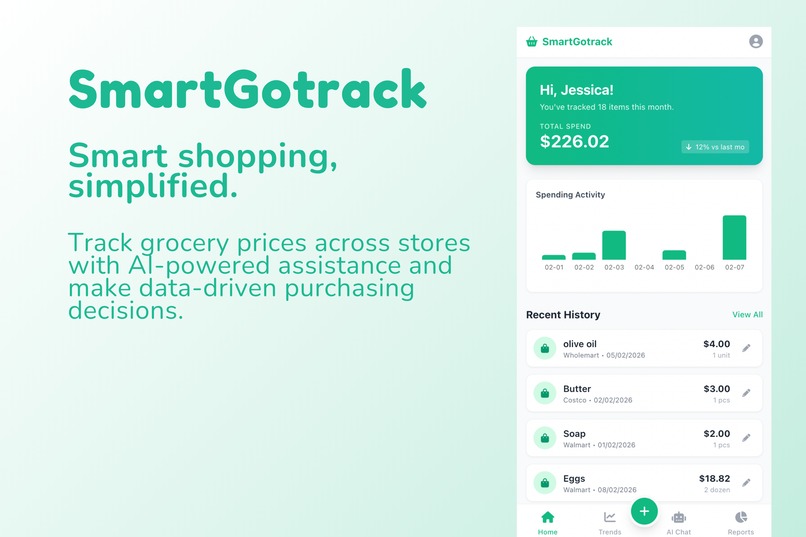
Smartgotrack
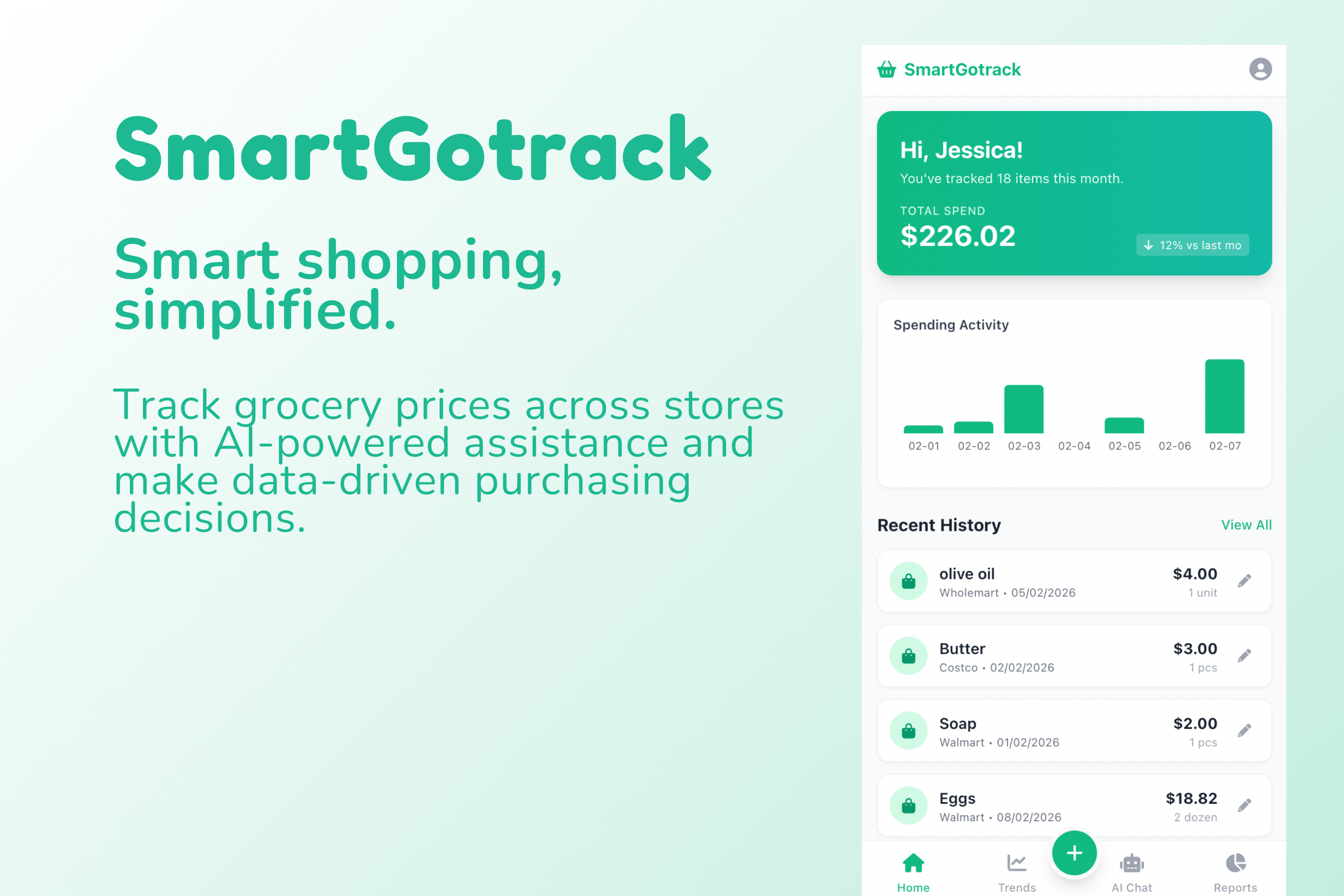
Inspiration
My wife returns home from the grocery store, bags in hand, only to realize she paid $4 for eggs at Store A when Store B had them for $2.99. She knew there was a difference, but couldn't remember which store was cheaper. This happens every week. Multiply this across rice, cooking oil, vegetables, and dozens of other items, and those "small" price differences add up to hundreds of dollars a year.
In an era where inflation dominates headlines and household budgets strain under rising costs, most people are flying blind. They see the news reporting "5% inflation," but what does that mean for their specific basket of groceries? Does it matter if the CPI says vegetables are up 3% when their preferred vegetables are up 15%?
The inspiration for SmartGotrack came from a simple observation: People don't need another app to record their financial regrets—they need a tool that prevents those regrets in the first place.
What it does
SmartGotrack help how households make grocery decisions by turning scattered purchase data into actionable intelligence. At its core, SmartGotrack does three main things:
- Makes Data Entry Effortless (AI Chat Assistant) Forget tedious forms and spreadsheet rows. With SmartGotrack, logging a purchase is as natural as telling a friend what you bought: "I bought 2kg of rice for $8 at Walmart yesterday"
- Reveals Where Your Money Goes (and Where It Shouldn't) SmartGotrack builds a living database of your purchases, transforming raw data into crystal-clear insights: Price Comparison Matrix: See at a glance that Store A sells rice for $4/kg while Store B charges $5.50/kg. Color-coded cells immediately show you where to save—green for best prices, red for worst.
- Turns Insights Into Action Information without action is just interesting trivia. SmartGotrack closes the loop: Where to Buy: Before you shop, ask the AI: "Where should I buy eggs?" Get instant recommendations based on your actual purchase history, not generic coupons or ads.
How we built it
Building SmartGotrack was a journey of strategic technical choices aimed at one goal: ship fast, learn faster.
- Gemini 3 to brainstorm for creating a PRD and prompt.
- Vibe coding using Google AI Studio based on a Prompt that Gemini provided to me earlier. I added AI Powered Chatbot.
- For AI Support I use Google Gemini 3 API:
- gemini-3-pro-preview: Used in the Chat Interface to intelligently parse natural language (e.g., "Bought milk for $3") into structured JSON data.
- gemini-3-flash-preview: Used in the Reports section to analyze spending history and generate financial insights/tips.
- Deployment directly from the Google AI Studio, which use Google Cloud Run in the background.
- Firebase Auth and Firestore Database to use authentication and database service to store each of users expenses.
Challenges we ran into
The Problem: My initial vision was ambitious—receipt OCR scanning, barcode scanning, AI chat, manual entry, price predictions, meal planning. Everything. The Trap: I was building a Swiss Army knife when users needed a really good knife. The Pivot: After sketching OCR flows and researching barcode APIs, we had a tough conversation: "Am I building to impress ourselves or to help users?"
The Lesson learned: This "simplified" approach was actually more powerful. AI chat handles receipt scanning's worst nightmare—illegible receipts, handwritten notes, market stall purchases with no receipt. Users could say "bought tomatoes, $3 worth" and the AI understood.
Accomplishments that we're proud of
Every expense tracker we studied had the same Achilles heel: data entry friction. Users download the app excited, log purchases for three days, then abandon it because it's work. We turned work into conversation. "I bought 2kg rice for $8 at Walmart yesterday" → Done in 8 seconds, including AI processing and confirmation. No forms. No dropdowns. No cognitive load. The pride: In user testing, people smiled when logging purchases. When was the last time a financial app made you smile? That's when we knew we'd cracked something special.
What we learned
Lesson learned: Sometimes the constraint is the innovation. Simplicity is sophistication. Focus on deliver MVP as fast as possible
What's next for SmartGotrack
SmartGotrack becomes the financial operating system for household shopping worldwide.
Imagine
Morning: SmartGotrack notification: "Good morning! Rice is on sale at Store B (20% off). Add to today's shopping list?"
Midday: You're at the store. Open SmartGotrack. See your list with prices. Scan items as you shop. App confirms: "You're saving $12 vs usual prices!"
Evening: Review weekly analytics: "You spent $130 this week, down 8% from last week. Your personal inflation this month: 3% (vs national 5%). Top saver: Switching to Store B for vegetables saved $18."
Sunday: Family budget meeting. Open SmartGotrack's forecast: "Based on trends, next month you'll spend ~$520 on groceries. To stay under $500, consider these swaps..."
Result: Households save hundreds yearly. Inflation doesn't feel like a helpless tidal wave—it's a measurable challenge they can fight with data.
Built With
- cloudrun
- firebase
- gemini
- google-cloud
- nextjs

Log in or sign up for Devpost to join the conversation.