-
-
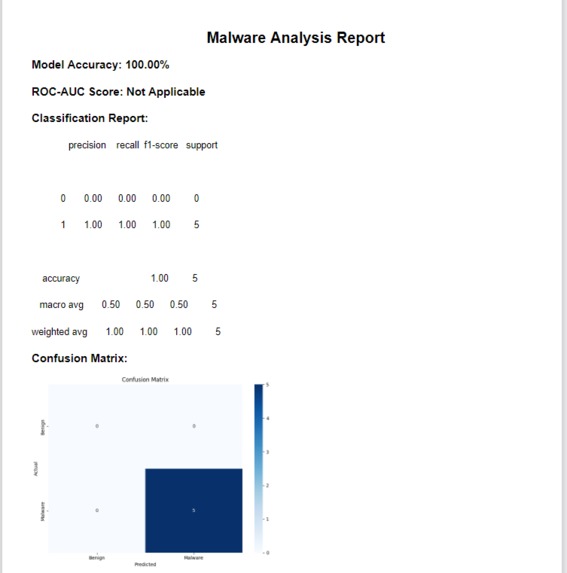
Malware File Report
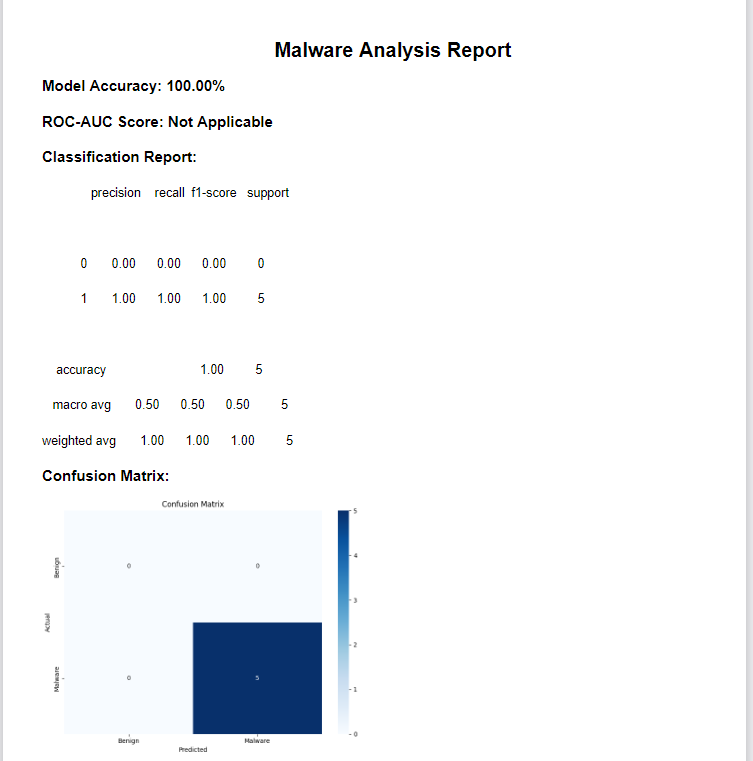
Inspiration
The rise of cyber threats and the sophistication of modern malware inspired us to create SmartGuard, an AI-powered malware detection tool. As malware becomes increasingly evasive, traditional signature-based methods are less effective. We wanted to leverage machine learning to identify malicious processes based on behavioral patterns and real-time data analysis, providing a smarter and more adaptive defense system for endpoint protection.
What it does
SmartGuard analyzes process-level information, such as hash values, execution time, state transitions, and priority levels, to detect malware. Using machine learning, it classifies processes as either benign or malicious based on predefined features. It offers real-time monitoring, alerts for suspicious behavior, and can automatically quarantine potentially harmful processes. The tool is designed to improve accuracy over time as it learns from new data.
How we built it
We built SmartGuard using a combination of data science and cybersecurity techniques. Here’s how it was done:
Data Collection: We gathered process-level data, including system information such as hashes, timings, and resource usage, from both malicious and benign software. Feature Extraction: Key features such as process hash values, priority shifts, and execution behaviors were extracted. Machine Learning: We employed supervised learning techniques, training models like Random Forest and Support Vector Machines (SVM) to classify malware based on the extracted features. Evaluation: We evaluated the performance of the models using precision, recall, and F1-score, and applied cross-validation to ensure the model’s robustness. Real-time Monitoring: For real-time detection, we implemented an alert system to flag suspicious activities immediately.
Challenges we ran into
Data Quality: Collecting and labeling accurate datasets of malicious and benign processes was time-consuming and critical for the model's success. Feature Selection: Choosing the right features from raw process data was challenging. We had to carefully analyze which metrics best predicted malware behavior without adding noise to the model. False Positives: Balancing between high detection rates and avoiding false positives was a key challenge. Tweaking the model to minimize both types of errors required multiple iterations.
Accomplishments that we're proud of
Successful Detection: Our machine learning model was able to detect malicious processes with a high degree of accuracy, significantly reducing false positives compared to traditional detection methods. Real-Time Monitoring: Implementing real-time detection and alerts to mitigate potential malware threats as soon as they're detected was a major milestone. Scalable Design: The tool is designed to improve its detection capabilities as it processes more data, making it future-proof as malware evolves.
What we learned
Behavioral Analysis: Malware detection is more effective when analyzing the behavior of processes over time, rather than relying solely on static indicators like hash values. Model Tuning: Fine-tuning machine learning models requires iterative testing, validation, and recalibration. Small adjustments in the algorithm and data handling can significantly affect outcomes.
What's next for smartgaurd: ai malware detection
Threat Mitigation: Introducing automatic quarantine and process termination features to immediately stop malicious processes from causing damage. User Interface: Enhancing the user interface for better real-time monitoring and reporting, making the tool more user-friendly for cybersecurity teams.


Log in or sign up for Devpost to join the conversation.