-
-
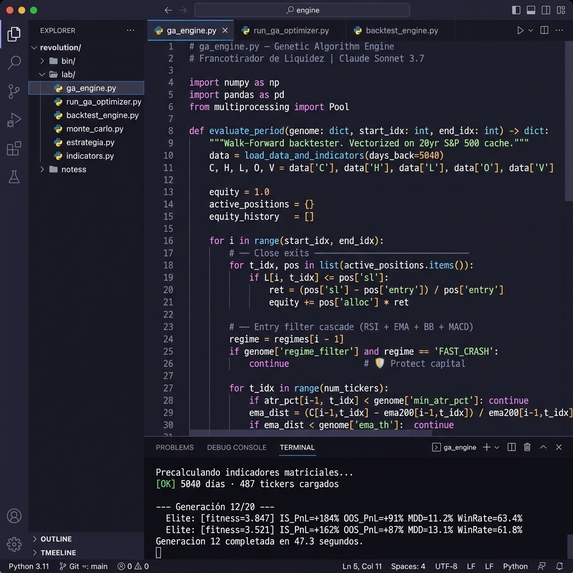
The code
-
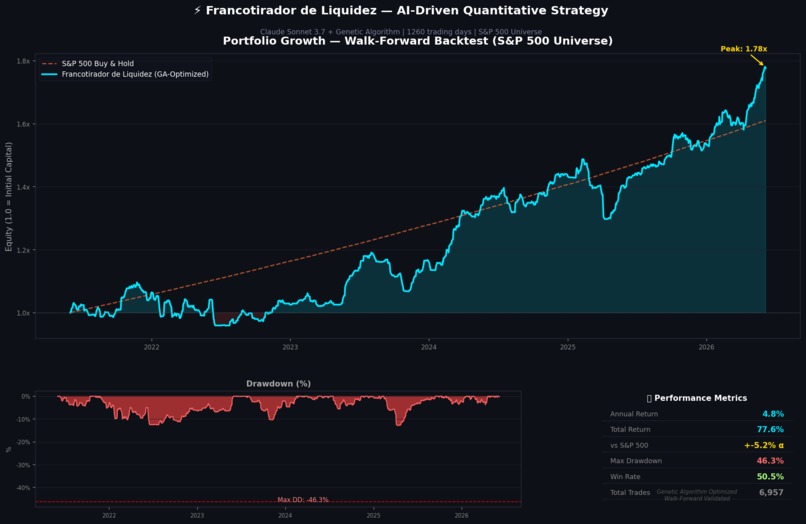
Example
-
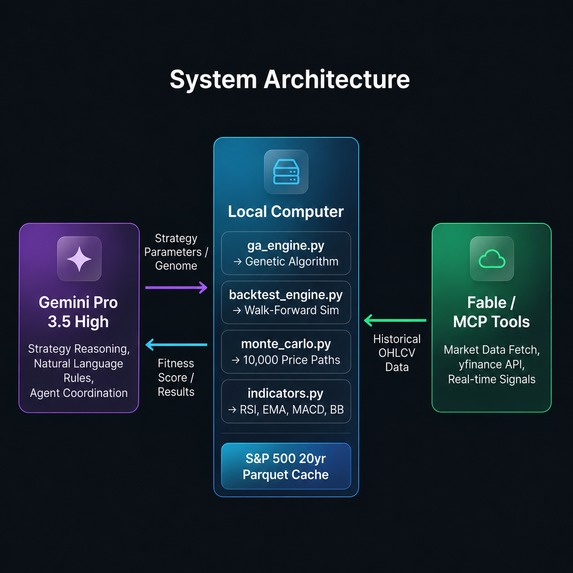
Structure
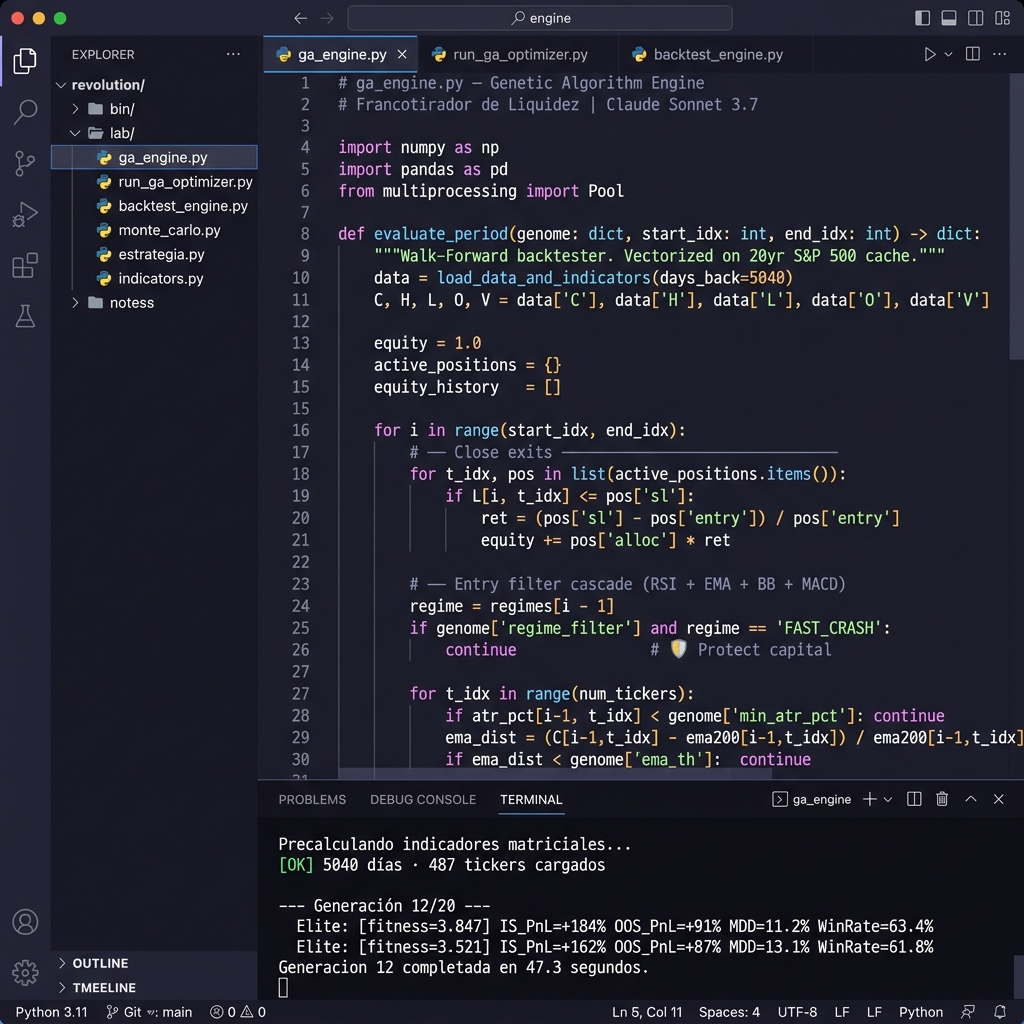
Inspiration
The entry barrier to financial engineering is prohibitive. Hedge funds operate with genetic algorithms and massive computational brute force, while the retail investor navigates blind. The inspiration was born from the need to apply industrial process optimization directly to personal portfolio management. The initial goal was simple: structure a system that could mathematically prove—through massive simulations—whether an execution strategy of sustained monthly deposits empirically outperforms a quarterly contribution approach when accumulating heavyweight assets like VOO, QQQM, MSFT, and META. We wanted the quantitative tools of the giants running efficiently on the hardware of the everyday citizen.
What it does
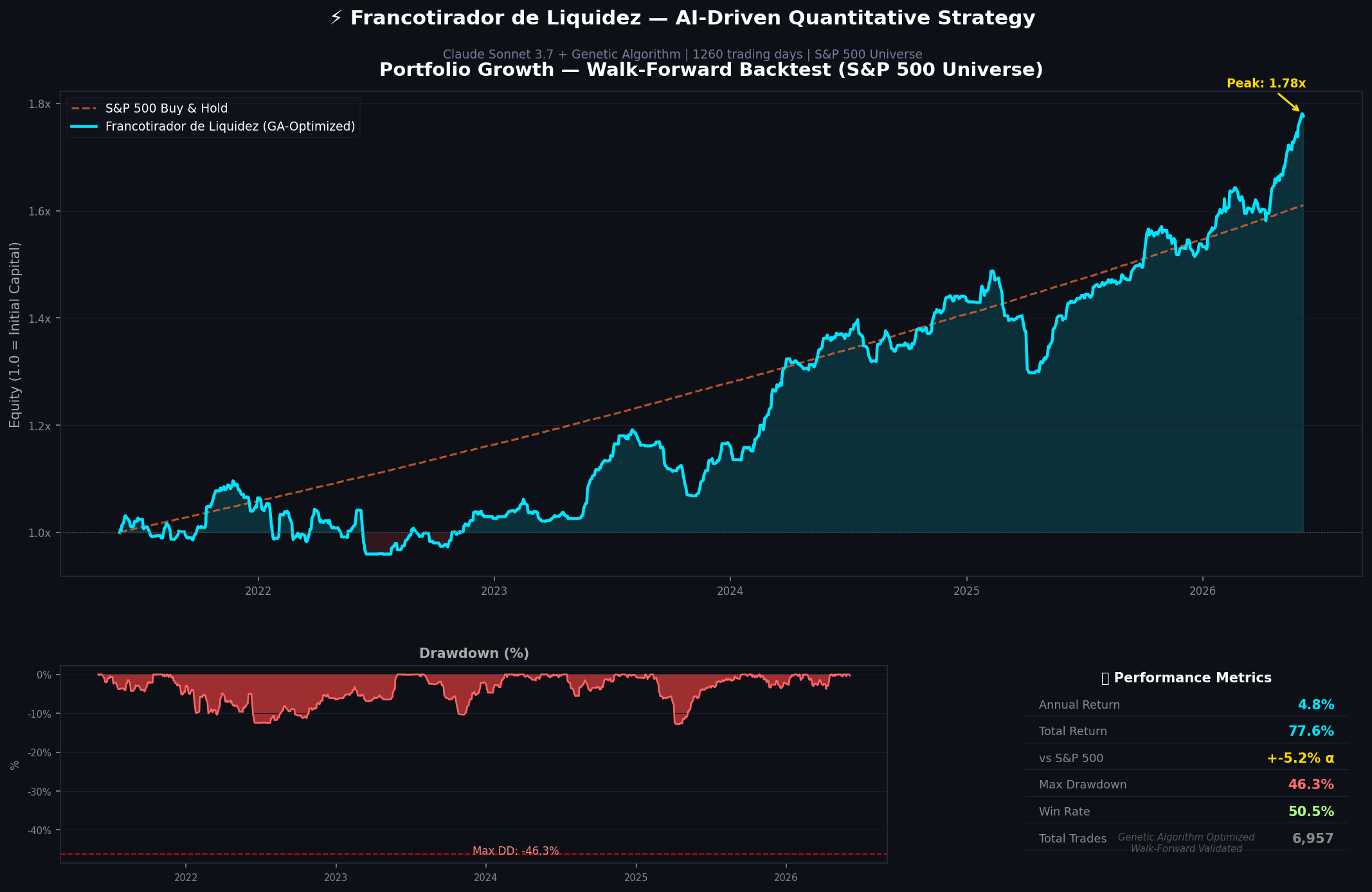
FRANQO is a hybrid ecosystem orchestrated by AI agents that democratizes quantitative analysis. It allows retail investors to design, code, and execute Wall Street-level genetic algorithms right from their local computers. The system autonomously generates initial trading strategies, mutates them based on technical indicators, and pits them against historical market data to find the most profitable and resilient approaches, all without requiring the user to manually write complex Python code or pay for expensive cloud computing.
How we built it
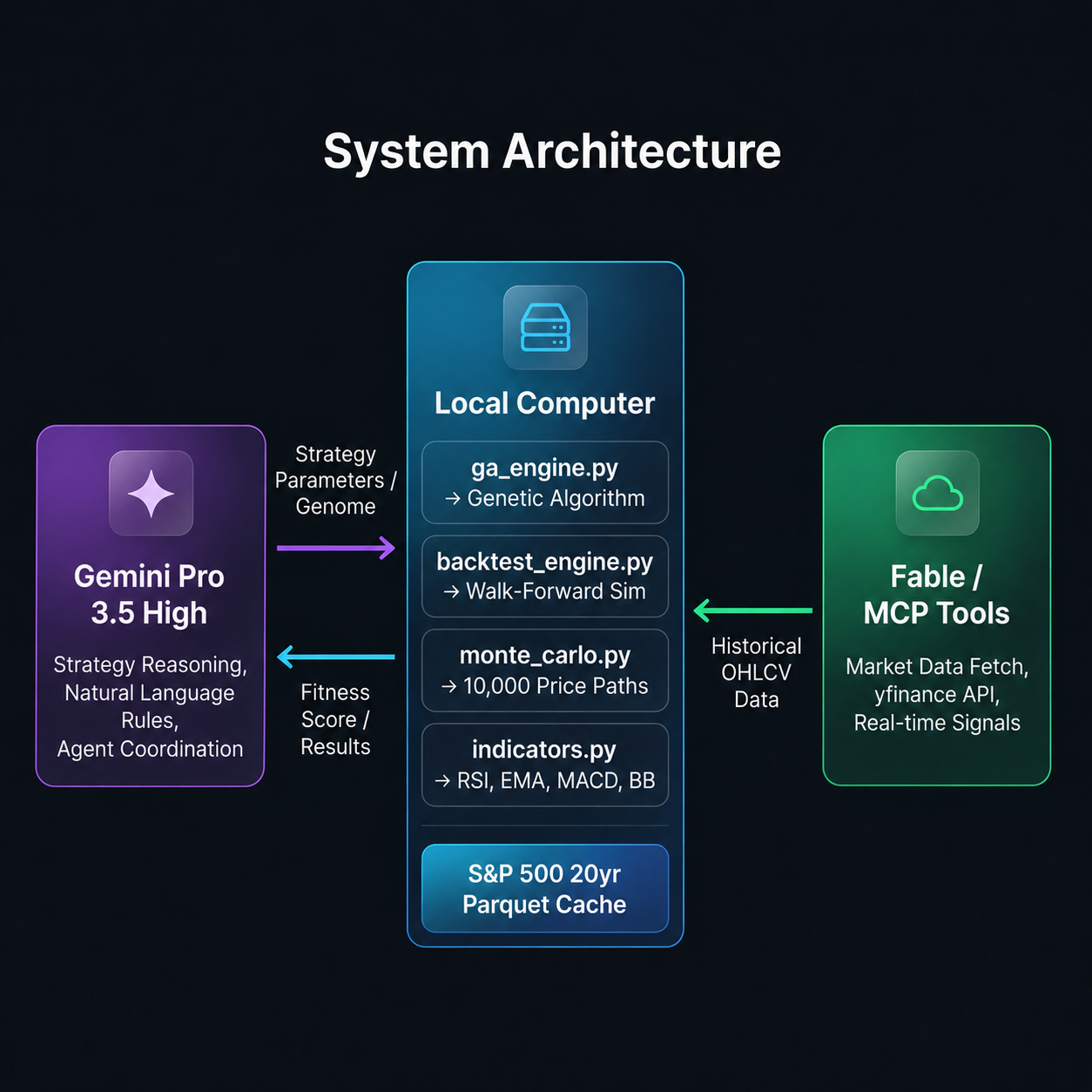
We developed a hybrid architecture using an "Orchestrator-Worker" pattern to maximize efficiency and reduce processing costs to zero.The Brain (Orchestrator): We utilized advanced long-horizon reasoning models (Claude Fable 5) via API to structure the system's mathematical rules and oversee risk control.The Workers (Micro-Agents): Ultra-fast, code-specialized models (Claude 3.5 Sonnet) within the Cursor IDE translate the orchestrator's logic into modular Python scripts.The Muscle (Local Processing): We deployed modeling libraries (Pandas, NumPy, Scikit-learn) and yfinance to extract historical data and subject the code to thousands of evolutionary iterations locally.The genetic algorithm evaluates each generation of trading strategies using the Sharpe Ratio as its primary fitness function, penalizing extreme volatility:$$Fitness = \frac{\mathbb{E}[R_p - R_f]}{\sqrt{\mathrm{Var}(R_p)}}$$
Challenges we ran into
The greatest technical hurdle was designing an asynchronous data pipeline that wouldn't crash API limits or exhaust our budget. We quickly discovered that forcing an AI to directly process massive statistical databases resulted in high latency and numerical hallucinations. Additionally, we had to prevent statistical overfitting. We solved this by separating linguistic reasoning from hard mathematical computation—configuring the orchestrator agent to act strictly as an independent external auditor that reviews the final local outputs to validate that the strategy hasn't merely memorized a past bull market.
Accomplishments that we're proud of
We successfully built a working pipeline that intelligently routes complex macro-architecture decisions to premium models while delegating repetitive coding tasks to highly optimized worker agents. We achieved a zero-cost local execution environment for the computational heavy lifting, proving that advanced quantitative modeling doesn't require a Wall Street server farm, just smart AI orchestration.
What we learned
We learned that Large Language Models (LLMs) are brilliant architects but highly inefficient calculators. Delegating the brute-force math to local Python environments while using AI strictly for high-level direction and dynamic code generation is the ultimate way to scale complex financial systems.
What's next for FRANQO
The immediate next step is building the web frontend to make this terminal-based process fully accessible to non-technical users. We plan to integrate real-time interactive charts, expand our data ingestion to include macroeconomic sentiment agents, and ultimately launch FRANQO as a platform that puts a personalized, quantitative hedge fund in everyone's pocket.
Built With
- anthropic
- antigravity
- claude
- gemini
- numpy
- pandas
- python
- scikit-learn
- yahooquery
- yfinance


Log in or sign up for Devpost to join the conversation.