-
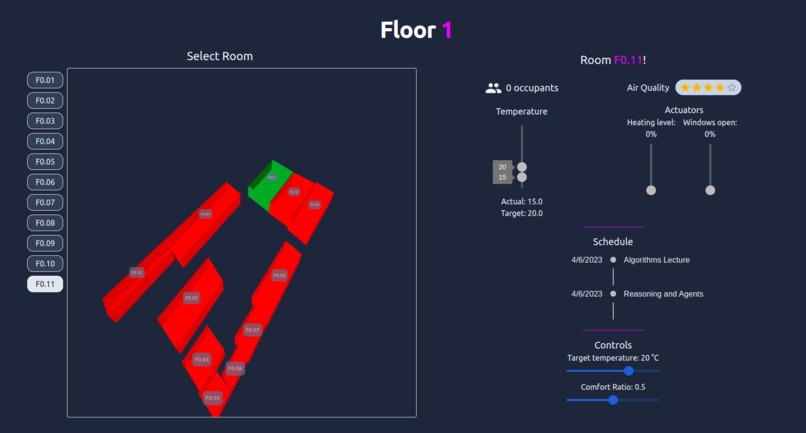
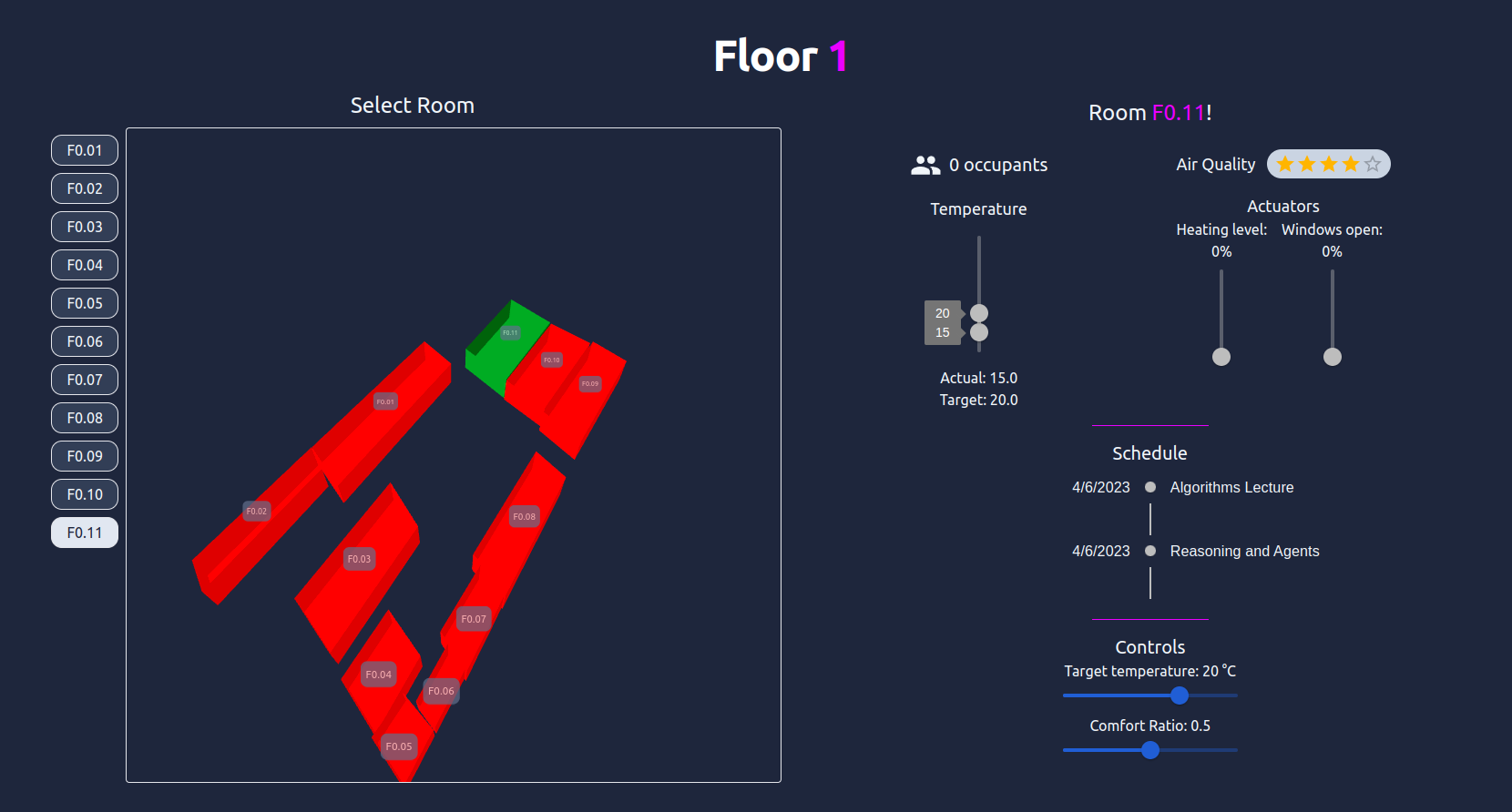
A screenshot of our system in action
Inspiration
We were inspired by the inefficient energy use in Appleton Tower caused by students leaving windows wide open and radiators fully open during cold winter days. Our mission was to automate the process of air conditioning rooms by determining what rooms need to be heated and optimizing for future rewards.
What it does
The project controls heating and ventilation in each room in the Informatics forum to achieve a user-selectable tradeoff between comfort and energy savings.
How we built it
Our project consists of 3 parts. A simulation of the informatics forum
- had to use a simulation since we didn't have the sensor infrastructure in place
- allows us to quickly test the performance of our system on larger time frames
User interface
- this system aggregates all the data from the informatics forum and displays it in a user-friendly fashion
- allows the user to control the system: select the offset between energy savings and comfort as well as per room temperature targets.
Control system
- the whole informatics forum is controlled by a per-room model predictive controller that assumes a steady state for the number of people in the room
- it optimizes the state of the system for the next 15h to achieve the desired offset between energy and comfort
Challenges we ran into
After a while of working on this project, we got second thoughts on whether this project was enough and whether it was something that we would be able to get into a state where we'd be proud to present it. We debated whether we should try to pivot to a different idea and try our luck there. In the end, we settled on staying with this project and even tho it was hard to persevere at the start when it seemed like there were so many more interesting things we could be working on we're glad we did because the scale and the number of things we managed to do with our systems is nothing to scoff at.
We opted for a 3D view of the informatics forum so that the user can move around different floors and have an easy view of the rooms with the most heating and best air quality. Creating this React component proved more difficult than we originally expected as we needed to transform latitude and longitude to Cartesian coordinates, determine the orientation of rooms, and trace them out with vectors.
Accomplishments that we're proud of
We've managed to build a working control system that manages to maintain temperature and air quality more efficiently than our estimates of the current system. We have a working front end for the system with clear visuals as well as a room suggestion system to minimize the number of rooms with a single person.
What we learned
As we went with a type-safe solution to prevent unexpected run-time problems, some of us had to learn more typescript and related tools like tRPC. With the wide range of tools necessary to bring such a project to fruition, there was always something new to learn, whether that be new database definition languages like Prisma or frameworks like nextJS. In addition to the technology aspect, we appreciated that it's worth putting in the effort to fix bugs so that we could see the final project up and running. From the initial development on our local machines to deploying our software on AWS we found that this weekend was fulfilling and a great learning experience.
What's next for SmartForum
We would love to see our system in action controlling the climate in the Informatics forum. Obviously, this is a big ask but we believe that the infrastructure necessary for this can be acquired relatively inexpensively. The data collected would not only allow us to test our system but also allow other students to endeavor similar projects.
We would also love to integrate our system with the Microsoft Teams calendar so that we can pre-condition rooms before we know people are going to enter them.
As with all systems, our system is not perfect at the moment. We've made a few design decisions that inadvertently made our system necessarily slow. The next step would be to take these slow parts of the system back to the drawing board and redesign them for better performance.


Log in or sign up for Devpost to join the conversation.