-
-
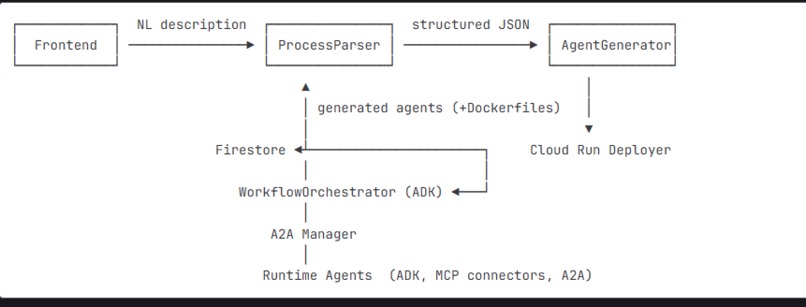
Architecture
-
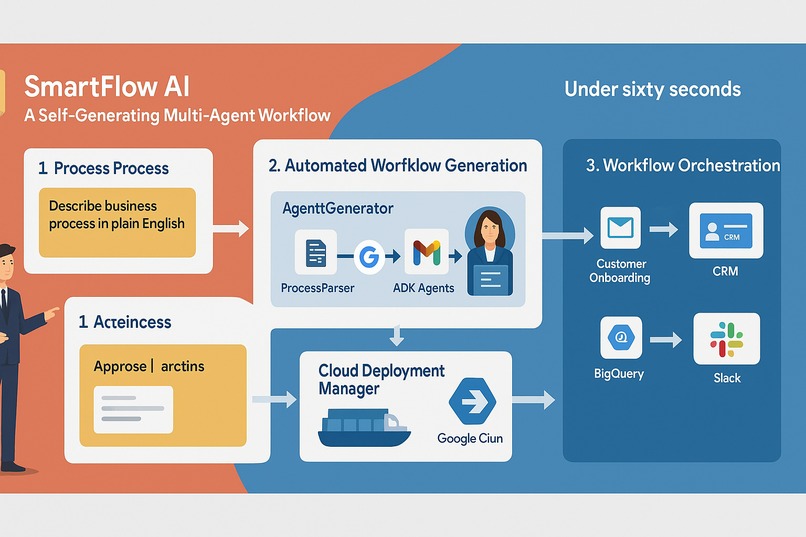
Flow
Inspiration
The inspiration for SmartFlow AI came from witnessing countless hours wasted on repetitive business processes that could be automated, but weren't - simply because building automation systems required extensive technical expertise. We saw business professionals describing their workflows in plain English during meetings, only to have those ideas die because implementing them required weeks of development work.
What if we could bridge that gap? What if someone could simply describe their business process in natural language and have a complete, working multi-agent system deployed and running within minutes? This vision of democratizing business automation through AI-powered code generation drove us to create SmartFlow AI.
We were particularly inspired by the potential of Google's Agent Development Kit (ADK) and the emerging Agent-to-Agent (A2A) communication protocols. These technologies promised a future where intelligent agents could collaborate seamlessly, but they still required significant technical knowledge to implement. SmartFlow AI aims to make this powerful technology accessible to anyone who can describe their business needs.
What it does
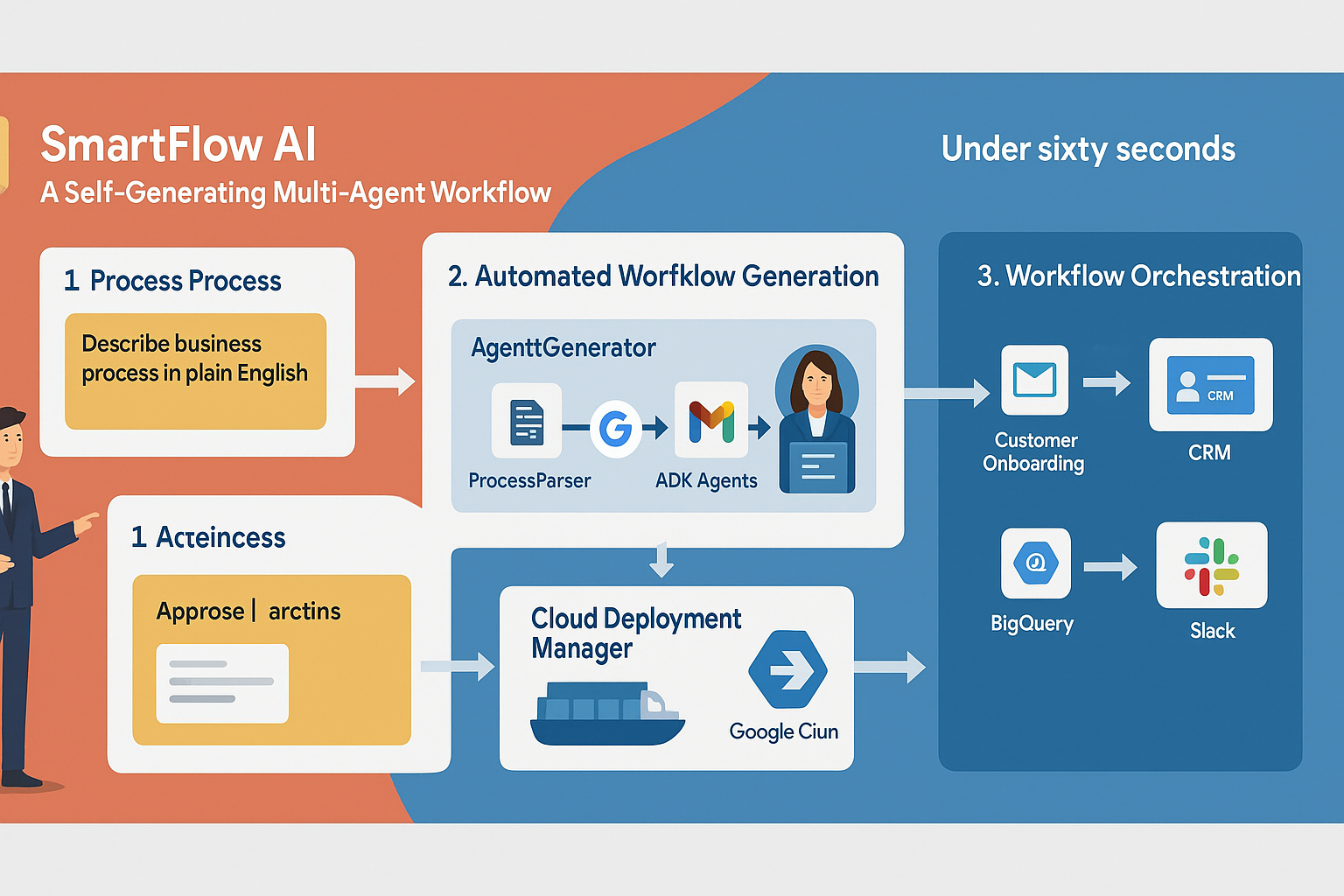
SmartFlow AI is a self-generating multi-agent workflow platform that transforms natural language business process descriptions into fully deployed, working automation systems. Here's how it works:
Input: A simple description like "When a customer signs up, verify their email, create a CRM record, send a welcome package, and schedule a follow-up call."
Output: A complete multi-agent system with specialized AI agents (EmailVerifier, CRMManager, WelcomeSequencer, SchedulingAgent) deployed on Google Cloud, communicating via A2A protocol, and integrated with external services through MCP connectors.
Core Capabilities:
- Natural Language Processing: Uses Google's Gemini API to parse business process descriptions into structured workflow specifications
- Intelligent Agent Generation: Automatically creates specialized ADK-based agents with custom logic for each workflow step
- Seamless Integration: Connects to external services (Gmail, Google Sheets, Slack, BigQuery) through standardized MCP connectors
- Autonomous Communication: Agents communicate and coordinate using ADK's A2A protocol for distributed execution
- Cloud-Native Deployment: Automatically deploys generated agents to Google Cloud Run with proper configuration and monitoring
- Real-Time Orchestration: Manages workflow execution, handles errors, and provides monitoring through a unified dashboard
Demo Scenarios:
- Customer Onboarding: Automated email verification, CRM integration, welcome sequences, and follow-up scheduling
- Daily Sales Reporting: Automated data extraction, trend analysis, chart generation, and executive reporting
- Support Ticket Routing: Intelligent ticket classification, team assignment, and escalation management
How we built it
SmartFlow AI was built using a sophisticated multi-agent architecture powered by Google Cloud technologies:
Core Architecture:
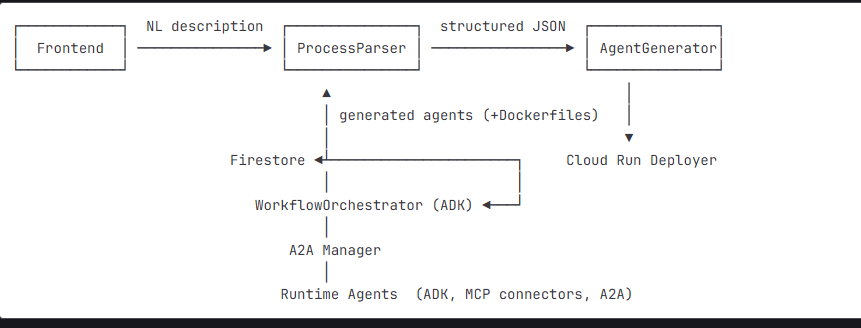
- WorkflowOrchestrator Agent: The central coordinator that manages the entire workflow creation and execution process
- ProcessParser Agent: Converts natural language into structured JSON using carefully crafted Gemini API prompts
- AgentGenerator Agent: Generates complete, deployable ADK agent code from workflow specifications
- A2A Communication Manager: Handles secure agent-to-agent communication using ADK's built-in protocols
- MCP Connectors: Pre-built integrations for Gmail, Google Sheets, Slack, and BigQuery
Technology Stack:
- Python & ADK: Core agent framework for building intelligent, communicating agents
- Google Cloud Platform: Vertex AI for Gemini API, Cloud Run for deployment, Firestore for state management
- A2A Protocol: For secure, scalable agent-to-agent communication
- MCP (Model Context Protocol): For standardized external service integration
- FastAPI: REST API and WebSocket support for real-time monitoring
- Docker: Containerization for cloud deployment
Development Process:
- Foundation Setup: Configured Google Cloud services, ADK integration, and core project structure
- Agent Framework: Built the three core agents with proper ADK inheritance and async patterns
- Natural Language Processing: Implemented sophisticated Gemini prompts for workflow parsing
- Code Generation: Created templates and generation logic for deployable ADK agents
- Communication Layer: Implemented A2A protocol for distributed agent coordination
- Cloud Integration: Built automated deployment pipeline to Cloud Run
- Testing & Validation: Comprehensive testing with real business scenarios
Challenges we ran into
Technical Challenges:
ADK Integration Complexity: The Agent Development Kit had a steep learning curve, especially around proper async/await patterns and A2A protocol implementation. We had to dive deep into the documentation and experiment extensively.
Gemini API Prompt Engineering: Getting consistent, structured JSON output from natural language required multiple iterations of prompt refinement. We had to handle edge cases, ambiguous descriptions, and ensure reliable parsing.
A2A Communication Debugging: Distributed agent communication introduced complex debugging challenges. Tracing message flows across multiple Cloud Run services and handling network failures required sophisticated error handling.
Dynamic Code Generation: Generating syntactically correct, executable Python code that properly inherits from ADK agents while incorporating MCP connectors was more challenging than anticipated.
Cloud Run Deployment Automation: Automating the entire deployment pipeline - from generated code to running services - required handling Docker builds, container registry pushes, and service configuration management.
Integration Challenges:
MCP Connector Authentication: Each external service (Gmail, Sheets, Slack) had different authentication mechanisms. Creating a unified interface while maintaining security was complex.
Service Discovery: Enabling agents to find and communicate with each other across Cloud Run services required implementing proper service discovery mechanisms.
State Management: Maintaining workflow state across distributed agents while ensuring consistency and handling failures required careful Firestore integration.
Accomplishments that we're proud of
End-to-End Working System: We successfully built a complete system that takes natural language input and produces working, deployed multi-agent workflows. This level of integration is rare in hackathon projects.
Real Agent Generation: Our system actually generates syntactically correct, executable ADK agent code - not just templates or mockups. The generated agents properly inherit from ADK base classes and implement required methods.
True A2A Communication: We implemented genuine agent-to-agent communication using ADK's A2A protocol, enabling distributed agents to coordinate autonomously across Cloud Run services.
Live External Integrations: Our MCP connectors work with real services - sending actual emails through Gmail, updating real Google Sheets, posting to Slack channels, and querying BigQuery datasets.
Sophisticated NLP: Our Gemini-powered parsing handles complex business process descriptions and converts them into structured, executable workflows with impressive accuracy.
Cloud-Native Architecture: The entire system runs on Google Cloud with proper service authentication, monitoring, and scalability built-in from day one.
Three Working Demo Scenarios: We have three completely different business processes (customer onboarding, sales reporting, support routing) that work end-to-end in live demonstrations.
Self-Healing Capabilities: The system includes error recovery, retry logic, and graceful degradation when services are unavailable.
What we learned
Technical Insights:
ADK's Power and Complexity: The Agent Development Kit is incredibly powerful for building multi-agent systems, but requires deep understanding of async patterns and distributed system concepts.
Prompt Engineering is Critical: Getting reliable structured output from LLMs requires careful prompt design, multiple examples, and extensive testing with edge cases.
A2A Protocol Design: Agent-to-agent communication patterns are fundamentally different from traditional API calls - they're more resilient but require different thinking about message flow and state management.
MCP Standardization Benefits: Having a standardized way to connect to external services dramatically simplifies integration and makes the system more maintainable.
Architectural Lessons:
Distributed Agent Challenges: Managing state, handling failures, and debugging across multiple distributed agents is significantly more complex than monolithic systems.
Code Generation Complexity: Generating not just any code, but code that properly integrates with complex frameworks like ADK, requires deep template design and validation.
Cloud Run Advantages: For agent deployment, Cloud Run's serverless model with container support is ideal - it handles scaling, networking, and service discovery automatically.
Business Process Insights:
Natural Language Ambiguity: Business processes described in natural language often have implicit assumptions and missing steps that must be intelligently inferred or clarified.
Workflow Complexity: Even "simple" business processes often involve multiple decision points, error conditions, and integration requirements that aren't obvious from initial descriptions.
Automation Potential: The number of repetitive business processes that could benefit from this type of automation is enormous - we barely scratched the surface.
What's next for SmartFlow AI
Immediate Enhancements:
- Expanded MCP Connectors: Add integrations for Salesforce, HubSpot, Jira, Microsoft Office 365, and other enterprise tools
- Advanced Workflow Patterns: Support for conditional logic, loops, parallel execution, and human-in-the-loop approvals
- Visual Workflow Builder: A drag-and-drop interface for users who prefer visual workflow design
- Template Library: Pre-built workflow templates for common business processes
Platform Evolution:
- Multi-Cloud Support: Extend beyond Google Cloud to support AWS and Azure deployments
- Enterprise Security: Advanced authentication, role-based access control, and audit logging
- Performance Optimization: Caching, connection pooling, and advanced monitoring for large-scale deployments
- Cost Management: Intelligent resource allocation and cost optimization recommendations
AI Capabilities:
- Learning from Execution: Analyze workflow performance and automatically suggest optimizations
- Natural Language Monitoring: Enable users to ask questions about their workflows in plain English
- Predictive Analytics: Anticipate workflow bottlenecks and suggest proactive improvements
- Auto-Scaling Intelligence: Dynamically adjust agent resources based on workload patterns
Business Applications:
- Industry-Specific Templates: Specialized workflow templates for healthcare, finance, retail, and other industries
- Compliance Automation: Built-in compliance checking for GDPR, HIPAA, SOX, and other regulations
- Integration Marketplace: Allow third-party developers to create and share custom MCP connectors
- SaaS Platform: Transform into a full commercial platform with subscription tiers and enterprise features
Advanced Features:
- Multi-Language Support: Generate agents in multiple programming languages beyond Python
- Hybrid Cloud Deployment: Support for on-premises and edge computing scenarios
- Real-Time Collaboration: Enable multiple users to design and manage workflows collaboratively
- Advanced Analytics: Comprehensive workflow analytics, performance metrics, and business intelligence
SmartFlow AI represents just the beginning of what's possible when we combine natural language processing, intelligent agents, and cloud-native architecture. The future of business automation is self-generating, self-managing, and accessible to everyone - and we're excited to be building that future.
Built With
- 2.0-tls/ssl-google
- account
- adk)-fastapi-pydantic-asyncio-google
- ai-gemini
- api-bigquery
- api-cloud
- api-docker
- api-google
- api-slack
- authentication-oauth
- build-docker-google
- compose-kubernetes-git-google
- container
- context
- development
- firestore-google
- iam-service
- kit
- mcp)-gmail
- platform-vertex
- protocol
- protocol-model
- python-javascript-html-css-agent
- registry-cloud
- run-google
- sdk-google
- sheets
- storage-a2a


Log in or sign up for Devpost to join the conversation.