-
-
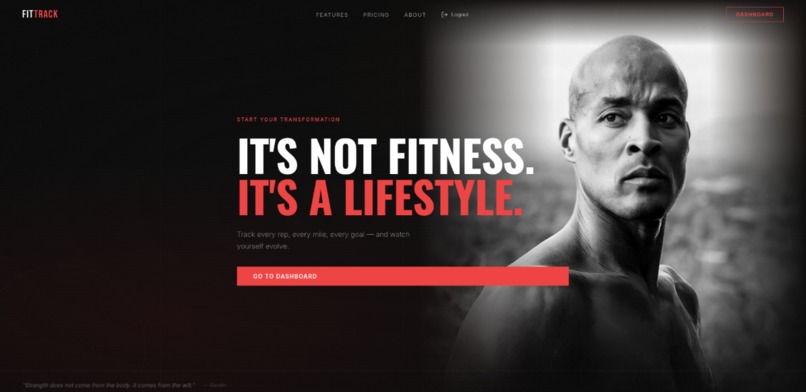
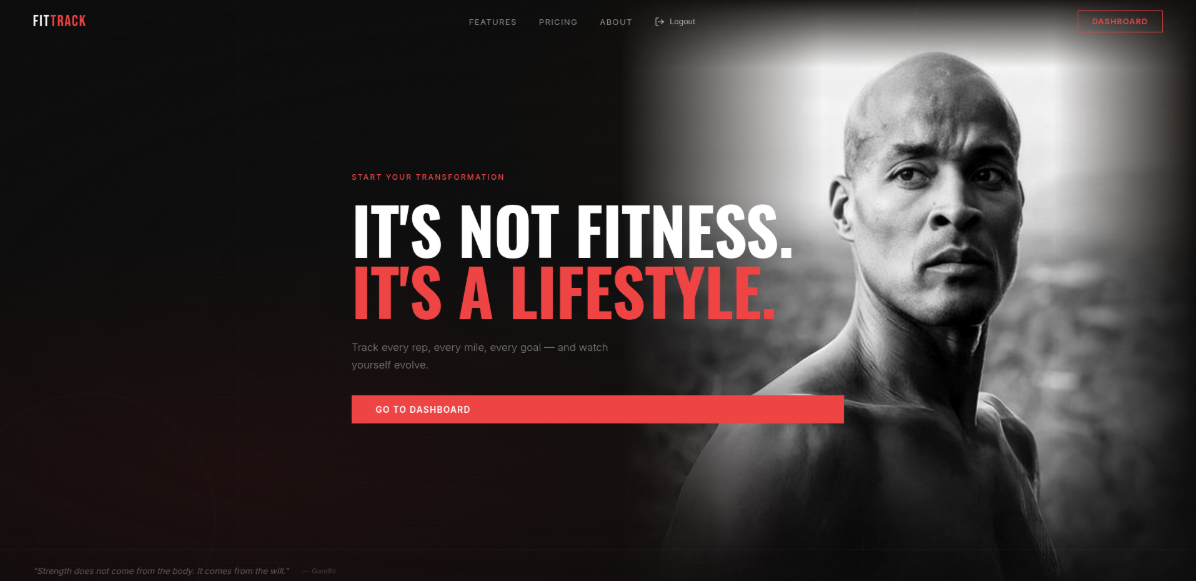
Landing Page
-
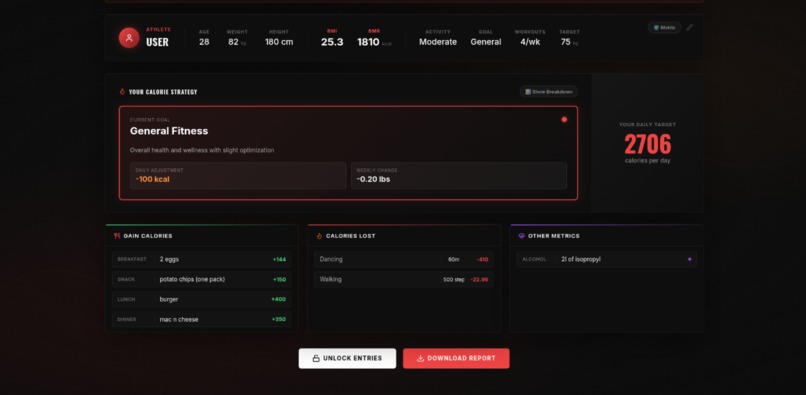
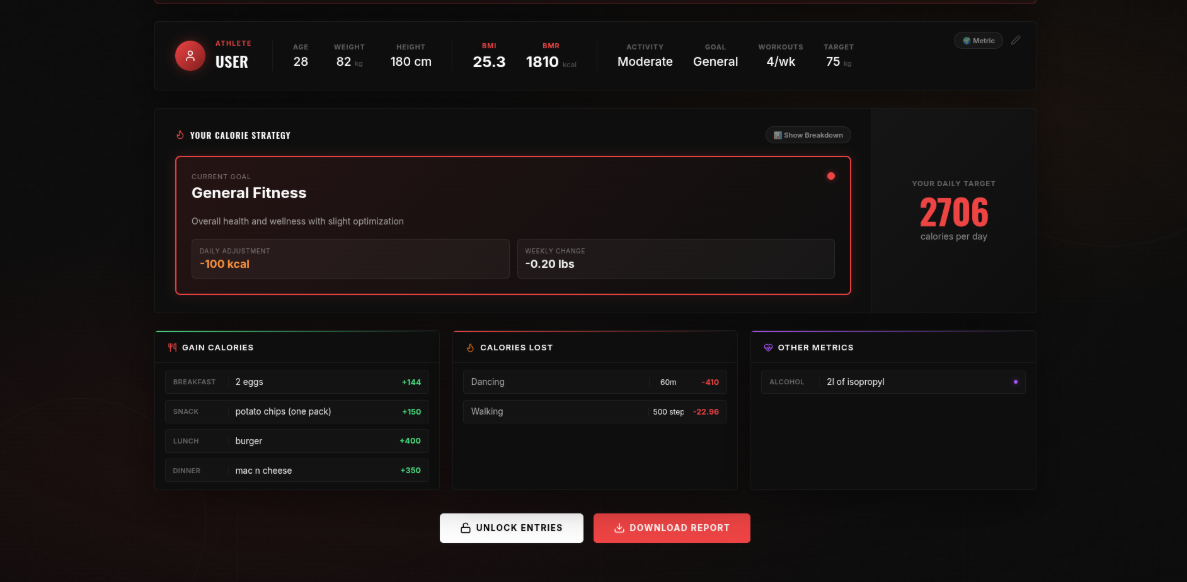
Fitness Dashboard
-
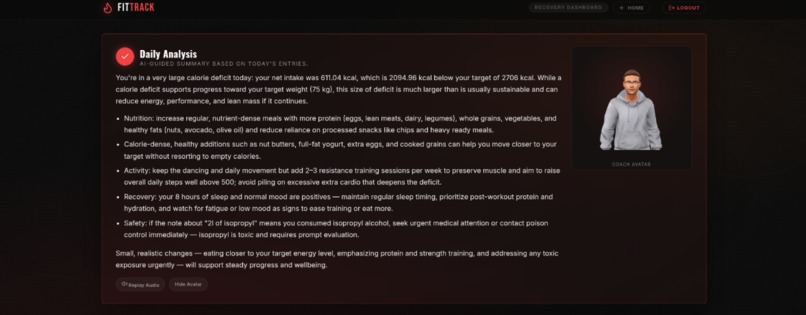
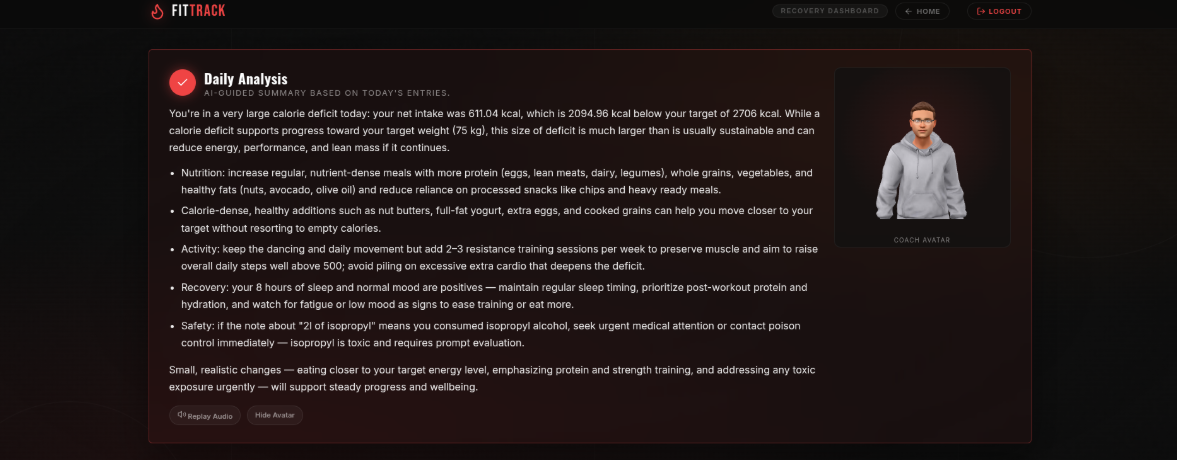
Natural language output with virtual avatar and text-to-speech.
-
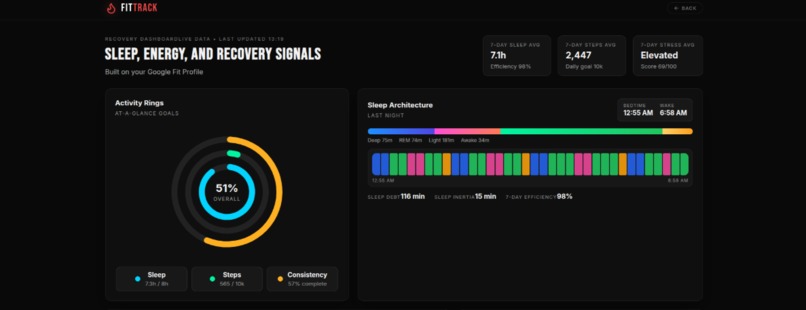
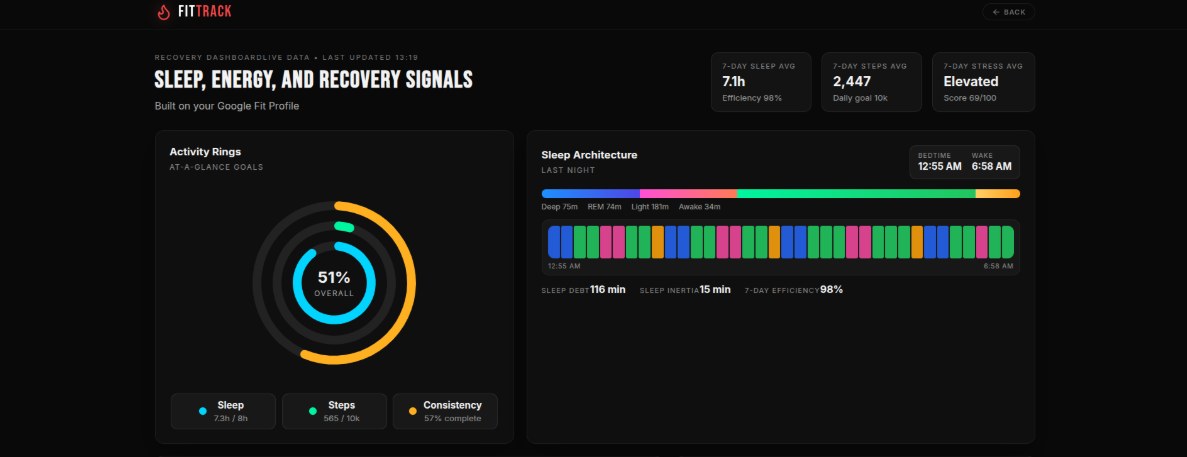
Activity Rings and Sleep Architecture
-
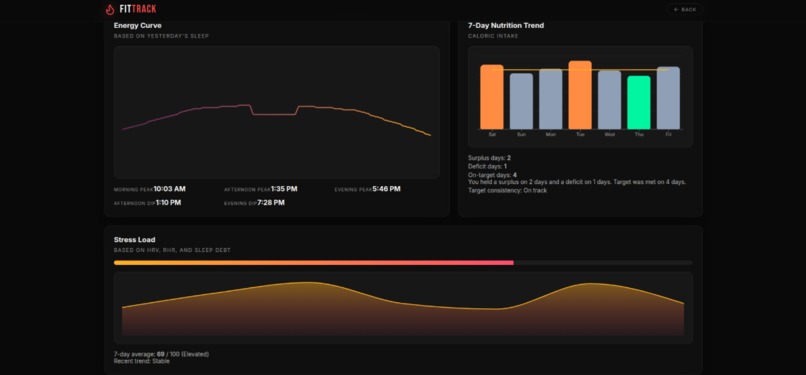
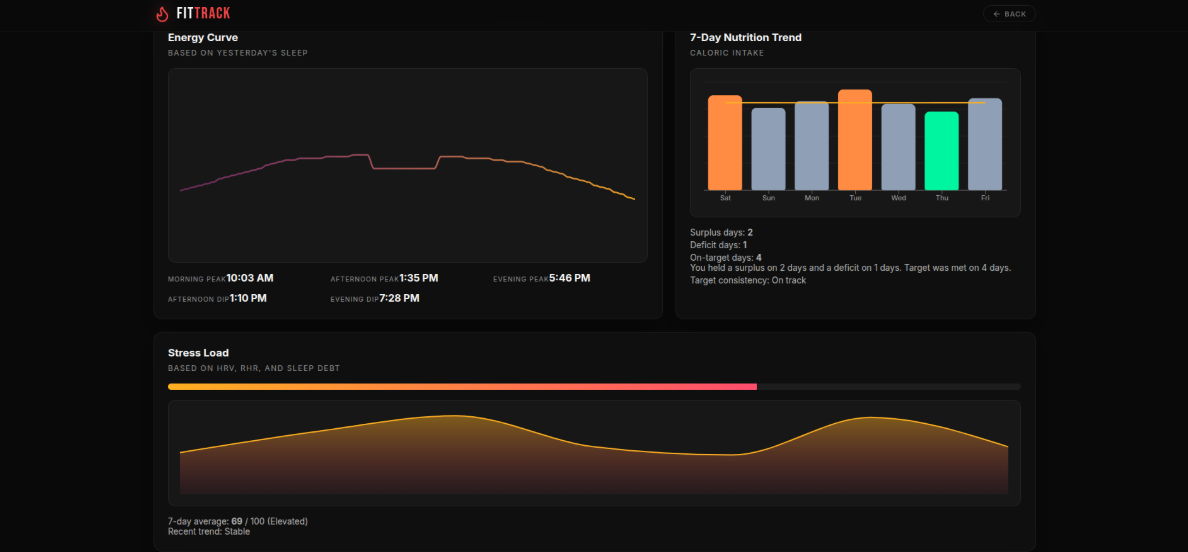
Energy Graph, Nutrition Track and Stress Levels
-
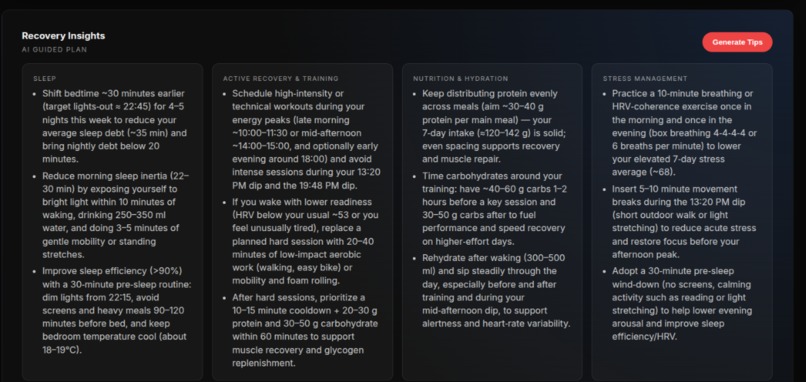
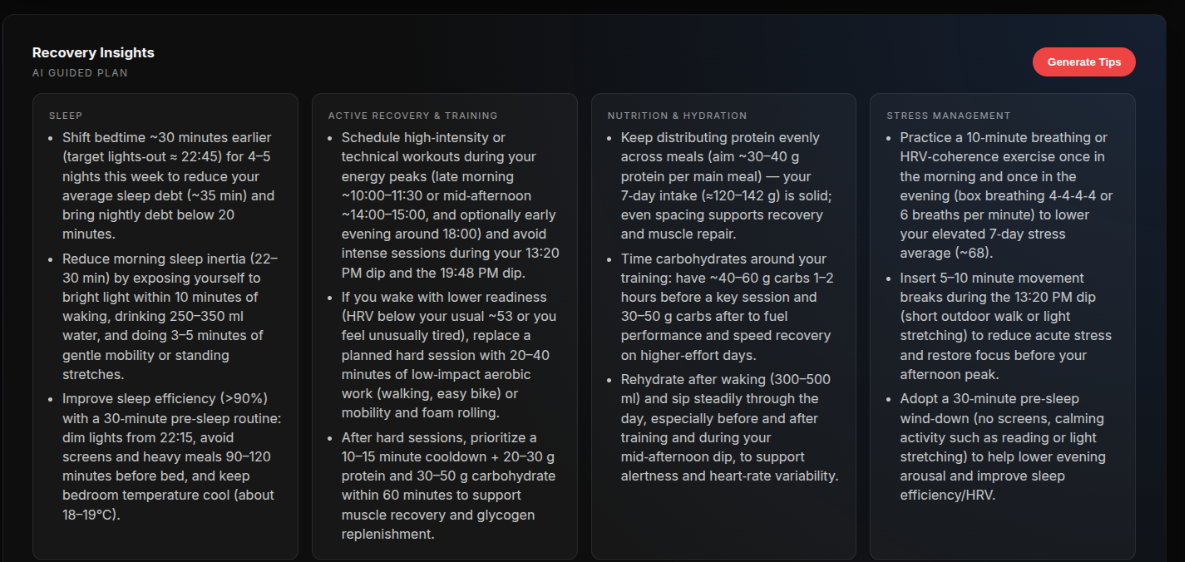
AI Guided recovery tips and optimization advice.
The FitTrack Story: From Bio-Signals to Daily Action
The Inspiration: Solving “Data Fatigue” We are the most tracked generation in history, yet we are also the most confused. The core problem is Data Fatigue: existing apps collect massive amounts of numbers but leave the heavy burden of interpretation entirely on the user. We built FitTrack to solve this “last mile” problem.
Our motivation was to create a bridge between raw biological signals—like HRV, sleep architecture, and stress loads—and actual human behavior. We wanted to move away from static charts and toward a Daily Decision System that tells you what to do now.
How We Built It: The Deterministic–Generative Hybrid
FitTrack is built on a modern, decoupled architecture designed for speed and intelligence:
Frontend: React, TypeScript, Vite, styled with Tailwind CSS, hosted on Vercel.
Backend: FastAPI (Python) hosted on Render Intelligence Layer: a structured pipeline using the OpenAI API to convert raw data into grounded coaching
The Logic Pipeline The novelty of our project is the Deterministic–Generative Hybrid. We don’t just “ask an AI” for generic advice; we compute hard metrics first to ensure the coaching is grounded.
Data Ingestion: We pull real-time health signals (sleep stages, resting heart rate, HRV) via Google
Health integrations. Deterministic Calculation: We compute hard metrics locally on the backend. For example, we calculate Sleep Debt to estimate recovery needs.
LLM Synthesis: These “hard facts” are passed into openai_service.py to generate categorized, narrative coaching tips.
Challenges We Faced Building a cross-platform health assistant that bridges multiple cloud services presented significant hurdles:
The Deployment Bridge: Connecting a Vercel frontend to a Render backend required precise CORS configuration for secure cross-domain communication. Cold Starts & Latency: Render’s free tier can “spin down” after inactivity, so we designed the frontend to handle potential wake-up delays gracefully. Output Reliability: Ensuring the LLM returns consistent, structured advice (instead of hallucinations) was hard. We addressed this with Pydantic schemas in schemas.py so the AI outputs strict JSON that the UI can reliably render.
What We Learned We learned that Natural Language is the New UI. By replacing rigid database search bars with semantic intake—where a user can simply type “burrito bowl and a 3-mile walk”—we reduced logging friction dramatically.
We also learned that transparency builds trust. By showing the Energy Curve (a visual representation of daily energy windows), we aren’t just giving orders—we’re teaching users how to interpret their own signals.
Why FitTrack Wins Existing solutions are either too simple (basic trackers) or too complex (data autopsies). FitTrack wins because it turns the noise of biometrics into the clarity of a conversation
Built With
- fastapi
- firebase
- google-health-api
- javascript
- node.js
- openai-api
- python
- react
- render
- three.js
- typescript
- versel


Log in or sign up for Devpost to join the conversation.