-
-
SmarterDoc AI
-
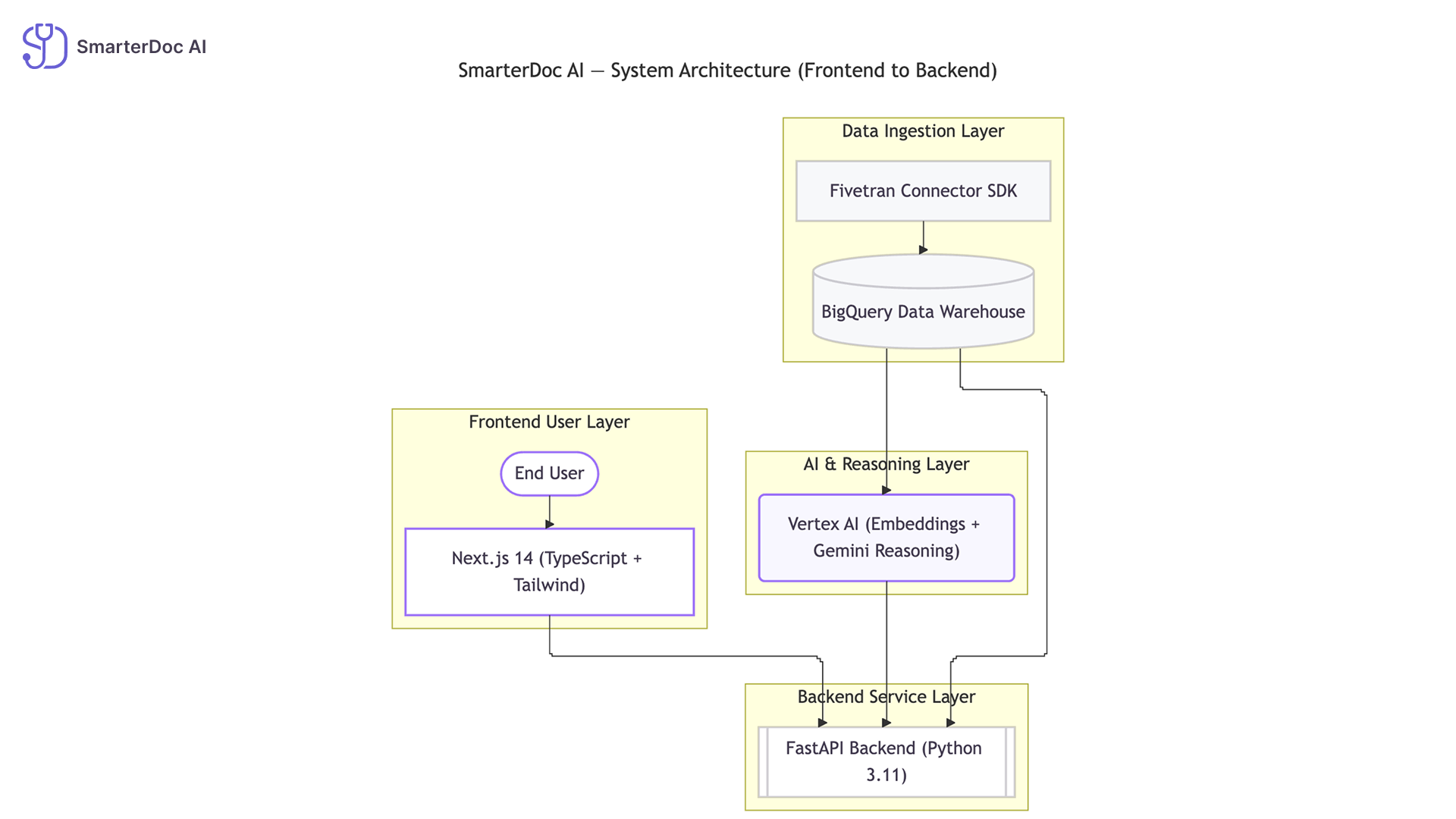
Frontend Flow
-
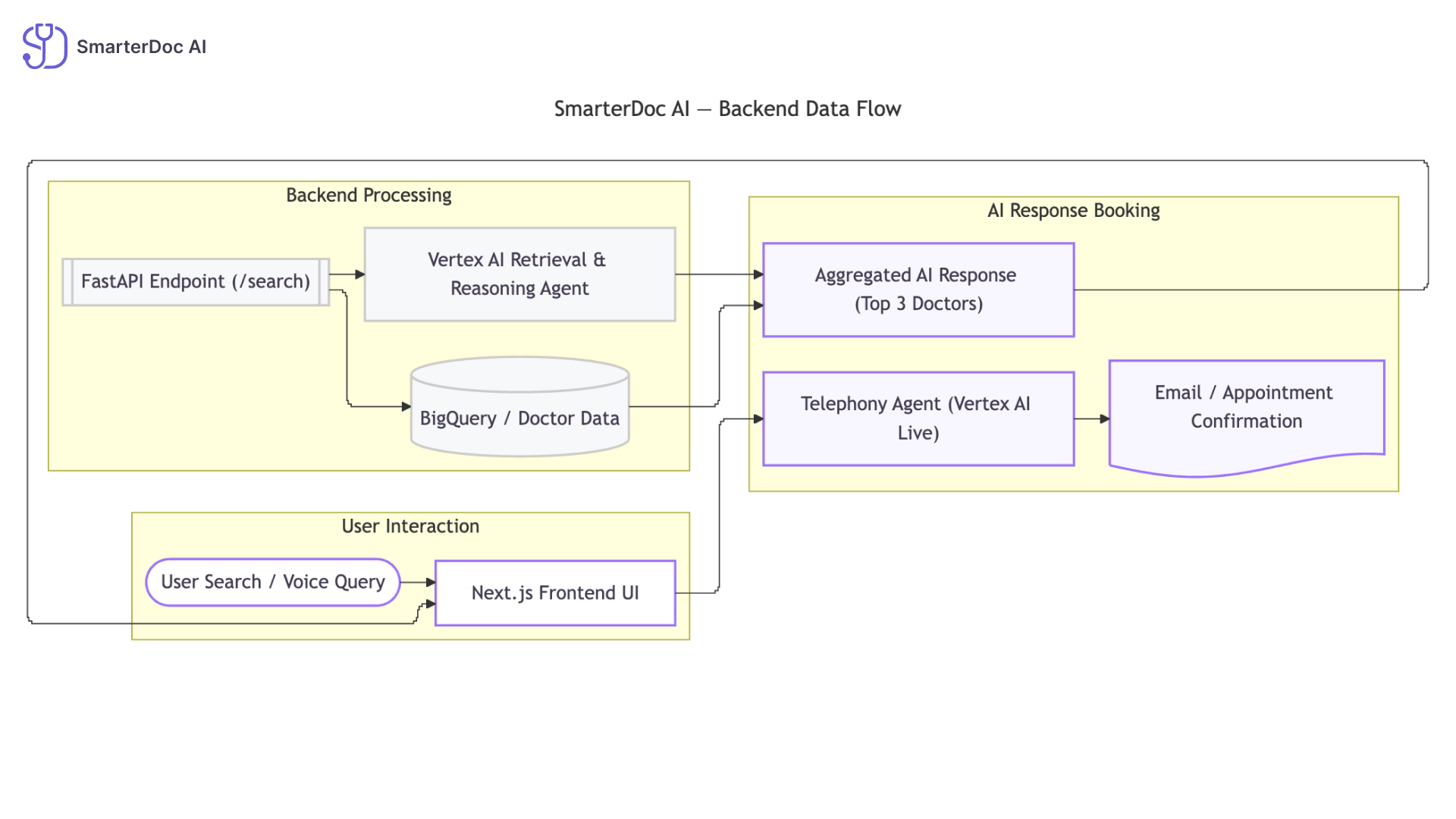
Backend Flow
Project Story
Inspiration
Healthcare data today is fragmented and overwhelmingly complex. Patients lack a unified way to find a compatible doctor that checks off all their specific requirements. We still have to google for a doctor’s patient testimonials and track record. SmarterDoc AI was inspired by a simple idea: finding the right doctor should be seamless, not manual.
Our goal was to combine grounded searched data with AI-driven personalization and auto-appointments to make healthcare navigation easier and more efficient.
What It Does
SmarterDoc AI is an intelligent healthcare search and recommendation platform that connects patients and physicians through our multi-agent flow. The platform allows users to:
- Search for doctors by specialty, insurance, and location.
- View verified doctor profiles from the NPI Registry and PubMed.
- Visualize nearby providers on an interactive Google Map.
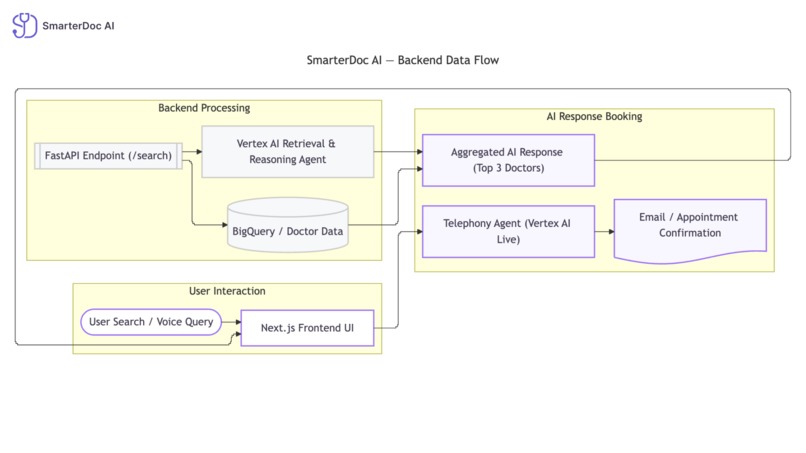
- Receive AI-generated recommendations that base decisions on provider profile and query similarity with dynamic weighted ranking.
- Make automated phone-call appointments through our telephony agent.
Our application is built on data powered by Fivetran and the GCP ecosystem.
How We Built It
| Layer | Description | Technologies |
|---|---|---|
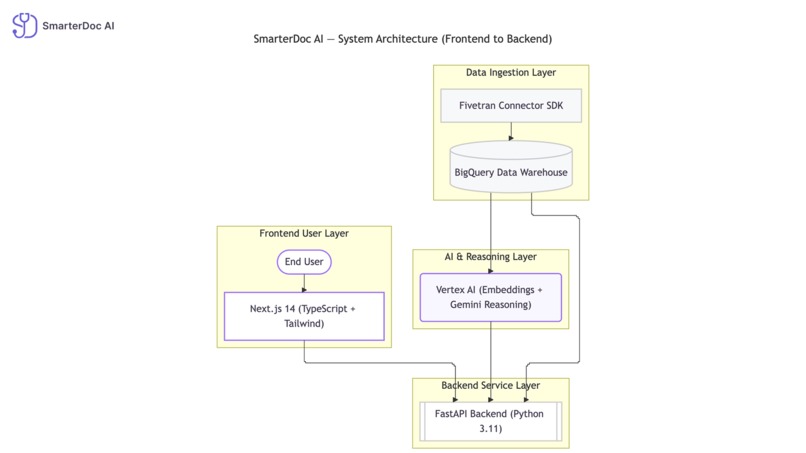
| Frontend | Web interface for search, filtering, and booking | Next.js 14, Tailwind CSS, TypeScript |
| Backend | API layer for ranking, retrieval, and data analysis | FastAPI (Python 3.11+), Docker |
| Infrastructure | Deployment and CI/CD | Google Cloud Run, GitHub Actions |
| Data & AI | Data pipelines, analytics, and AI recommendations | Fivetran, BigQuery, Vertex AI, Cloud Storage |
Data Integration
- Built three custom connectors using the Fivetran Connector SDK to extract provider data and enrichment with Gemini grounded search.
- Loaded the data into BigQuery and deployd vector embeddings to Vector Search Endpoint, processed with Vertex AI.
- Enabled scheduled flow and checkpoints to update new provider's information.
Search and AI Layer
- Vertex AI embeddings for vector similarity search on provider profile and user query in the first filter layer.
- Agent-assigned dynamic contextual weights to provider features based on user's query in the ranking calculation; the feature scores are then used along with provider composite profiles for the agent to make the final selection.
Cloud Infrastructure
- Deployed both frontend and backend on Google Cloud Run using Docker containers.
- Managed continuous deployment with GitHub Actions.
- Used GCP Secret Manager for configuration security and scalability.
Challenges We Faced
- Merging data from multiple public sources with inconsistent schema and building the Fivetran connectors with sophisticated data processing pipelines.
- Balancing AI explainability and performance in doctor ranking models and optimizing deterministic output for similar queries.
- Reducing RAG agent search latency on provider selection.
- Optimizing container startup times for Cloud Run cold starts.
What We Learned
- Building a data-driven AI application requires equal attention to infrastructure, data quality, and user trust.
- Transparent recommendations are essential; AI should be explainable and the results should be backed.
- Fivetran pipelines can significantly reduce ETL complexity and work seamlessly with GCP ecosystem like Google BigQuery and Vertex AI.
- Fivetran has an agent script where you can post on Gemini Gem and provide it a knowledge base to quickly spin up a prototype connector using the Fivetran SDK (workability not guaranteed).
- Vertex AI provides powerful and scalable hybrid vector search capabilities.
What’s Next
- Integrate Gemini API for conversational healthcare recommendations.
- Expand regional data sources for better coverage and cost prediction.
- Launch a public dashboard for real-time healthcare analytics (using Fivetran to read in user appointment data).
- Collaborate with research partners to evaluate model fairness and bias reduction.
Built With
- ai-agents
- bigquery
- docker
- fastapi
- fivetran
- gcp
- gemini
- github
- googlemapapi
- llm
- multi-agents
- next.js
- npiregistryapi
- pubmedapi
- rag
- tailwind
- typescript
- vertexai


Log in or sign up for Devpost to join the conversation.