-
-
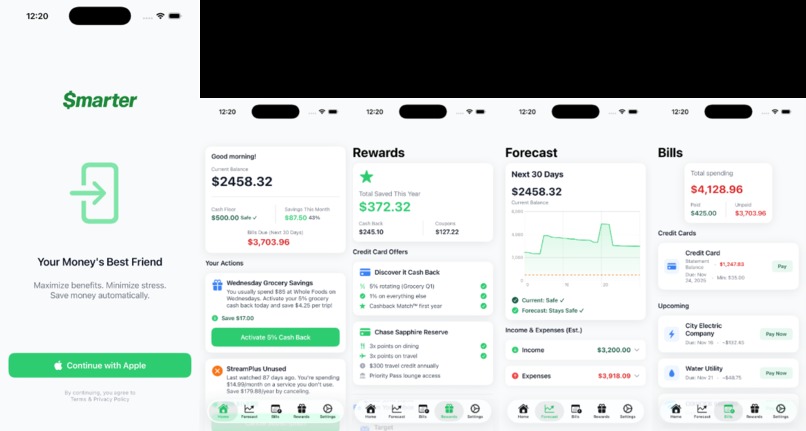
Major tabs
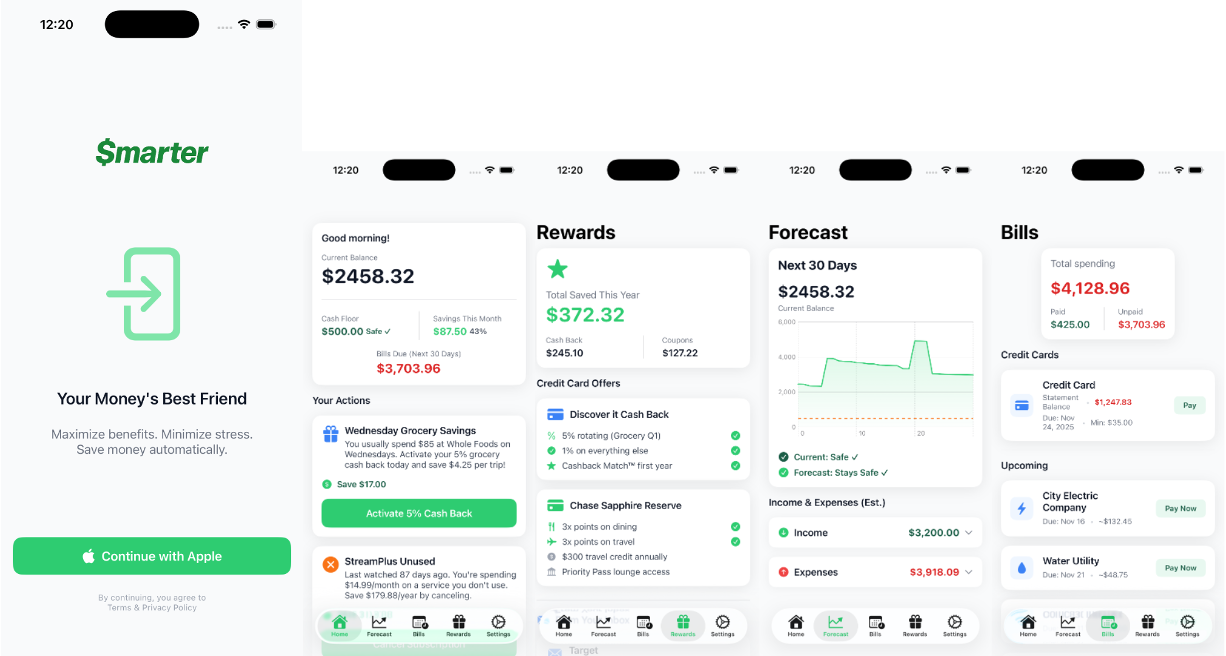
Inspiration
Most people own multiple credit cards, bank accounts, loyalty programs, and subscriptions, yet leave money on the table. Rewards expire, cell-phone protection is forgotten, travel credits go unused, and overlapping memberships quietly drain cash. We wanted a single tool that understands your financial life, watches your cash flow, and surfaces the right perk or warning at the moment you need it. That became $marter (Smarter).
What it does
$marter is an DATA powered benefits wallet that connects your cards, accounts, and memberships into one unified view. It automatically:
- Maps each account to its perks and protections
- Monitors upcoming bills, paychecks, and card due dates
- Predicts short term cash flow and flags risk of missing payments
- Suggests which card or benefit to use in a given situation, and highlights limited time offers
In $marter, we provide greater transparency and control.
How we built it
- Data layer: Unified schema for accounts, cards, benefits, and transactions, using synthetic or public datasets to simulate real user histories
- AI engine:
- LLM based parsers to turn messy perk descriptions and offer terms into structured attributes
- Rules plus ML layer for repayment planning, cash flow risk detection, and benefit matching
- LLM based parsers to turn messy perk descriptions and offer terms into structured attributes
- Client app: iOS prototype showing a consolidated cash timeline, benefit recommendations, and repayment suggestions, with a chat style assistant on top
- APIs: Backend services exposing endpoints for account aggregation, perk retrieval, risk scoring, and LLM powered explanations
Challenges we ran into
- Designing a flexible data model for very different benefit types, from airline lounge access to extended warranty
- Making AI explanations trustworthy and concise so users understand why Smarter recommends an action
- Simulating realistic cash flow and offer data for a hackathon, while keeping the architecture ready for real bank and card APIs
Accomplishments that we are proud of
- Going from problem statement to a working iOS prototype that shows financial life, predicted cash flow, and personalized perk tips in one place
- Building an AI layer that not only answers questions but also proactively pushes alerts like “you can safely delay this payment” or “use Card X here for 5 percent back”
- Creating a modular architecture that can plug into live financial data sources with minimal changes after the hackathon
What we learned
- People do not want another finance dashboard, they want clear next best actions that respect their risk tolerance and mental load
- Hyper personalization depends on UX as much as on models, automation must feel like support rather than loss of control
- Even synthetic data needs realistic edge cases, such as irregular income, lumpy expenses, overlapping subscriptions, and surprise fees
What is next for Smarter
- Hardening privacy, consent, and security so Smarter can be deployed as a consumer app or embedded bank product
- Integrating with real account aggregation APIs for live transactions and balances
- Expanding the perks knowledge graph to cover travel, healthcare, employer benefits, and local memberships
- Adding goal based planning, for example, maintain at least X dollars cash buffer and grow savings by Y per month, with AI generated scenario recommendations

Log in or sign up for Devpost to join the conversation.