-
-
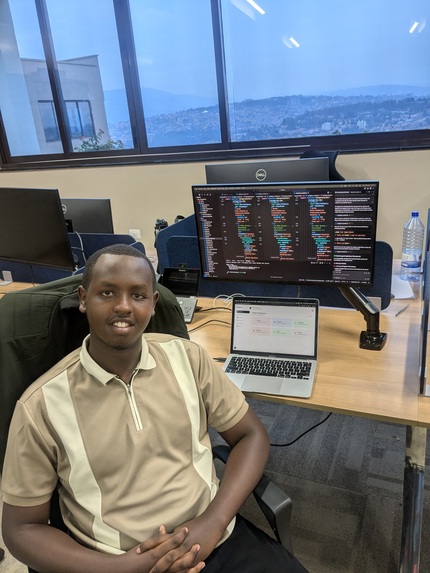
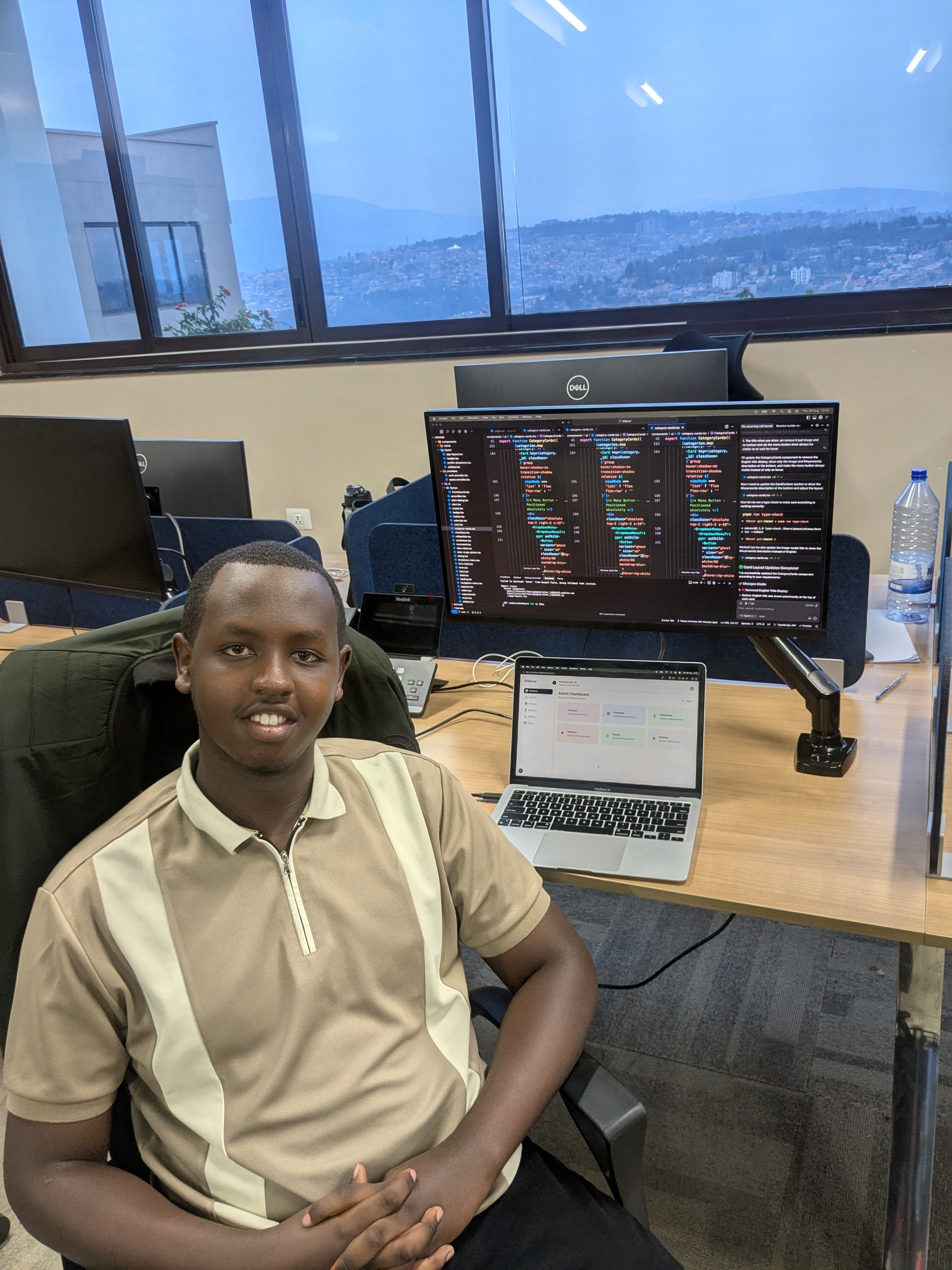
Me developing the project "SMARTEN"
SMARTEN: Every Drop of Water Counts
Inspiration
SMARTEN was born from a real experience, not just an idea.
During the March–April 2026 holiday (Spring break), I experienced a severe water shortage in my village. For almost three weeks, water was barely available for 30 minutes a day. Families were forced to walk approximately 5 km to a nearby spring to collect water. The source was not properly safe, clean, or sanitized, and some people in the community became sick.
After three weeks, technicians from WASAC, Rwanda's official water utility, came to investigate. What they discovered was surprising: the problem was not a lack of water. A major underground leak in the main pipe supplying the area was causing water to disappear before it reached the community.
This raised a critical question for me:
If an underground leak can deprive an entire community of water for weeks before being discovered, why can't we detect and locate it automatically?
I realized that the consequences of undetected leaks extend far beyond wasted water. They can mean wasted energy used to pump and treat water, lost revenue for utilities, wasted time and money for communities, unsafe alternative water sources, and reduced public trust.
That experience became the foundation of SMARTEN.
Our vision is simple: make every drop visible, controllable, and accountable.
What it does
SMARTEN is an IoT-powered smart water management system designed to help water utilities detect, locate, monitor, and respond to water losses while also giving consumers greater visibility and control over their water usage.
For water distribution companies such as WASAC, SMARTEN provides:
- Real-time water-flow monitoring
- Leakage detection and section identification
- Leak localization, with the proposed system incorporating acoustic Time Difference of Arrival (TDoA) technology for more precise positioning
- Real-time alerts when abnormal water loss is detected
- Remote control of water distribution using smart valves
- Analytics to support maintenance, planning, and decision-making
For individual consumers, SMARTEN provides:
- Real-time visibility of personal water consumption
- Usage statistics and consumption patterns
- The ability to remotely turn their water supply on or off through a mobile application
- Greater awareness of consumption, helping users reduce unnecessary water usage and potentially lower their bills
The central principle behind SMARTEN is that water loss should not have to remain invisible until it becomes a crisis.
How we built it
We started by building a physical prototype that represents a simplified water-distribution network.
The prototype contains a water source, smart valves, water-flow sensors, pipes, a simulated leakage point, and a household/customer section. Flow sensors measure water movement at different points in the network. By comparing readings, the system can demonstrate how a discrepancy can indicate water being lost between monitoring points.
The prototype also demonstrates remote control. A smart valve can be controlled electronically to simulate a utility shutting off water to a particular section, while another valve represents the consumer's ability to control their household supply.
On the embedded side, we experimented with microcontrollers such as the ESP8266/NodeMCU and ESP32, water-flow sensors, solenoid valves, relay modules, pumps, and LoRa communication modules.
For the software and data side, our broader SMARTEN architecture uses IoT communication, backend services, databases for monitoring data, dashboards, and a mobile application. Technologies explored across the project include MQTT, React, Flutter, InfluxDB/TimescaleDB, Arduino/ESP32, and low-power IoT connectivity.
However, building the prototype taught us that a system designed for a demonstration is very different from one designed for real underground water infrastructure.
Our technical research therefore led us toward a more scalable architecture based on NB-IoT and LoRaWAN, particularly using NB-IoT for major distribution lines. NB-IoT can take advantage of existing cellular infrastructure, provide better coverage for underground/deep-indoor environments, and support nationwide deployment where cellular service is available.
We also designed an intelligent power-management approach:
Instead of continuously transmitting data and rapidly draining batteries, sensors can wake when flow is detected or according to a schedule, transmit only the necessary information, and return to a low-power state.
Challenges we ran into
One of our biggest challenges was communication reliability.
Our initial ESP8266/Wi-Fi approach worked for a prototype, but underground water infrastructure presents very different conditions. Soil and pipe materials can significantly reduce signal penetration, and remote pipeline locations may not have Wi-Fi access.
We also tested LoRa peer-to-peer communication and found that the approximately 130 m range achieved in our testing was not sufficient for long-distance water pipelines.
To address this, we implemented a hybrid communication architecture, using low-power communication between field sensors and strategically placed gateway devices, which then transmit data over longer-range networks such as cellular or internet-based connections. This makes the system more suitable for widely distributed water infrastructure.
Another major challenge was power consumption. Underground sensors may be difficult or expensive to access once deployed. Keeping them constantly active would drain batteries quickly and make the system impractical to maintain.
We addressed this by implementing intelligent sleep/wake cycles. Sensors remain in low-power sleep mode and activate only at scheduled intervals or when abnormal flow or pressure is detected. This significantly reduces energy consumption while still allowing the system to detect leaks quickly.
We also faced cost and deployment challenges. A system that works in a laboratory or school prototype must eventually be affordable, durable, weatherproof, maintainable, and scalable across an entire water-distribution network.
To solve this, we designed SMARTEN using modular and locally available components, allowing individual sensors or valves to be replaced without replacing the entire system. We also designed the system so that it can be deployed gradually, starting with critical sections of a water network and expanding as needed.
At the prototype level, we also had material limitations. We initially received fewer sensors, valves, microcontrollers, pipes, and other components than the complete prototype required.
We overcame this by adapting the prototype design, sourcing additional materials ourselves, and prioritizing the most important functions, allowing us to demonstrate the complete concept despite the limited resources.
These challenges ultimately strengthened the project because they forced us to think beyond simply making something work and instead ask:
Can this actually work in the real world?
And more importantly, they pushed us to develop solutions that make SMARTEN more reliable, energy-efficient, affordable, and scalable for real-world water networks.
Accomplishments that we're proud of
We are proud that SMARTEN evolved from a real community problem into a functioning physical prototype and a broader technical solution for smart water management.
We successfully demonstrated the core concept of monitoring water flow, simulating leakage, and remotely controlling water through smart valves.
We are also proud of the fact that our solution addresses the problem from both sides of the water system: the utility and the consumer. Rather than focusing only on detecting leaks, SMARTEN connects monitoring, detection, control, analytics, and consumer awareness into one ecosystem.
Our work also pushed us to investigate the realities of large-scale deployment, including connectivity, power management, cost, scalability, and maintenance. Our technical design projects a potential battery lifetime of 5+ years through intelligent power management and an estimated five-year total ownership cost of approximately $200 per device, although these figures remain projections for the proposed deployment architecture rather than measurements from a nationwide deployment.
Most importantly, we are proud that SMARTEN is rooted in a problem we have personally witnessed. We are not trying to solve an imaginary problem. We have seen what an undetected underground leak can do to a community.
What we learned
The biggest lesson we learned is that solving a real problem requires more than building technology that works.
We learned to start with the problem and work backward toward the technology.
We also learned that the environment in which a system operates matters enormously. A Wi-Fi connection that works perfectly in a classroom may be completely unsuitable underground. A battery that powers a prototype for a demonstration may not be appropriate for a sensor expected to operate for years without physical access.
SMARTEN taught us about:
- IoT and embedded systems
- Sensor-based monitoring
- Remote actuation and smart valves
- MQTT and connected systems
- Low-power communication
- NB-IoT and LoRaWAN
- Data analytics and time-series data
- Mobile and web interfaces
- System architecture
- Business models and cost analysis
- Designing technology around real-world constraints
Most importantly, we learned that innovation is not just about inventing something new. It is about finding a better way to solve a problem that genuinely matters to people.
What's next for SMARTEN
The next step for SMARTEN is to move from a prototype into real-world pilot deployment.
Our goal is to place smart monitoring stations at strategic points within water-distribution networks and use real operational data to identify abnormal flow patterns and potential leakages.
The proposed system can then combine flow discrepancies, sensor data, connectivity, and eventually acoustic localization to help utilities move from simply knowing that water is being lost to understanding where the loss is happening and responding quickly.
We envision a system where utility operators can see their network through a centralized dashboard, receive real-time alerts, analyze historical data, and remotely isolate affected sections using smart valves.
At the consumer level, we want to continue developing the mobile experience so households can monitor their consumption, understand their usage patterns, and control their water supply remotely.
In the long term, our ambition is to scale SMARTEN beyond a prototype and contribute to a smarter and more sustainable water-distribution infrastructure across Rwanda and, eventually, other regions facing similar challenges.
Because for us, SMARTEN is not simply about detecting leaks.
It is about preventing a hidden problem in the ground from becoming a crisis above it.
Every Drop of Water Counts.
Built With
- arduino
- css3
- django
- html5
- mqtt
- mqtt/websocket-based
- postgresql
- python
- react-js
- rest-apis
- rfid-module
- sensors
- smart-valves
- typescript

Log in or sign up for Devpost to join the conversation.