-
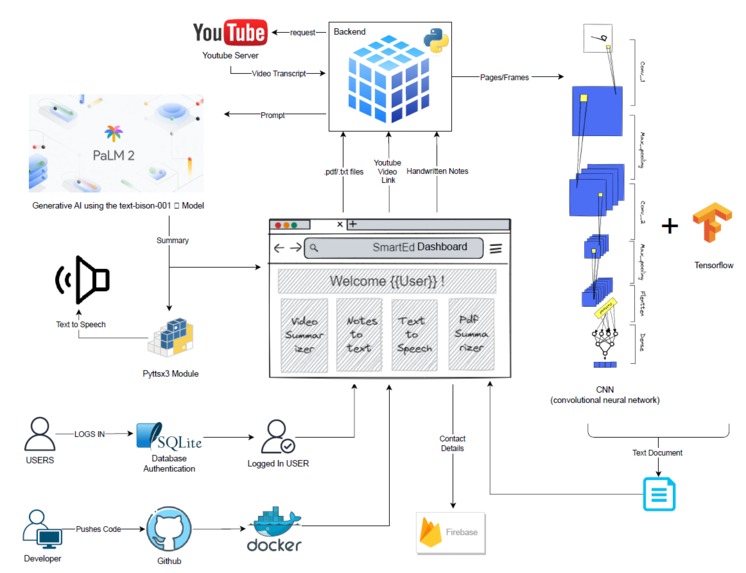
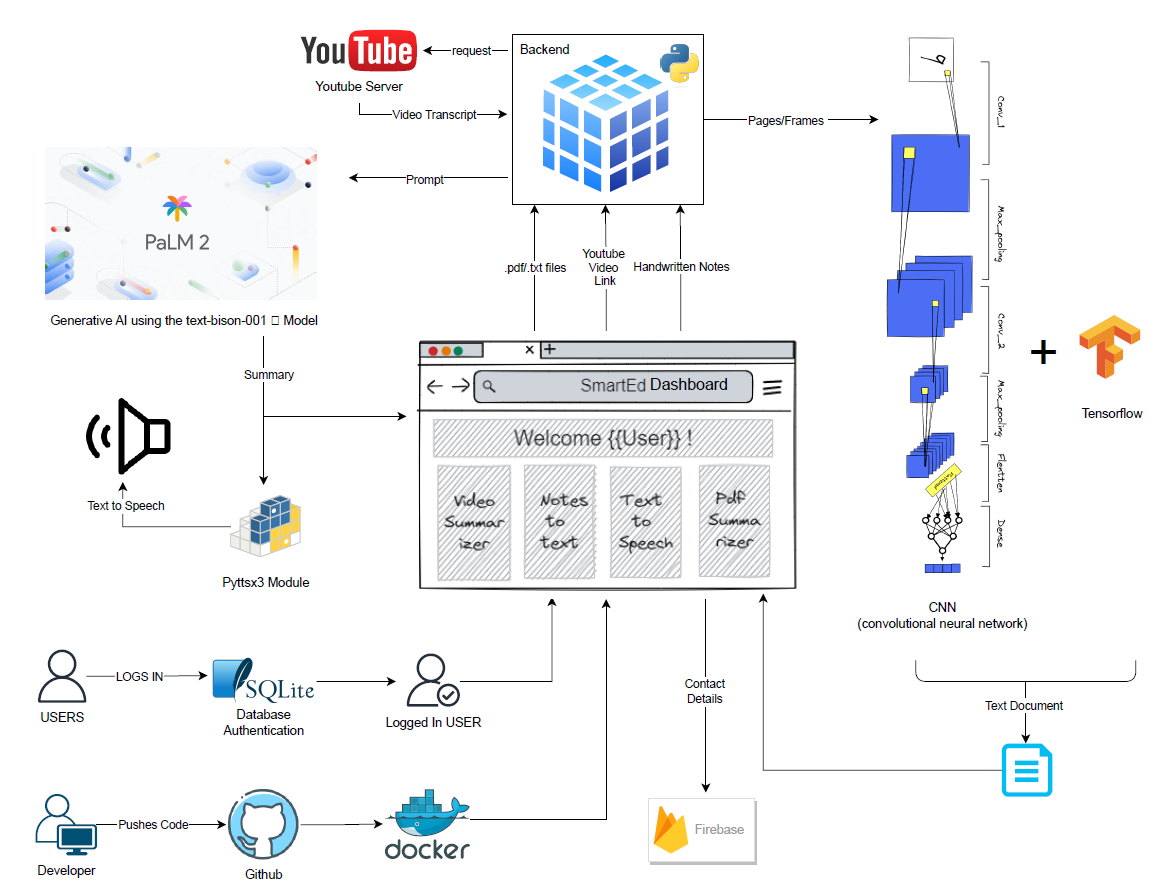
Architectural Diagram
-
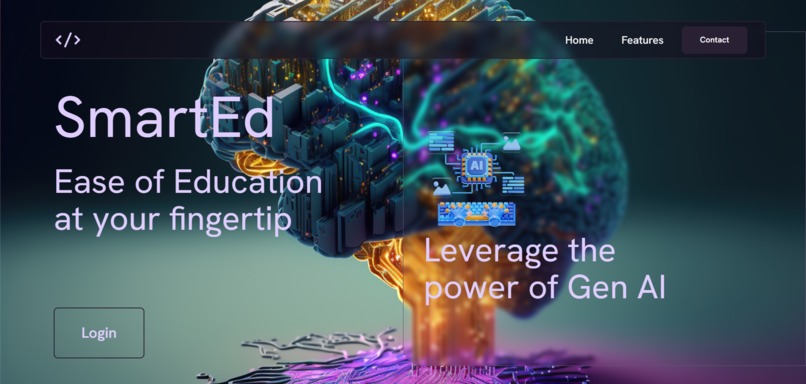
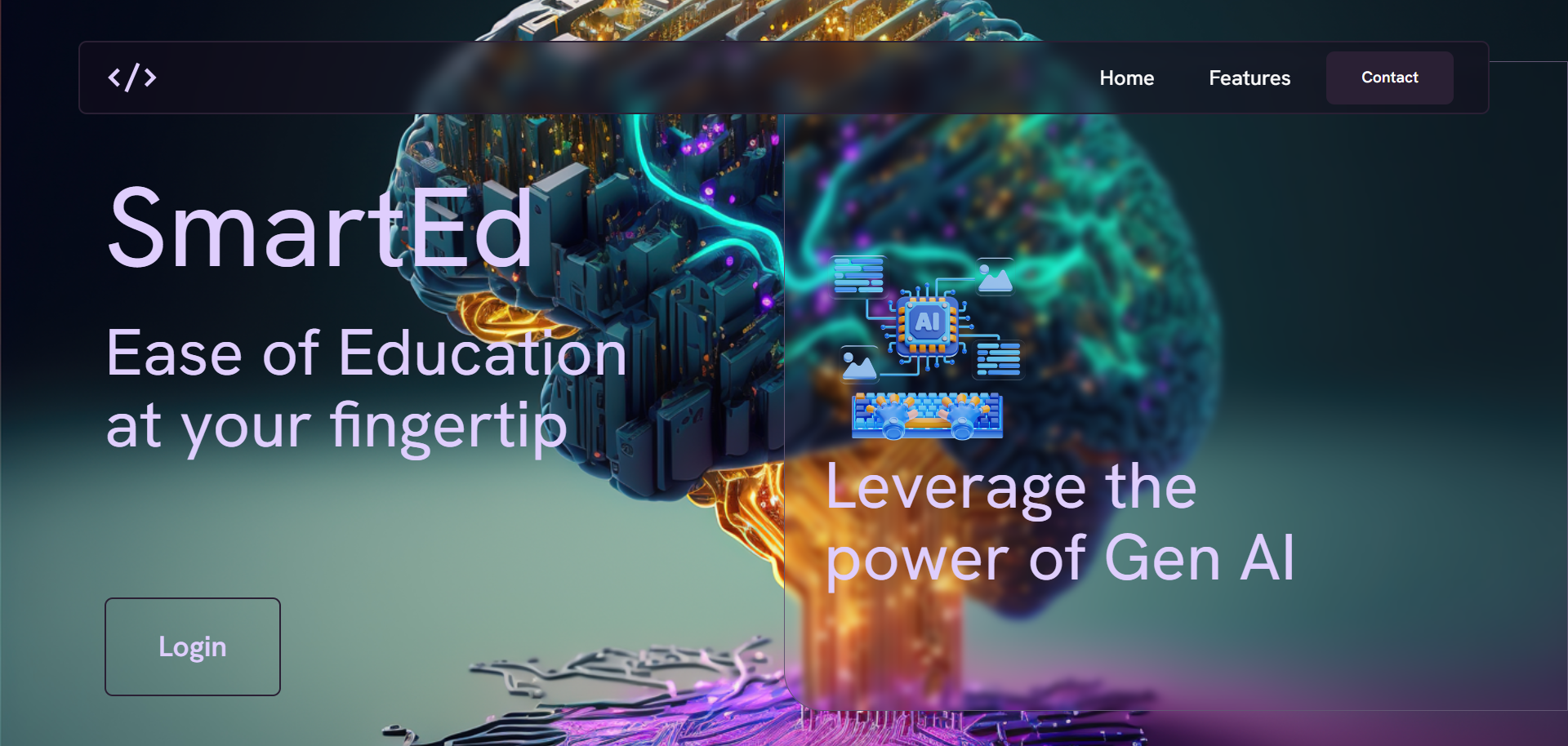
Home Page
-
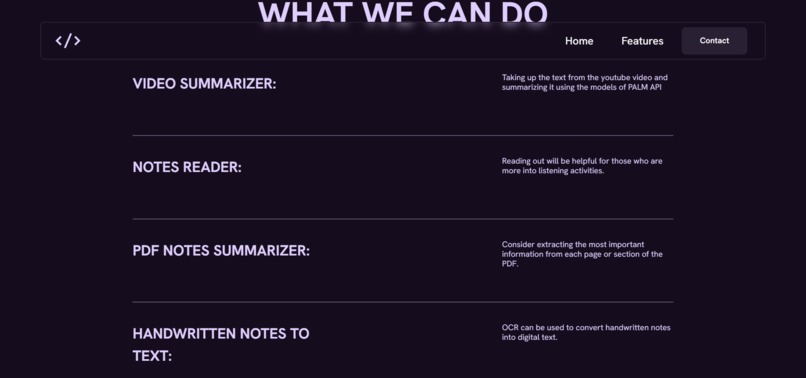
Features
-
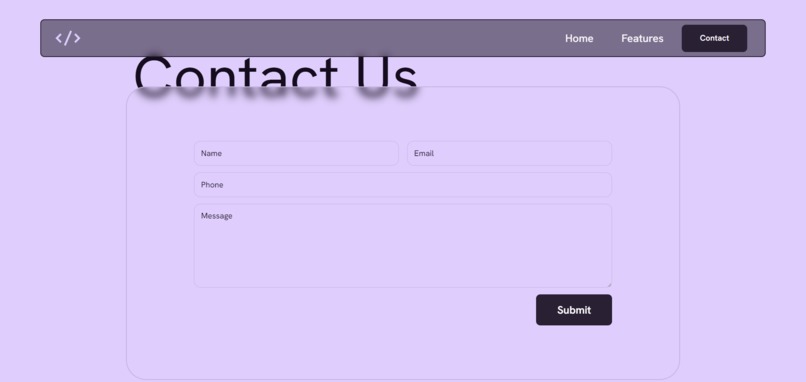
Contact
-
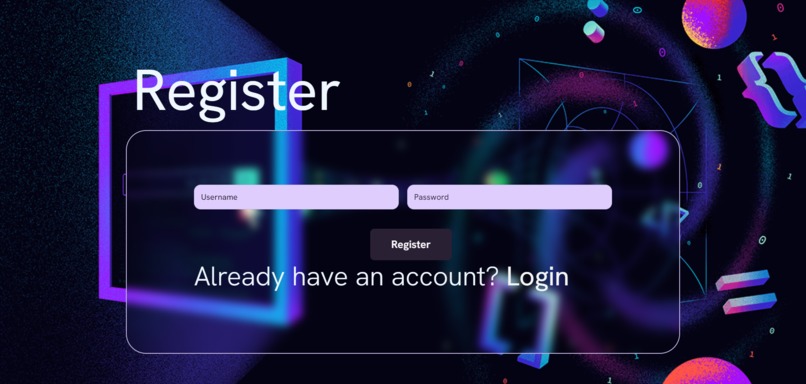
Register
-
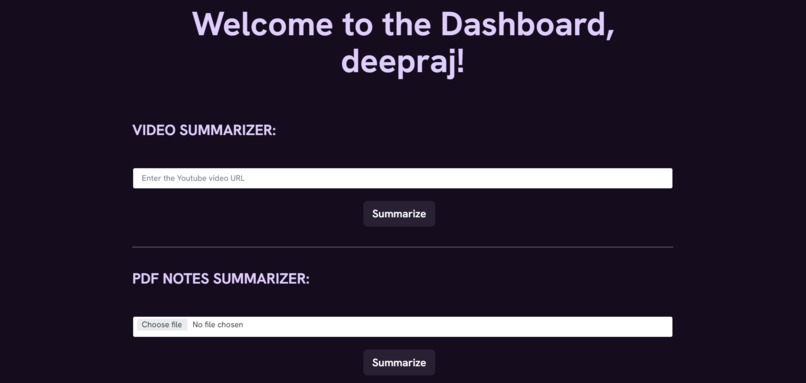
Dashboard


Use Case Title:
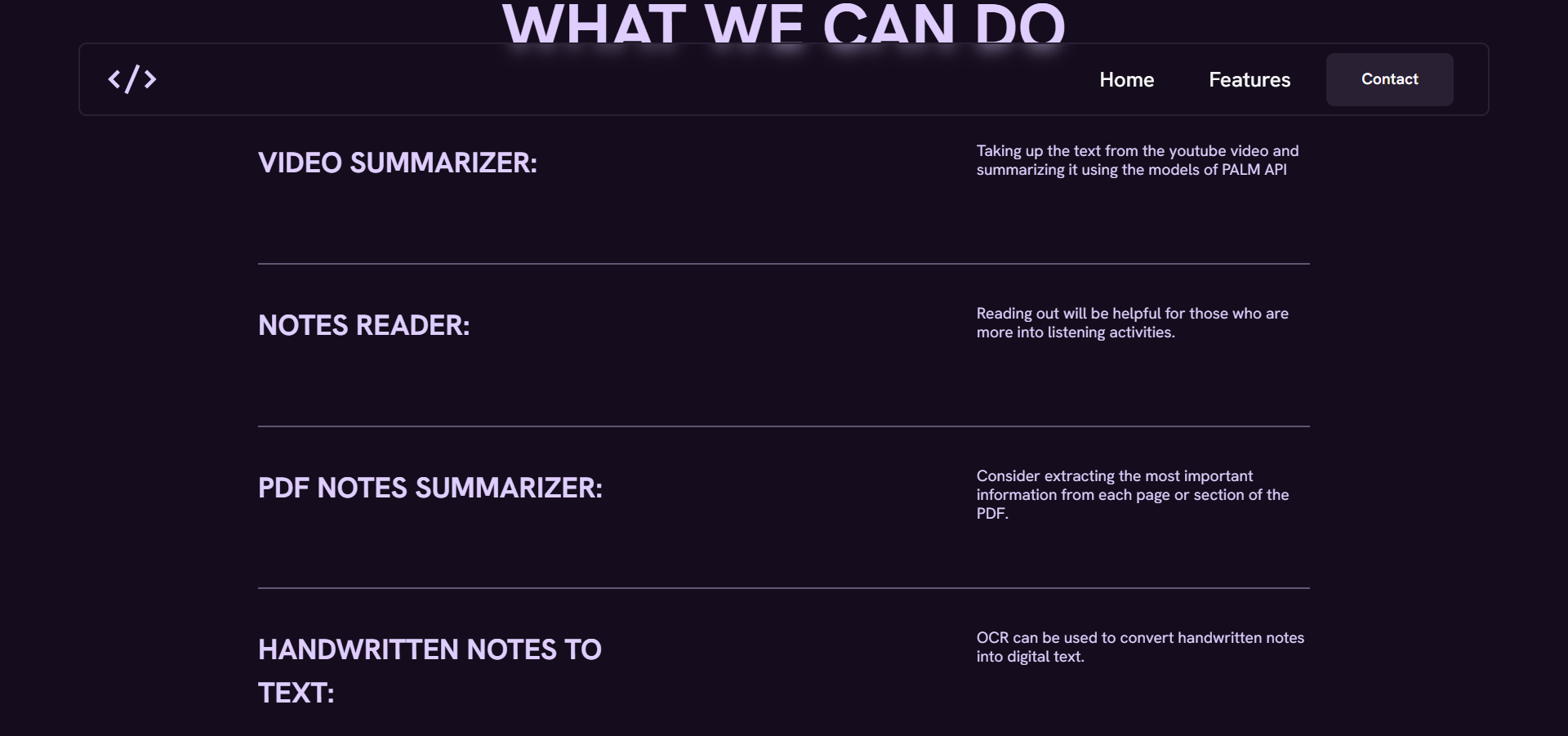
The use case for SmartEd is "Efficient and Accessible Learning Enhancement for College Students."
Description:
Use Case: SmartEd - Efficient and Accessible Learning Enhancement for College Students Description: SmartEd addresses the challenges faced by college students in accessing, summarizing, and comprehending educational content. The platform employs various AI tools to streamline the learning process. AI Tools Involved:
- PALM API (text-bison-001): - Utilized for Video Summarization and PDF Summarization.
- Extracts key information from YouTube videos and PDF documents.
- Convolutional Neural Networks (CNN) and TensorFlow:
- Powers the Handwritten Notes to Text conversion.
- Converts physical notes into digital text files. Target Audience:
- College Students: The primary audience, seeking efficient and accessible tools to enhance their learning experience.
- Educators: Those interested in leveraging technology to provide more digestible content for students. Problem Solving:
- Lengthy Content Distillation:
- Solution: Video Summarizer condenses lengthy YouTube lectures into concise summaries using PALM API.
- Benefit: Students can quickly grasp key concepts without investing excessive time.
- Multimodal Learning Preferences:
- Solution: Text to Speech feature converts summaries into audio, accommodating diverse learning preferences.
- Benefit: Enables auditory learners and supports on-the-go review.
- Transition from Analog to Digital Notes:
- Solution: Handwritten Notes to Text conversion using CNN and TensorFlow.
- Benefit: Facilitates seamless transition, sharing, and editing of physical notes.
- Effective PDF Content Summarization:
- Solution: PDF Summarizer breaks down lengthy PDFs, summarizing each page with PALM API.
- Benefit: Ensures efficient summarization without exceeding API query limits. Conclusion: SmartEd's use case targets the common pain points of college students and educators, offering a multifaceted solution through AI tools. By enhancing accessibility and efficiency, SmartEd aims to make the learning journey more productive and enjoyable.
Tutorial for Use and Best Practices:
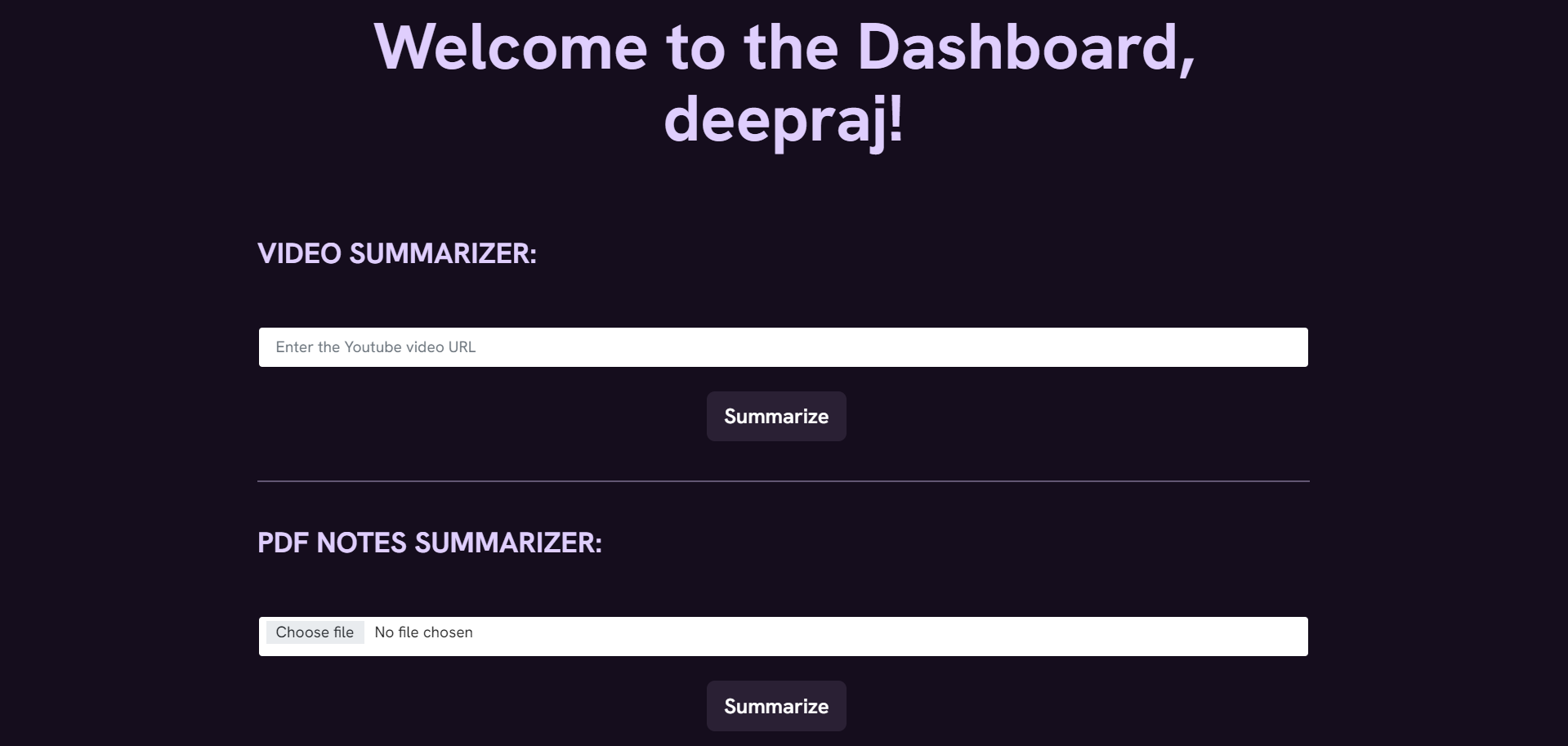
Video Summarizer:
- Input YouTube Link:
- Copy the link of the YouTube video you want to summarize.
- Navigate to Video Summarizer:
- Find the Video Summarizer feature on the platform.
- Paste YouTube Link:
- Paste the copied YouTube link into the designated field.
- Initiate Summarization:
- Click the "Summarize" button to initiate the summarization process.
- Access Summary:
- Once processed, access the summarized content. Text to Speech:
- Generate Summary:
- Utilize the Video Summarizer or input your own text.
- Access Text to Speech Feature:
- Navigate to the Text to Speech feature.
- Convert to Speech:
- Click the "Convert" button to transform the summarized text into speech.
- Listen to Summary:
- Access the audio file and listen to the summary. Handwritten Notes to Text:
- Capture Handwritten Notes:
- Take a clear photo of your handwritten notes.
- Access SmartEd:
- Visit the SmartEd platform.
- Navigate to Handwritten Notes to Text:
- Find the Handwritten Notes to Text feature.
- Upload Image:
- Upload the image of your handwritten notes.
- Initiate Conversion:
- Click the "Convert" button to initiate the conversion process.
- Download Text File:
- Download the converted text file. PDF Summarizer:
- Upload PDF:
- Select the PDF document you want to summarize.
- Access SmartEd:
- Visit the SmartEd platform.
- Navigate to PDF Summarizer:
- Find the PDF Summarizer feature.
- Upload PDF:
- Upload the selected PDF document.
- Initiate Summarization:
- Click the "Summarize" button to begin the process.
- Download Summarized PDF:
- Download the summarized PDF document. Best Practices:
- Quality Input:
- Provide clear and high-quality inputs for optimal results.
- Review Summaries:
- Always review the generated summaries for accuracy.
- Explore Features:
- Experiment with different features for a comprehensive learning experience.
- Stay Updated:
- Check for platform updates and improvements regularly. Resources: https://developers.generativeai.google/ https://www.tensorflow.org/ https://www.tensorflow.org/tutorials/images/cnn
Impacts on Learning:
The SmartEd use case significantly impacts the efficiency and accessibility of the learning experience. The following aspects are affected positively:
- Time Efficiency:
- With SmartEd: Video Summarizer reduces the time needed to grasp key concepts from lengthy lectures.
- Without SmartEd: Students may spend excessive time watching full-length videos, potentially missing essential information.
- Learning Preferences:
- With SmartEd: Text to Speech accommodates auditory learners, offering a diverse learning experience.
- Without SmartEd: Auditory learners might struggle to engage with the material effectively.
- Transition to Digital Learning:
- With SmartEd: Handwritten Notes to Text facilitates a seamless transition from physical to digital notes.
- Without SmartEd: Students relying on handwritten notes face challenges in sharing, editing, and organizing their materials.
- PDF Content Digestibility:
- With SmartEd: PDF Summarizer breaks down lengthy documents, making content more manageable.
- Without SmartEd: Reading lengthy PDFs without summarization may lead to information overload. In the absence of SmartEd, the learning experience would likely be more time-consuming, less adaptable to diverse learning preferences, and hindered by the challenges of managing analog notes and lengthy documents. SmartEd enhances learning by providing tools that streamline and adapt to the individual needs of students, ultimately making the learning journey more efficient and enjoyable.
Limitations and Ethical Considerations:
Hindrances to Learning:
- Overreliance on Summaries:
- How: Students might overly depend on summarized content, missing the depth and context of the full materials.
- Mitigation: Encourage users to use summaries as supplements, not replacements, and provide opportunities for deeper exploration.
- Biases in Summarization:
- How: AI models may unintentionally introduce biases based on the data they were trained on.
- Mitigation: Regularly update and diversify training data, implement bias-detection mechanisms, and engage in continuous monitoring and refinement.
- Misinterpretation of Handwritten Notes:
- How: Handwritten Notes to Text may misinterpret ambiguous or complex handwriting.
- Mitigation: Encourage users to write clearly and review the AI-generated text for accuracy.
- Inaccuracies in PDF Summarization:
- How: PDF Summarizer may struggle with highly technical or domain-specific content.
- Mitigation: Provide a mechanism for users to review and manually edit summaries, especially for specialized content. Biases at Play:
- Language Bias:
- How: Summarization models may be biased towards certain linguistic structures or styles.
- Mitigation: Regularly update language models with diverse linguistic data.
- Cultural Bias: - How: Cultural nuances in educational content might be overlooked.
- Mitigation: Integrate diverse cultural perspectives into training data and continuously assess for cultural biases. Ensuring Validity of AI-Generated Results:
- User Feedback and Review:
- How: Encourage users to provide feedback on the accuracy and relevance of summaries.
- Validation: Regularly review user feedback and implement improvements accordingly.
- Continuous Model Training:
- How: Regularly update AI models with fresh and diverse data.
- Validation: Monitor model performance over time and validate against a diverse set of educational content.
- Human Oversight:
- How: Integrate a human review process to assess and validate complex or critical content.
- Validation: Cross-verify AI-generated results with human expertise to ensure accuracy.
- Transparency and Explainability:
- How: Implement transparent AI models that provide insights into the summarization process.
- Validation: Enable users to understand how the AI arrived at certain conclusions, fostering trust in the results. By addressing these potential hindrances and biases, SmartEd aims to create a more robust and reliable learning enhancement platform, ensuring that AI-generated results align with the educational objectives and needs of the users.
Inspiration
- SmartEd was inspired by the common struggles of college students in accessing and summarizing educational content effectively.
What it does
- SmartEd is a comprehensive educational platform.
- Features include Video Summarizer, Text to Speech, Handwritten Notes to Text, and PDF Summarizer.
How we built it
- Integration of advanced technologies such as CNN and PALM API (text-bison-001) for video and PDF summarization.
- Meticulous algorithm fine-tuning and API integration for accurate and coherent results.
Challenges we ran into
- Integrating third-party APIs, especially managing rate limits.
- Ensuring the accuracy of the summarization process required iterative algorithm refinement.
Accomplishments that we're proud of
- Successful creation of a platform addressing real-world educational challenges.
- Integration of diverse features like Video Summarizer and Handwritten Notes to Text conversion.
What we learned
- Valuable lessons in API integration, algorithm optimization, and handling diverse educational content.
- User feedback played a crucial role in shaping SmartEd's capabilities.
What's next for SmartEd
- Future developments include Notes to Flow Chart functionality and a Conversational Chat feature.
- These additions aim to enhance user interaction and provide a more immersive learning experience.


Log in or sign up for Devpost to join the conversation.