-
-
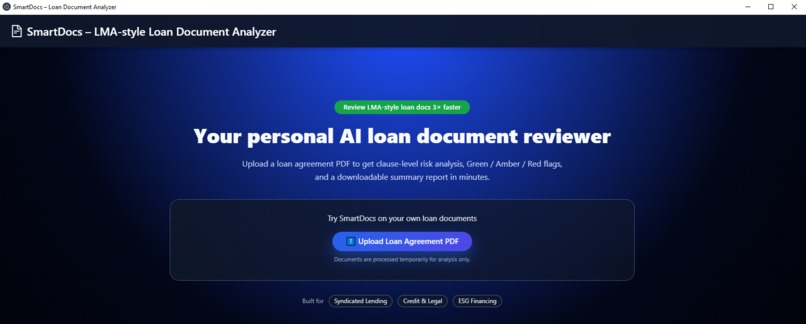
SmartDocs AI Landing Page
-
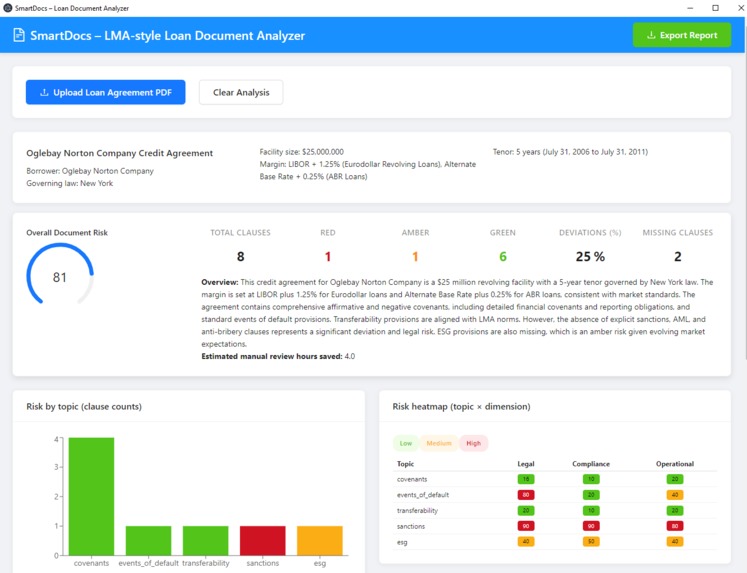
Dashboard Overview
-
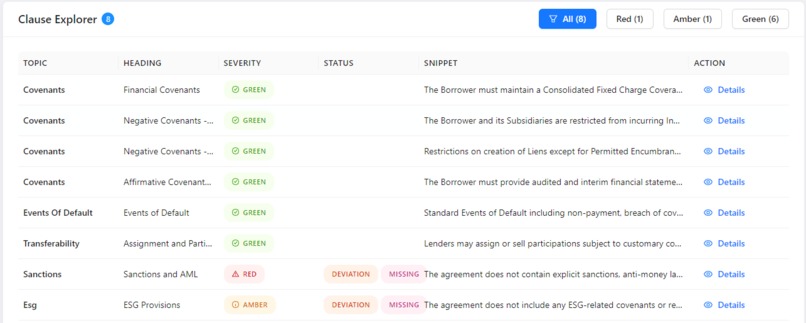
Clause Explorer
-
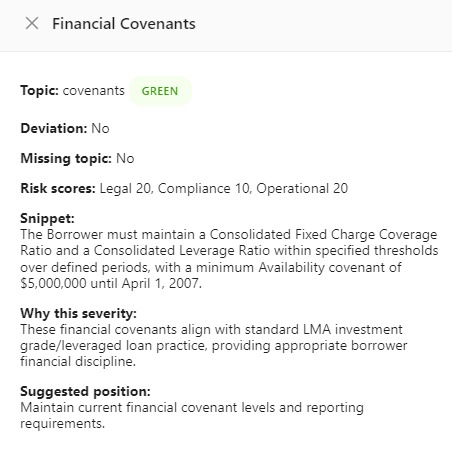
Clause Detail in Full
-
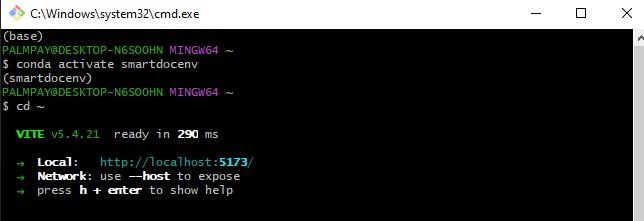
Frontend setup (web)
-
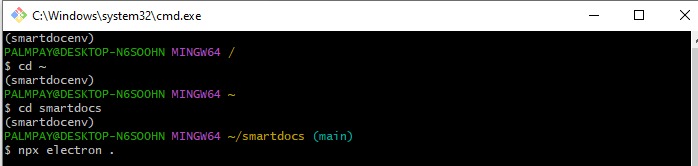
Desktop (Electron) Development


SmartDocs – AI Loan Document Analyzer
Inspiration 💡
During conversations with credit analysts at regional banks, we discovered a critical bottleneck: each loan agreement requires 4+ hours of manual review. With 150+ page documents filled with complex legal language, analysts must meticulously check covenants, events of default, sanctions clauses, and ESG provisions. This process is:
- Time-consuming and expensive ($200-400 per document in labor costs)
- Prone to human error and fatigue
- Creates bottlenecks during peak lending periods
- Prevents analysts from focusing on strategic decision-making
We saw an opportunity to leverage AI to transform this tedious process into an efficient, consistent, and comprehensive analysis tool.
What SmartDocs Does 🎯
SmartDocs is a desktop-first AI application that transforms a 4-hour loan document review into a 15-minute comprehensive analysis—a 94% time reduction that saves banks $200-400 per document.
The Intelligence Behind It
Unlike generic document AI tools, SmartDocs understands LMA loan agreements. It delivers:
1. Multi-Dimensional Risk Scoring
Every clause gets three independent risk assessments, where each dimension is scored 0-100:
- Legal Risk: Contractual exposure and enforceability
- Compliance Risk: Regulatory adherence (Basel III, Dodd-Frank)
- Operational Risk: Execution complexity and monitoring burden
2. Intelligent Clause Classification
Our AI categorizes and labels each clause:
- Topic: Covenants, Events of Default, Transferability, Sanctions, ESG
- Severity: 🟢 GREEN (standard), 🟡 AMBER (review needed), 🔴 RED (critical)
- Status: STANDARD, DEVIATION, or MISSING
3. Market Deviation Detection
SmartDocs compares each clause against LMA market standards and flags deviations with precise explanations of what's non-standard and why it matters.
4. Explainable AI
For every finding, SmartDocs provides:
- Full text excerpt
- Detailed rationale explaining the severity
- Recommended negotiation position
- Supporting references to market practice
Real-World Validation ✅
Test Case: Oglebay Norton Company Credit Agreement
- Document: 150+ pages, $25M revolving facility
- Processing Time: 15 minutes
- Analysis Delivered:
- 8 clauses identified across 5 critical topics
- 🔴 1 RED FLAG: Missing explicit sanctions, AML, and anti-bribery clauses (Legal Risk: 100/100)
- 🟡 1 AMBER WARNING: Missing ESG provisions (Compliance Risk: 45/100)
- 🟢 6 GREEN CLAUSES: Standard financial covenants with appropriate thresholds
- 25% deviation rate requiring attention
- 2 missing critical clauses that would have been overlooked in manual review
- Time saved: 4.0 hours
The result? A credit analyst can now review 16 documents per day instead of 2.
How We Built It 🛠️
Architecture: Desktop-First Security Meets Cloud-Scale AI
We architected SmartDocs as a native desktop application because financial institutions demand on-premise security for sensitive loan documents. But we needed cloud AI power. Our solution: a hybrid architecture.
Desktop Layer (Electron v31)
// Electron main process - native OS integration
const { app, BrowserWindow } = require('electron');

function createWindow() {
  const win = new BrowserWindow({
    width: 1600,
    height: 1000,
    webPreferences: {
      nodeIntegration: false,    // Security: no Node in renderer
      contextIsolation: true     // Isolate web content
    }
  });

  win.loadURL('http://localhost:5173');  // Dev: Vite server
  win.setMenuBarVisibility(false);       // Clean desktop UI
}

app.whenReady().then(createWindow);
Frontend (React 18 + Vite)
Built a responsive, data-dense interface using:
- Ant Design: Enterprise-grade components (Tables, Drawers, Cards)
- Recharts: Interactive visualizations (risk heatmaps, bar charts)
Progressive disclosure: Summary → Topics → Clause details → Full analysis
// Clause detail drawer - explainable AI in action
const ClauseDetailDrawer = ({ clause }) => (

{clause.why_severity}
{clause.suggested_position}
);
**Backend (FastAPI + Python)**

High-performance API server handling PDF processing and AI orchestration:
```python
from fastapi import FastAPI, UploadFile
from analyzer import analyze_document

app = FastAPI()

@app.post("/analyze")
async def analyze_loan_document(file: UploadFile):
    """
    Main analysis endpoint
    - Saves uploaded PDF
    - Extracts text and structure
    - Calls AI analysis pipeline
    - Returns structured risk assessment
    """
    file_path = await save_upload(file)

    # Multi-stage AI analysis
    analysis = analyze_document(file_path)

    return AnalyzeResponse(
        deal_header=analysis['deal_header'],
        clauses=analysis['clauses'],
        risk_score=analysis['overall_risk'],
        deviation_pct=analysis['deviation_pct'],
        hours_saved=analysis['hours_saved']
    )
AI Engine (OpenAI GPT-4 with Custom Prompting)
The magic happens here. We engineered prompts that turn GPT-4 into an LMA loan expert:
def analyze_clause(clause_text: str, topic: str) -> ClauseAnalysis:
    """
    Structured AI analysis with validation
    """
    prompt = f"""
    You are an expert credit analyst reviewing LMA loan agreements.

    Analyze this {topic} clause and provide:
    1. Legal Risk (0-100): Assess contractual exposure
    2. Compliance Risk (0-100): Evaluate regulatory adherence
    3. Operational Risk (0-100): Rate execution complexity
    4. Severity: GREEN (standard), AMBER (review), or RED (critical)
    5. Status: STANDARD, DEVIATION, or MISSING
    6. Rationale: Explain WHY this severity (2-3 sentences)
    7. Recommendation: Suggest negotiation position

    Compare against LMA market standards. Be specific.

    Clause text:
    {clause_text}

    Return as JSON matching this schema:
    {{
      "legal_risk": int,
      "compliance_risk": int,
      "operational_risk": int,
      "severity": str,
      "status": str,
      "rationale": str,
      "recommendation": str
    }}
    """

    response = openai.chat.completions.create(
        model="gpt-4",
        messages=[{"role": "user", "content": prompt}],
        temperature=0.3,  # Lower temp for consistency
        response_format={"type": "json_object"}
    )

    return ClauseAnalysis(**json.loads(response.content))
The Document Processing Pipeline
Step 1: Intelligent Chunking
150+ page PDFs exceed GPT-4's context window (128k tokens ≈ 96k words ≈ 200 pages). Our solution:
def chunk_document(pdf_text: str) -> List[Chunk]:
    """
    Smart chunking that preserves clause boundaries
    """
    # Detect section markers (LMA agreements have predictable structure)
    sections = detect_sections(pdf_text)  # e.g., "Article 5: Covenants"

    chunks = []
    for section in sections:
        if len(section.text) > MAX_CHUNK_SIZE:
            # Subdivide long sections at clause boundaries
            sub_chunks = split_at_clause_markers(section.text)
            chunks.extend(sub_chunks)
        else:
            chunks.append(section)

    return chunks
Step 2: Parallel AI Analysis
Process multiple chunks concurrently to minimize latency:
async def analyze_all_chunks(chunks: List[Chunk]) -> List[ClauseAnalysis]:
    """
    Concurrent API calls with rate limiting
    """
    tasks = [analyze_chunk(chunk) for chunk in chunks]
    results = await asyncio.gather(*tasks, return_exceptions=True)
    return [r for r in results if not isinstance(r, Exception)]
Step 3: Result Aggregation
Combine individual clause analyses into document-level insights:
def aggregate_results(clauses: List[ClauseAnalysis]) -> DocumentAnalysis:
    """
    Calculate overall risk score and metrics
    """
    # Weighted average by severity
    weights = {"RED": 3, "AMBER": 2, "GREEN": 1}

    risk_score = sum(
        (c.legal_risk + c.compliance_risk + c.operational_risk) / 3 * weights[c.severity]
        for c in clauses
    ) / sum(weights[c.severity] for c in clauses)

    deviation_pct = len([c for c in clauses if c.status == "DEVIATION"]) / len(clauses) * 100

    return DocumentAnalysis(
        overall_risk=int(risk_score),
        deviation_pct=round(deviation_pct, 1),
        clauses=clauses
    )
Challenges We Faced 🚧
1. PDF Parsing Complexity
Challenge: LMA loan agreements have inconsistent formatting, nested structures, and mixed content types.
Solution: Implemented intelligent chunking that preserves document hierarchy while staying within GPT-4's context limits. Used multiple parsing strategies (text extraction, structure detection, section identification).
2. Context Window Management
Challenge: 150+ page documents exceed GPT-4's context window.
Solution: Developed a smart chunking algorithm that:
- Divides documents into topic-based sections
- Maintains context overlap between chunks
- Aggregates results across multiple API calls
- Preserves clause relationships
3. Consistent Risk Scoring
Challenge: AI models can produce inconsistent outputs across similar clauses.
Solution:
- Engineered detailed prompts with specific scoring rubrics
- Used structured output formatting (JSON schemas)
- Implemented validation layers to ensure score consistency
- Added examples of standard LMA clauses for benchmarking
4. Desktop vs. Web Architecture
Challenge: Building for both desktop and web deployment with a single codebase.
Solution:
- Built React app to be environment-agnostic
- Used Electron wrapper for desktop deployment
- Configured API client to work with both localhost and remote backends
- Maintained separate build pipelines for web (Netlify) and desktop (Electron)
5. Performance Optimization
Challenge: Large PDF processing caused API latency and high costs.
Solution:
- Implemented streaming responses for real-time feedback
- Optimized prompt sizes to reduce token usage
- Added intelligent caching for repeated document sections
- Used batch processing where possible
6. UI/UX for Complex Data
Challenge: Presenting multi-dimensional risk scores and detailed clause analysis without overwhelming users.
Solution:
- Designed progressive disclosure (summary → details → full analysis)
- Used color-coded severity labels (GREEN/AMBER/RED)
- Created dual visualization approach (bar charts for distribution, heatmaps for dimensions)
- Implemented expandable detail drawers with comprehensive clause information
What We Learned 📚
Technical Insights
- Prompt engineering is critical: Small changes in prompt structure dramatically affected output quality
- Desktop architecture matters: Financial institutions prioritize security—desktop-first design was the right choice
- Structured outputs: Using Pydantic models and JSON schemas ensures reliable AI responses
- Chunking strategy: Smart document segmentation is more important than raw context window size
Domain Knowledge
- LMA Loan standards: Learned that syndicated loans follow predictable patterns:
- Articles 1-3: Definitions, facility terms
- Articles 4-6: Conditions precedent, representations
- Articles 7-9: Covenants (financial, negative, affirmative)
- Articles 10-12: Events of default, remedies
- Articles 13+: Administrative provisions
This structure enabled smarter chunking.
- Risk assessment: Understood how underwriters evaluate legal, compliance, and operational risks
- Banking workflows: Credit analysts need both high-level summaries and detailed clause-level analysis
Product Development
- Explainability is essential: Users need to understand WHY the AI scored something a certain way
- Quantified value matters: "Saves 4 hours" resonates more than "faster analysis"
- Multiple user personas: Different users (analysts, underwriters, compliance) need different views of the same data
Commercial Viability 💼
Value Proposition
- Time savings: 94% reduction (4 hours → 15 minutes)
- Cost savings: $200-400 per document
- Risk reduction: Consistent analysis reduces missed clauses
- Scalability: Process high volumes during peak periods
Market Opportunity
- 4,000+ US commercial banks
- 5,000+ credit unions
- 10,000+ underwriters and credit analysts
Business Model
- SaaS subscription: $199-499/user/month
- Enterprise licensing for large institutions
- ROI: Breaks even after 10-15 documents/month
What's Next 🚀
Short-term (Q1 2026)
- Pilot program with 3-5 regional banks
- User feedback integration
- Performance optimization for 500+ page documents
Medium-term (Q2-Q3 2026)
- Enterprise features (user management, audit logs, role-based access)
- Multi-language support (French, German loan agreements)
- Batch processing for portfolio reviews
Long-term (Q4 2026+)
- Direct integration with loan origination systems
- Real-time collaboration features
- Predictive analytics for deal outcomes
- Mobile companion app for executives
Built with ❤️ for transforming loan document review in financial institutions.

Log in or sign up for Devpost to join the conversation.