-
-
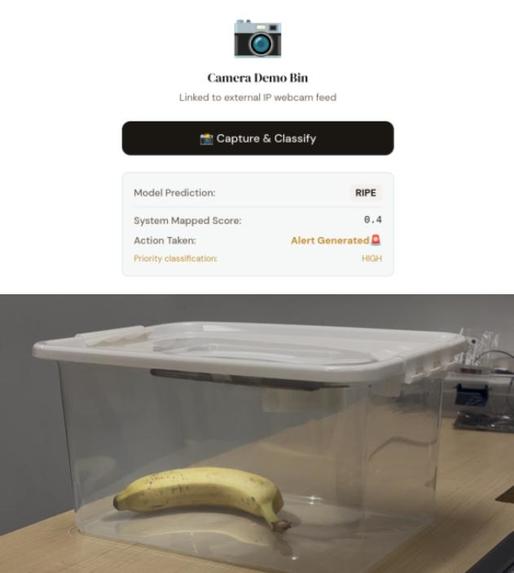
Successful Resnet Demo
-
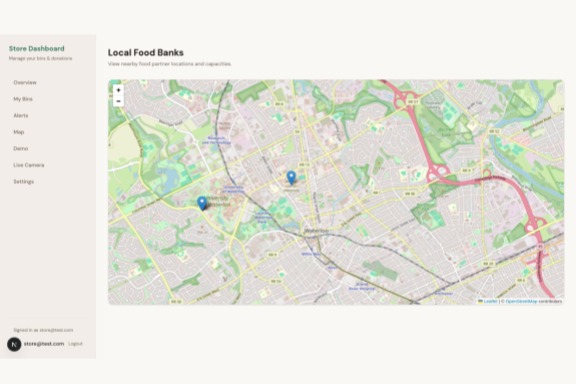
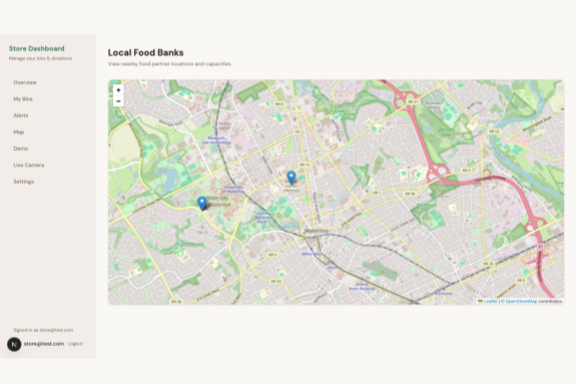
Mapped Repository of Donor's and Food Banks
-
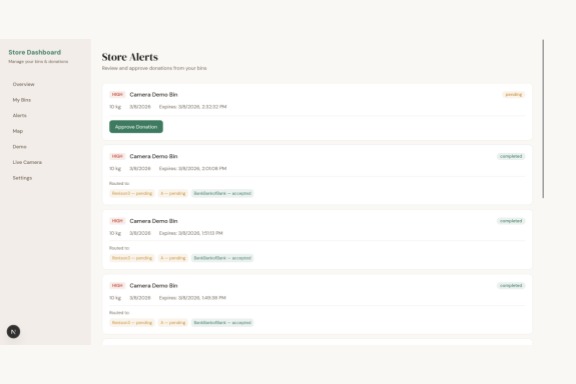
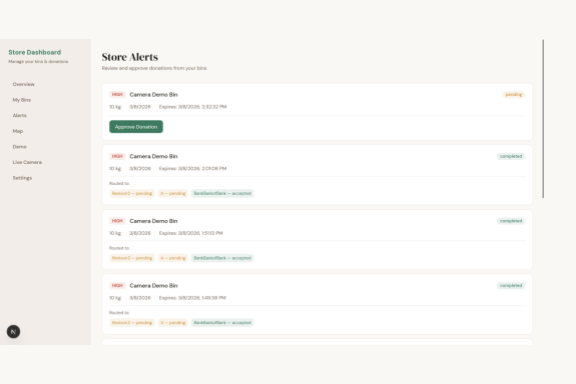
Store Alerted to Donate Food
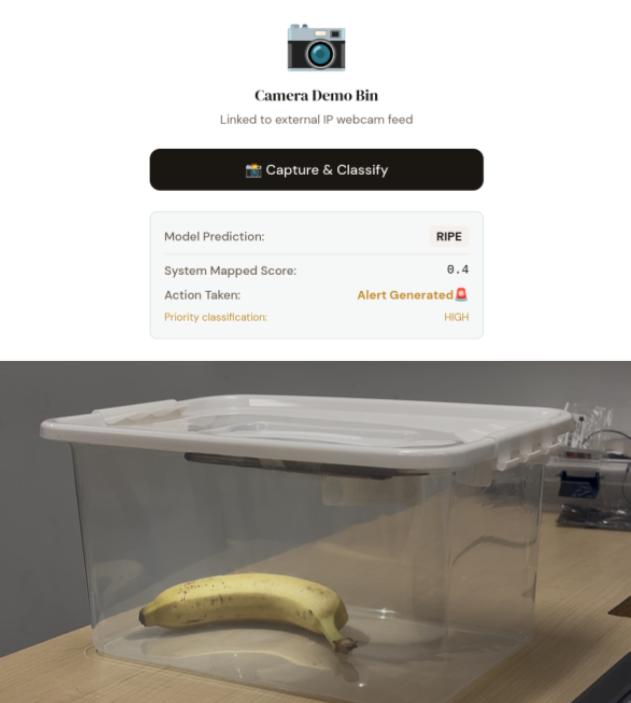
SmartCycle - A Seamless Solution for Food Redistribution
Inspiration
Every year, over 21 million tons of food are wasted in Canada, representing roughly $58 billion in lost value. Much of this food is still safe to eat but is discarded due to expiration dates, cosmetic imperfections, or overstocking. At the same time, 1 in 5 Canadians experiences food insecurity, and food banks have reported a 90% increase in demand since 2019.
Food waste also creates a serious environmental issue. When organic waste decomposes in landfills it produces methane, a greenhouse gas roughly 80× more potent than CO₂.
These overlapping problems inspired us to build SmartCycle: a platform designed to prevent food from becoming waste in the first place by redirecting surplus food from businesses to local food banks before it spoils.
What it does
SmartCycle is a B2B smart food recovery platform that connects grocery stores and businesses with nearby food banks. The system uses IoT-enabled smart bins and a Tailscale-powered platform to track food freshness and trigger donation alerts before food expires.
The system works in three main stages:
Smart Food Tracking IoT bins equipped with weight scales, our Resnet convolutional network, and ethylene sensors, monitor food freshness in real time. They classify items and predict spoilage, transmitting info via Tailscale.
Automated Donation Matching When food approaches spoilage, the platform uses a weighted Dijkstra's algorithm with freshness, location, and demand to match donations with nearby food banks.
Coordinated Pickup and Delivery Food banks receive alerts, accept donations, and confirm pickups through the dashboard.
This system helps:
- Reduce food waste
- Provide reliable food supplies to food banks
- Lower methane emissions
- Provide businesses with potential tax incentives for donations.
How we built it
SmartCycle combines IoT hardware, cloud infrastructure with Tailscale, and modern web technologies with Antigravity .
Key components include:
- IoT Smart Bins that monitor food freshness through sensors.
- Express.js API (Node.js + TypeScript) for backend services.
- Supabase PostgreSQL for data storage and real-time database functionality.
- Next.js dashboards for store managers and food banks to manage donations.
- Auth0 role-based authentication to separate donor and receiver workflows.
- Tailscale connects the bins' cameras and sensors to the servers for polling.
- Resnet convolutional neural network for freshness classification.
The platform includes multiple dashboards:
- Store managers can track bins and approve donations.
- Food banks can view incoming donations and confirm pickups.
- Administrators can monitor system-wide activity.
The donation workflow is managed through a multi-stage lifecycle:
\( Detection -> Alert -> Approval -> Routing -> Completion \)
This allows SmartCycle to automate the redistribution process from detection to confirmed pickup.
Challenges we ran into
One of the biggest challenges was integrating multiple complex systems into a single workflow. The platform required Tailscale's coordination between IoT telemetry, backend APIs, real-time databases, and multiple user dashboards.
Another challenge was designing the donation routing logic. The system needs to consider several variables simultaneously, including:
- Food freshness
- Nutritional value
- Distance to food banks
- Food bank capacity
To handle this, we implemented a weighted graph routing approach using Dijkstra’s algorithm, allowing the platform to determine the most efficient destination for each donation.
We also had to mock some AI components during development, such as freshness scoring and routing algorithms, while the core system architecture was being built.
Accomplishments that we're proud of
We are most proud of building an end-to-end system that connects real-world food recovery with digital infrastructure.
Key accomplishments include:
- Designing a working full-stack platform with IoT integration.
- Creating role-based dashboards for both donors and food banks.
- Developing a scalable backend architecture using modern technologies.
- Demonstrating how AI and logistics algorithms can be applied to social problems.
Most importantly, SmartCycle shows how technology can help turn food surplus into a valuable resource rather than waste.
What we learned
Through this project we learned several important lessons:
- Food waste is not just a logistics problem but a data problem. Better information about food freshness and supply chains can dramatically improve redistribution.
- IoT and AI systems require strong backend architecture to handle real-time data streams.
- User experience matters, especially when building tools for organizations like food banks that rely on efficient operations.
We also gained practical experience in full-stack development, cloud databases, API design, and system architecture.
What's next for SmartCycle
Our next goal is to move from prototype to real world pilot deployment.
Future plans include:
- Launching a 6-month pilot program in Waterloo with local grocery stores and food banks.
- Integrating the freshness scoring AI model fully into the system.
- Improving the donation routing algorithm with real-time demand data.
- Expanding the platform to include restaurants, cafeterias, and warehouses.
- Adding predictive analytics to forecast surplus food supply.
In the long term, SmartCycle aims to become a scalable infrastructure for food recovery, helping cities reduce waste, support communities, and lower environmental impact.
Built With
- antigravity
- auth0
- computervision
- convolutionalneuralnetworks
- next.js
- node.js
- python
- react
- resnet
- tailscale
- typescript


Log in or sign up for Devpost to join the conversation.