-
-
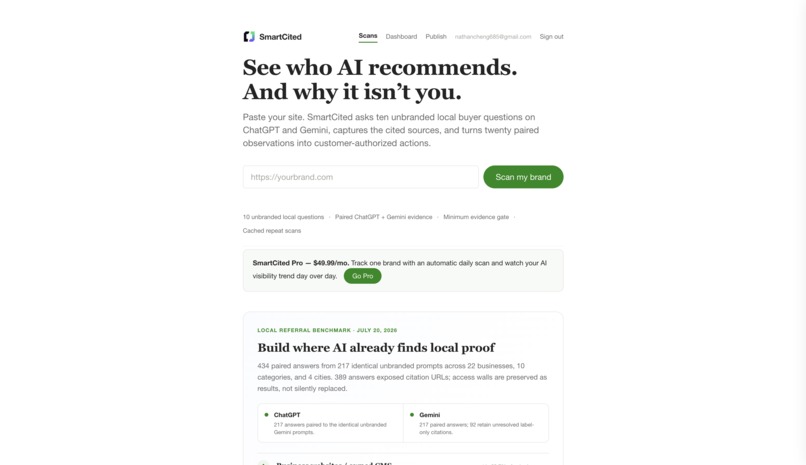
Product homepage
-
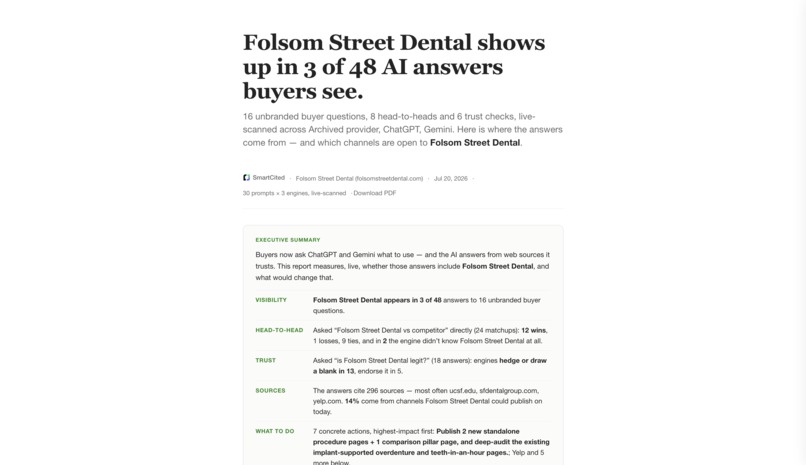
Visibility report
-
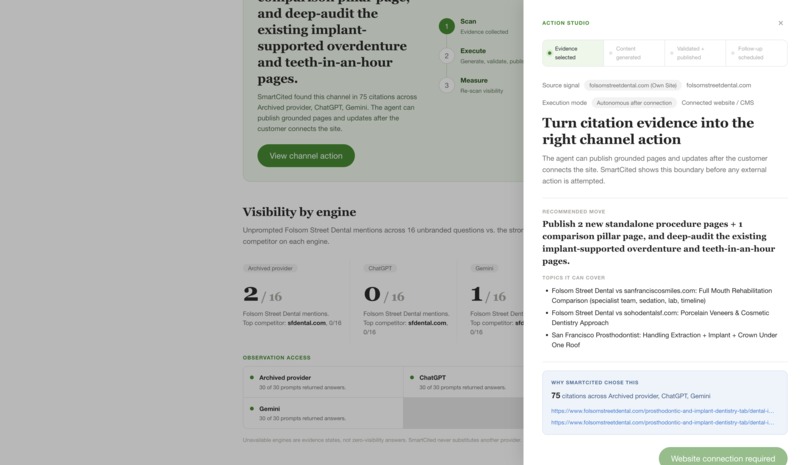
Three-channel action plan
Inspiration
When people need a local service, they usually do not know the business name. They ask questions like, "Which dentist in San Francisco is good with anxious patients?"
A good local business may never appear in the answer. The owner cannot see why competitors were recommended, which sources influenced the result, or what they should improve.
We built SmartCited to help local businesses understand and improve how they appear in AI recommendations.
What it does
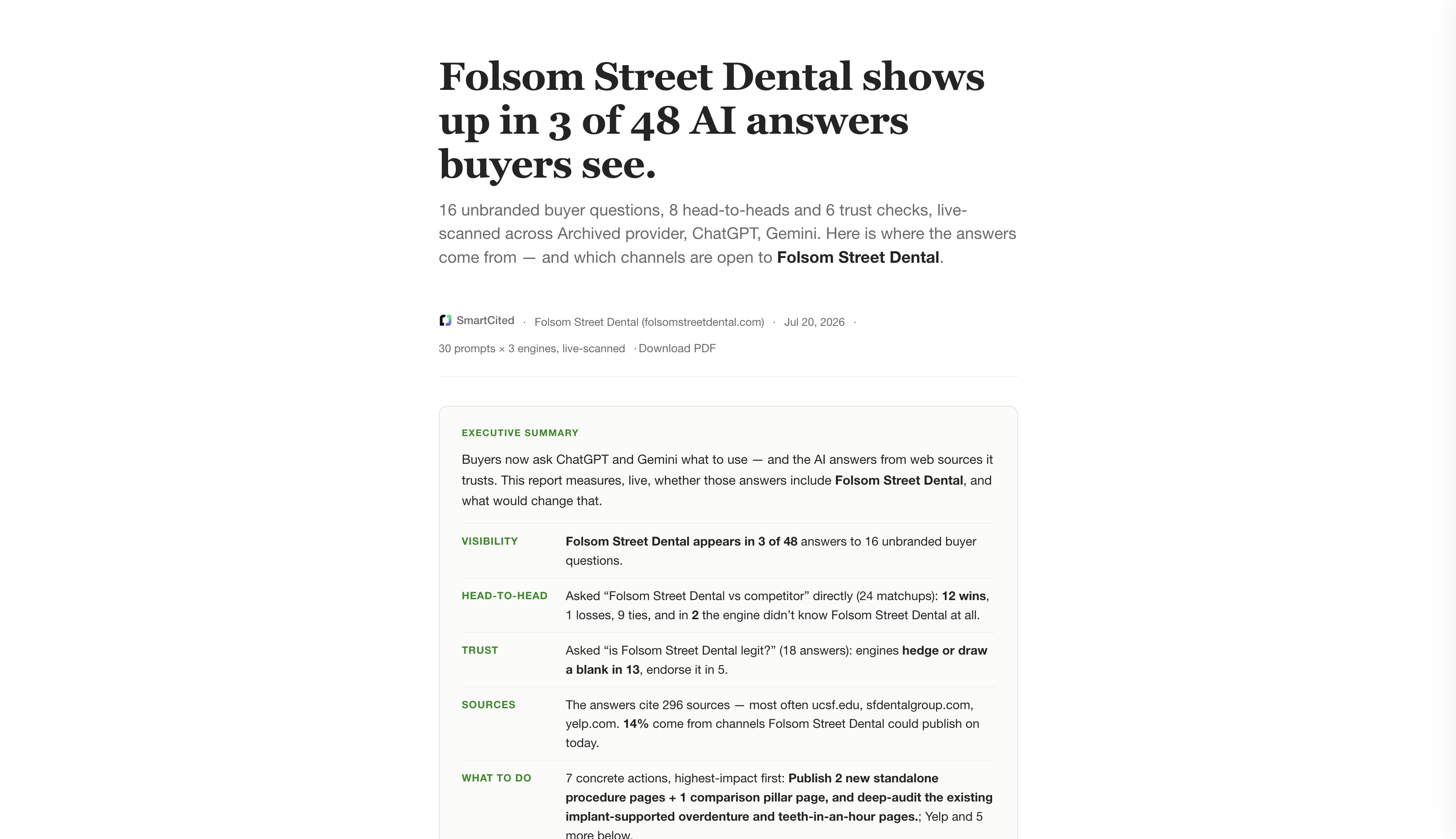
The customer enters their brand and website. SmartCited learns about the business and creates ten questions based on what local customers might ask.
The questions do not include the target brand, its website, contact details, or named competitors. SmartCited sends the same questions to OpenAI and Gemini, then records:
- Whether the brand appeared
- Where it ranked
- Which competitors appeared
- Which sources were cited
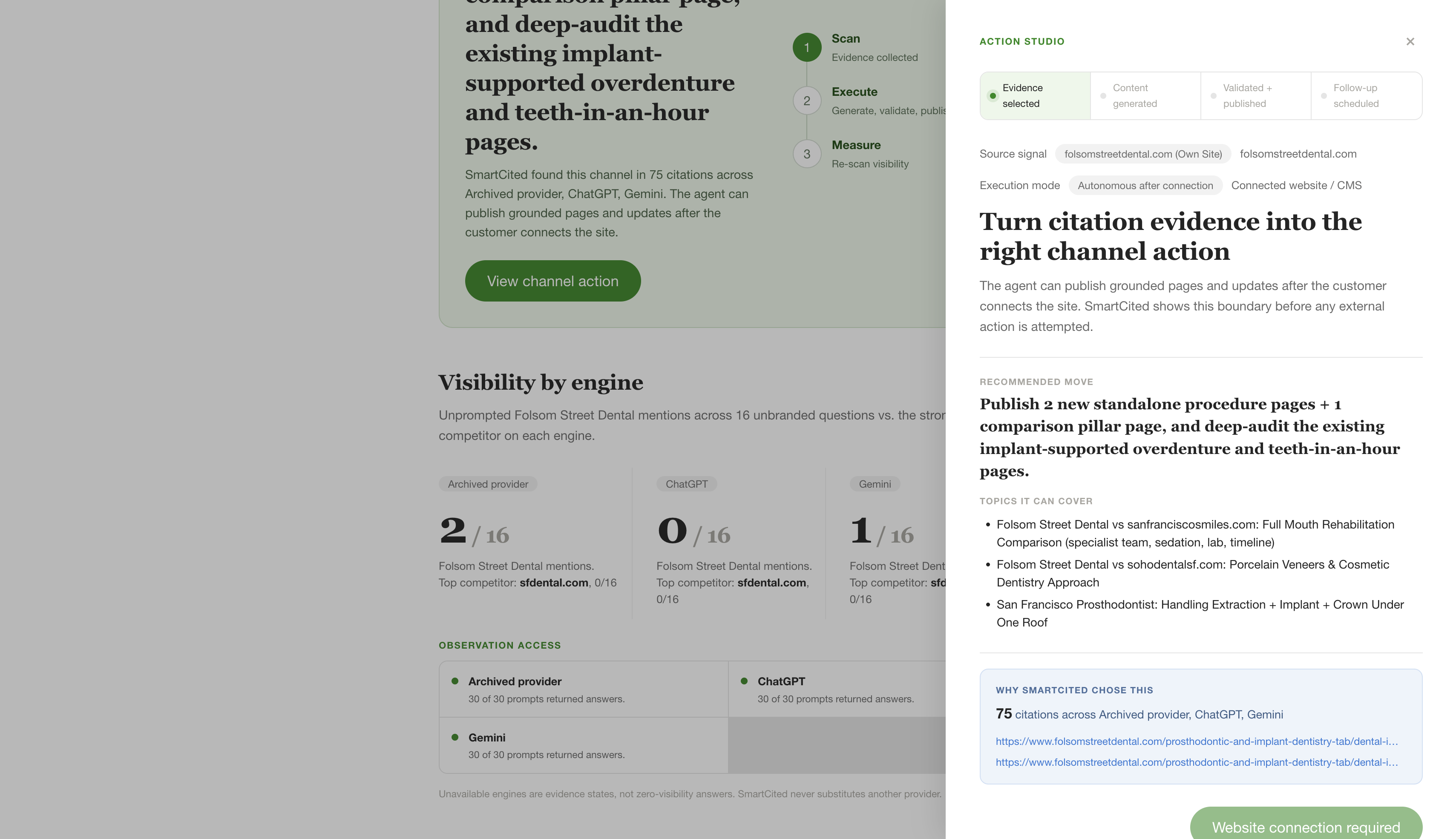
SmartCited uses this evidence to suggest an action on the customer's website, Yelp profile, or a relevant category directory.
With the customer's permission, the agent can carry out the action, save the public URL or platform receipt, and repeat the same searches later. This lets the owner see whether the business's visibility changed.
Why we chose these channels
We did not want to choose publishing platforms based on guesswork, so we collected 630 verified OpenAI and Gemini answers.
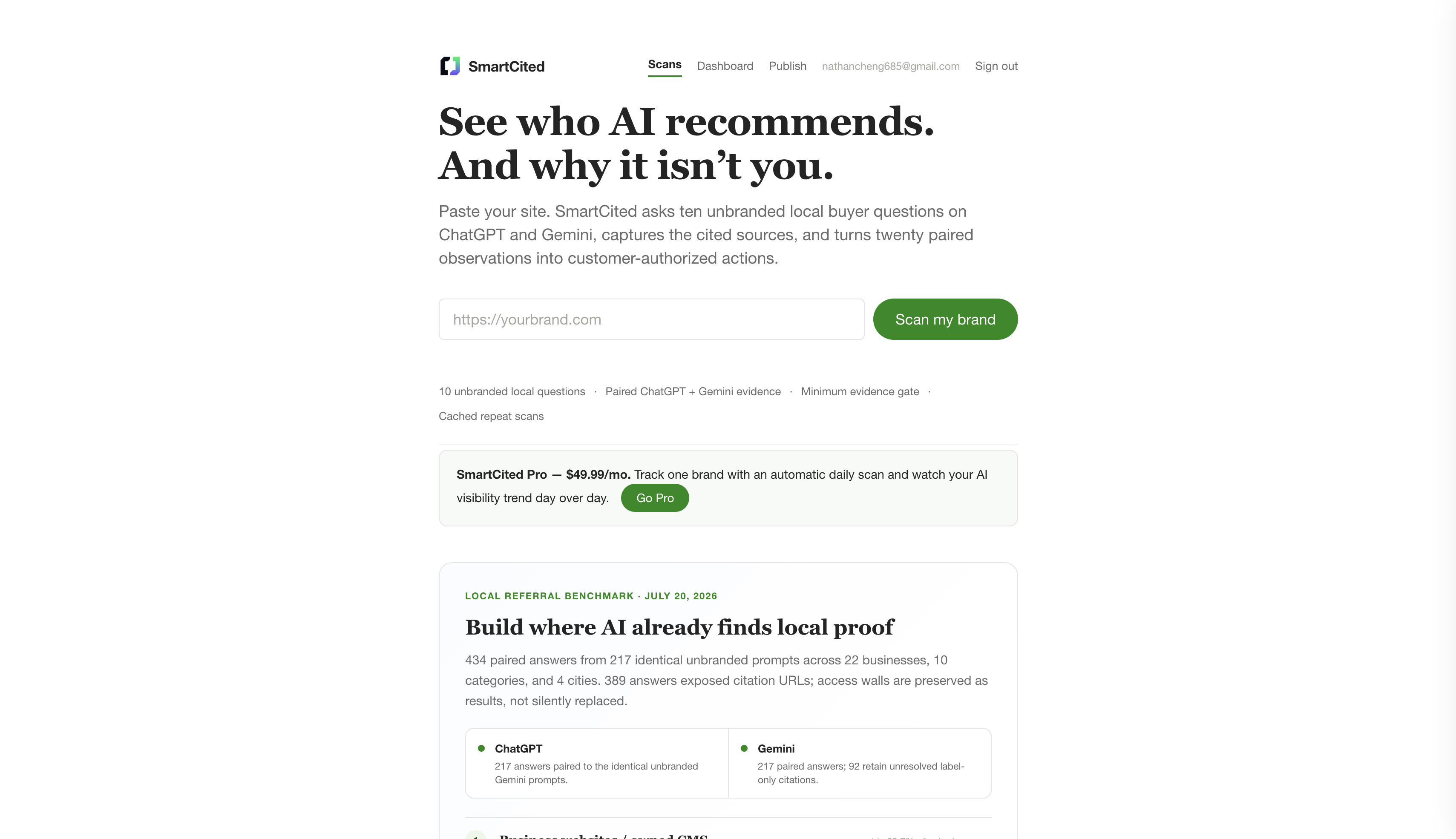
Our main comparison contains 434 answers from 217 identical unbranded questions completed on both engines. Business websites appeared in 62.7% of the answers, Yelp in 46.1%, and category directories in 41.0%.
These results led us to focus on customer websites, Yelp, and category directories.
The figures show where AI answers currently get their information. They do not prove that publishing on one of these channels will improve a business's visibility. That requires a real before-and-after test.
How we built it
We built SmartCited with Codex and GPT-5.6. We used them to design the workflow, write and review code, analyze the benchmark, combine our teammates' work, solve integration problems, and test the final product.
They also helped us catch a problem in our first benchmark. Some early questions included the target brand, which made the results biased. We rewrote the questions and added checks to make sure the brand does not leak into them.
SmartCited sends each question to the OpenAI Responses API with web search. It also calls the Gemini API with Google Search enabled and collects the sources returned with each answer.
Our team then built three action paths. Redd worked on publishing to customer-controlled websites. Alice built the Yelp owner workflow. Nathan built the category-directory workflow.
InsForge handles accounts, storage, backend functions, and deployment. Tavily reads customer websites and cited pages. The open-weight gpt-oss-120b model, hosted on Nebius, uses the collected evidence to prepare action drafts.
Before an action can be published, SmartCited checks the business facts, supporting evidence, platform rules, and customer permission. If something is missing, the agent stops. If the action succeeds, it saves the real public URL or platform receipt and schedules another scan.
Challenges we ran into
Our first challenge was creating a fair measurement. Asking about a business by name tests whether an AI knows that business. It does not test whether a new customer could discover it.
Our second challenge was platform access. A customer may control their website but still need OAuth, partner approval, or manual verification to update Yelp or a directory. We could not treat every platform as if it had the same publishing API.
The final challenge was testing external action without pretending that a business had authorized us. We tested the technical workflow with controlled inputs, but we still need a consenting customer for the first public before-and-after experiment.
Accomplishments that we're proud of
We used real search results to decide where SmartCited should act. We also combined three separate team projects into one workflow with shared rules for evidence, authorization, receipts, and follow-up scans.
For example, Folsom Street Dental appeared in none of twenty paired OpenAI and Gemini answers. Its website was never cited. In the same answers, other business websites appeared fourteen times, Yelp ten times, and category directories nine times.
Folsom Street Dental is only a read-only example. The business has not authorized us to publish or change any of its accounts.
The integrated product passes all 41 automated tests and TypeScript checking.
What we learned
A branded search measures recognition. An unbranded question measures discovery.
We also learned that frequent citations do not prove cause and effect. The only honest way to test an improvement is to publish an authorized change and repeat the same questions later.
Most importantly, a publishing agent needs to know when to stop. It should never invent business facts, customer permission, or a successful action.
What's next for SmartCited
Our next step is to work with a local business that gives us permission to run the full workflow.
SmartCited will measure its current visibility, choose one evidence-based improvement, publish through the customer's account, save the receipt, and repeat the same searches later.
That will give us our first real test of whether an authorized action improved the business's AI visibility.
Built With
- codex
- css3
- gemini-api
- ghost
- google-search-grounding
- gpt-5.6
- gpt-oss-120b
- html5
- insforge
- javascript
- nebius-token-factory
- node.js
- oauth
- openai-api
- openai-responses-api
- openai-web-search
- puppeteer
- tavily
- typescript
- wordpress
- yelp
- zod


Log in or sign up for Devpost to join the conversation.