-
-
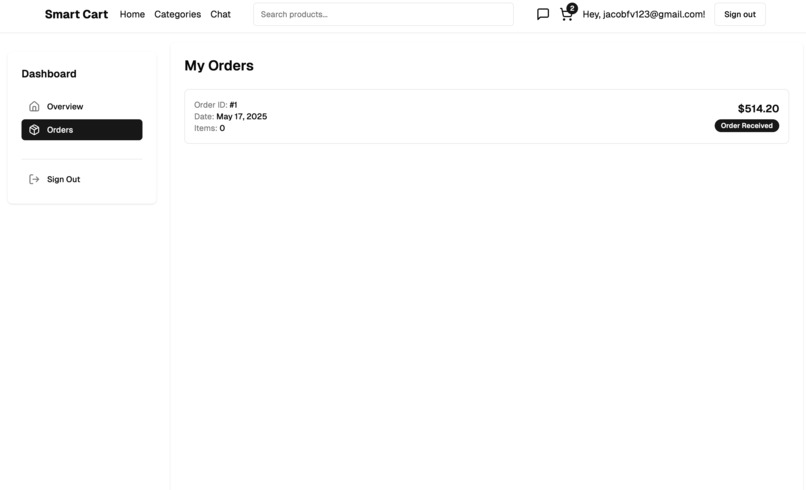
view your orders added by the web or mcp client!
-
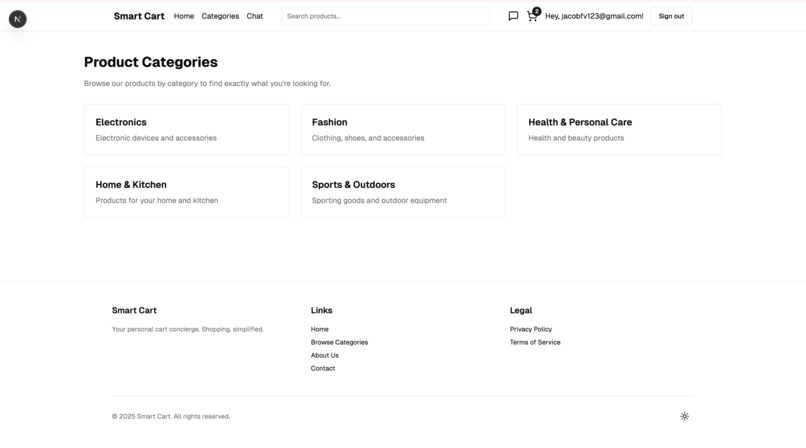
browse our ever increasing cross-platform inventory!
-
SmartCart!
Smart Cart: Your AI-Powered Predictive Shopping Concierge
Project By: Jacob Valdez
Inspiration
The modern online shopping experience is a paradox of choice: endless options, yet often overwhelming and fragmented. I've personally felt the frustration of juggling countless browser tabs, trying to remember items from different stores, and navigating multiple tedious checkouts. This fragmentation doesn't just waste time; it saps the joy out of discovering and acquiring things we need or love.
I was inspired by the idea of a truly intelligent shopping assistant – one that could not only unify the shopping process but also proactively understand my needs and preferences. What if an app could learn what I want, even before I explicitly search for it, and then make the entire purchasing journey seamless? This led to the concept of Smart Cart: a B2C predictive purchasing app designed to bring intelligence and simplicity back to online shopping.
What it does
Smart Cart aims to be your personal shopping command center. In its current hackathon iteration, it provides:
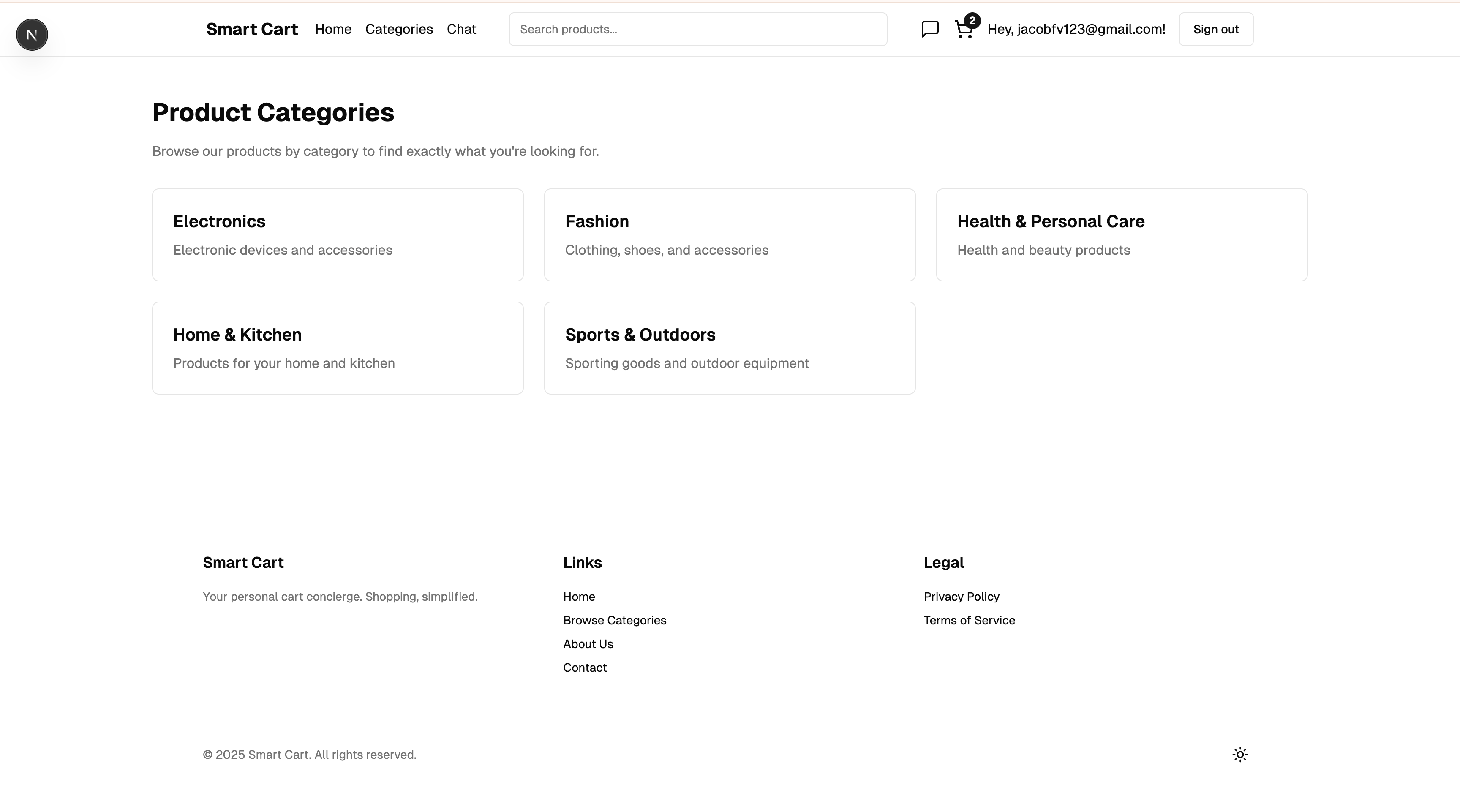
- Unified Product Discovery: Users can browse a curated catalog of products, view detailed information, and explore categories all within the Smart Cart interface.
- Intelligent Cart Management: Authenticated users can add items to a universal "Smart Cart," adjust quantities, and manage their selections in one place.
- AI-Powered Recommendations (Conceptual for Hackathon - Foundational Work Done): The architecture is designed to integrate with AI providers like ChatGPT, Gemini, and Claude. The vision is for Smart Cart to intelligently analyze user behavior and preferences (and eventually, natural language queries) to proactively recommend products they're likely to want to buy. For this hackathon, the focus was on building the robust e-commerce foundation necessary to power these future AI features.
- Streamlined Checkout: Users can proceed through a secure checkout process for items in their Smart Cart, including providing shipping information and completing payment via Stripe (using Stripe Checkout Sessions for a Stripe-hosted payment page).
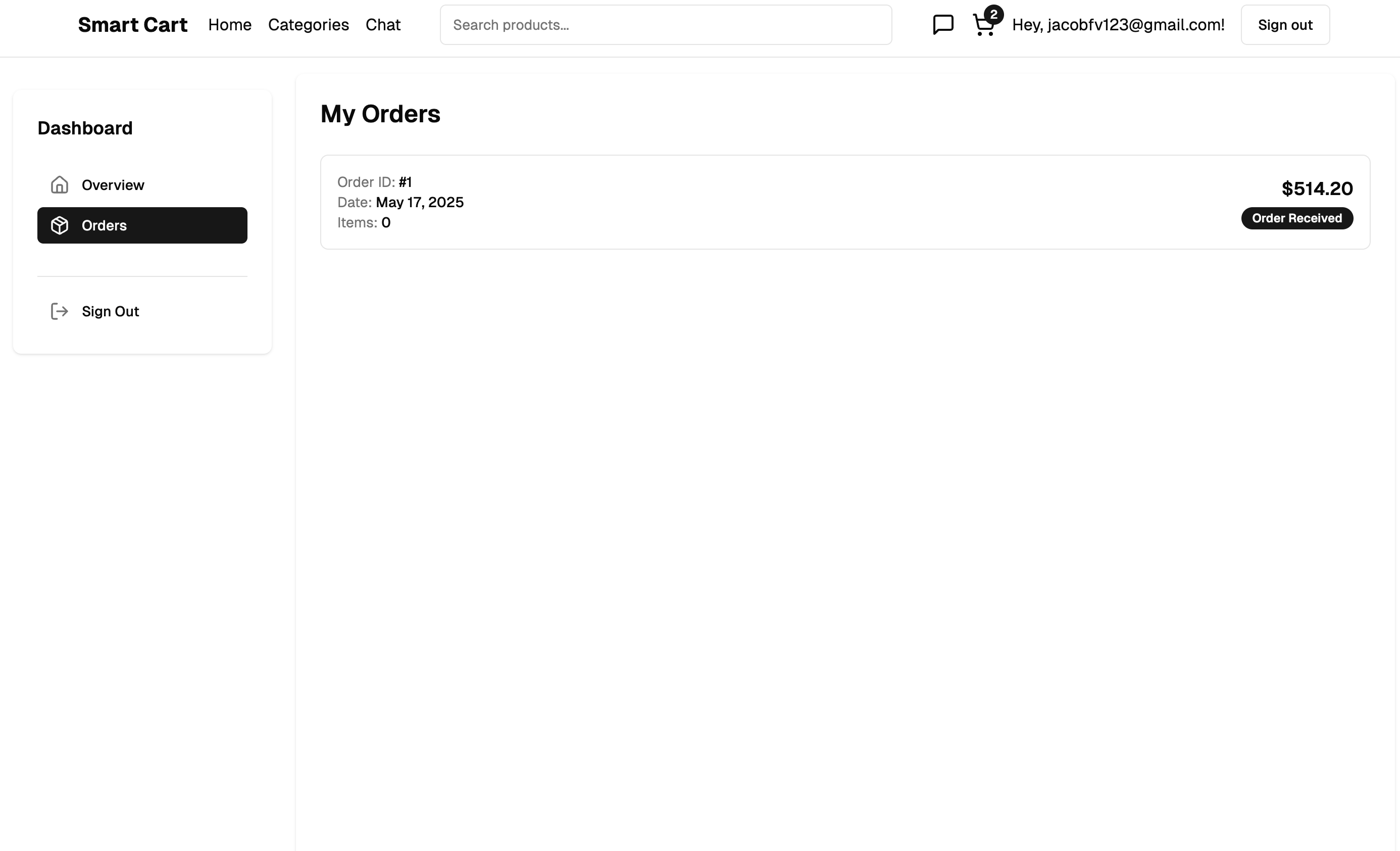
- Order Tracking: A user dashboard allows signed-in users to view their order history and the current status of their purchases (e.g., "Order Received," "Processing," "Shipped").
Essentially, Smart Cart simplifies the "shopping CUD" (Create, Update, Delete items in cart) and checkout process, while laying the groundwork for a truly predictive and personalized B2C shopping experience.
How I built it
As a solo developer for this hackathon, I focused on building a robust and scalable foundation using a modern tech stack:
- Frontend: Next.js (App Router) with React and TypeScript for a performant, type-safe user interface.
- Styling: Tailwind CSS for rapid UI development and consistent styling. ShadCN/UI components were leveraged for pre-built, accessible UI elements like buttons, inputs, and badges.
- Backend & Database: Supabase served as the all-in-one backend, providing PostgreSQL database, authentication, and instant APIs. Row Level Security (RLS) was implemented to ensure data privacy and security.
- Payments: Stripe (Checkout Sessions) was integrated for secure payment processing, offloading PCI compliance and providing a trusted checkout experience.
- Deployment: Vercel for seamless deployment and hosting of the Next.js application.
- AI Integration (Planned): The database schema and application flow are designed with future AI model integration in mind, allowing for natural language processing of user intent and predictive product suggestions. The core e-commerce functionality built during the hackathon is the necessary prerequisite for meaningful AI application.
The development process involved:
- Designing the database schema in Supabase for users, products, categories, carts, orders, and order items.
- Setting up authentication and user session management.
- Building out the product catalog display (listing, detail pages).
- Implementing core cart functionality (add, update, remove, view).
- Integrating Stripe Checkout for payment processing.
- Developing the order creation logic post-payment and the user dashboard for order history.
Challenges I ran into
- Scope Management (Solo Developer): Building a full-featured e-commerce platform, even as an MVP, is a significant undertaking for one person in a limited timeframe. Prioritizing core features (catalog, cart, checkout, basic dashboard) over more advanced AI integrations for the initial build was crucial but meant some aspirational features are still conceptual.
- Stripe Integration Nuances: While Stripe Checkout Sessions simplify the UI, correctly handling the webhook/redirect flow for order fulfillment (ensuring idempotency, verifying session status server-side, and gracefully managing payment success/cancellation/failure) required careful attention to detail and thorough testing.
- Server Actions & Client Component Interaction: Managing state and orchestrating data flow between server components (for data fetching and actions) and client components (for interactivity and form handling) in Next.js App Router required careful planning to ensure a smooth user experience and efficient data updates.
- End-to-End Testing: As a solo developer, rigorously testing every user flow (authentication, adding to cart, checkout with various scenarios, viewing orders) across different states was time-consuming but essential for stability.
Accomplishments that I'm proud of
- Functional End-to-End E-commerce Flow: Successfully implementing the complete user journey from product discovery through to a secure Stripe checkout and order confirmation within the hackathon timeframe.
- Solid Supabase Backend with RLS: Building a secure and well-structured backend with proper Row Level Security, ensuring user data is protected from the outset.
- Clean UI/UX Foundation: Creating a clean, intuitive, and responsive user interface using Tailwind CSS and ShadCN/UI, providing a professional feel even at this early stage.
- Scalable Architecture for AI: Designing the system in a way that the core e-commerce functionality directly supports and enables the future integration of powerful AI-driven predictive features. The groundwork is laid.
- Completing a complex B2C MVP solo: Demonstrating the ability to architect, develop, and integrate multiple services to deliver a functional application.
What I learned
- The Power of Modern Full-Stack Tooling: Leveraging Next.js, Supabase, and Vercel significantly accelerates development, allowing a solo developer to build surprisingly complex applications quickly.
- Pragmatic Prioritization is Key: In a hackathon (and in general), focusing on delivering a stable core experience first is more valuable than spreading efforts too thin across too many "nice-to-have" features.
- Idempotency in Payment Flows: The critical importance of designing backend processes (especially order creation post-payment) to be idempotent to prevent issues like duplicate orders if a webhook or redirect is processed multiple times.
- Server Components & Actions in Next.js: Gained deeper practical experience with the Next.js App Router paradigm, understanding its strengths for data fetching and mutations while managing client-side interactivity.
- B2C Product Thinking: Even in a hackathon context, thinking about the end-user experience, potential pain points, and the value proposition for a B2C product was a valuable exercise.
What's next for SmartCart
This hackathon project has laid a strong foundation. The exciting next steps for SmartCart involve bringing the "smart" to the forefront:
- AI Model Integration:
- Integrate with ChatGPT, Gemini, and/or Claude APIs.
- Develop features allowing users to describe their needs in natural language (e.g., "I'm looking for a birthday gift for my tech-savvy dad who loves coffee") and have Smart Cart generate relevant product suggestions.
- Implement predictive algorithms based on user browsing history, cart additions, past purchases, and trending items to proactively recommend products on the homepage or within product categories.
- Expanded Cross-Vendor Service (The Original Vision):
- Explore mechanisms (e.g., affiliate APIs, partnerships, or even sophisticated web scraping if ethically and technically feasible) to allow users to add items from a wider range of external vendor websites directly into their Smart Cart.
- Investigate multi-vendor checkout solutions (potentially using Stripe Connect or similar) to enable a single checkout for items sourced from different retailers (this is a complex, longer-term goal).
- Personalization Enhancements:
- Develop more sophisticated user profiles, including explicit preference settings.
- Implement features like "smart lists" (e.g., for groceries, wishlists, gift ideas) that can be auto-populated or refined by AI.
- User Onboarding & Feedback Loops: Improve user onboarding to highlight AI features and gather feedback to continuously refine the predictive models.
- Mobile Experience: Optimize further for a seamless mobile-first experience or explore a dedicated mobile app.
The ultimate vision is for SmartCart to become the indispensable, intelligent companion that transforms online shopping from a chore into a delightful and efficient experience.
Built With
- anthropic
- bun
- claude
- cursor
- mcp
- next
- openai
- postgresql
- stripe
- supabase
- typescript
- vercel
- windsurf

Log in or sign up for Devpost to join the conversation.