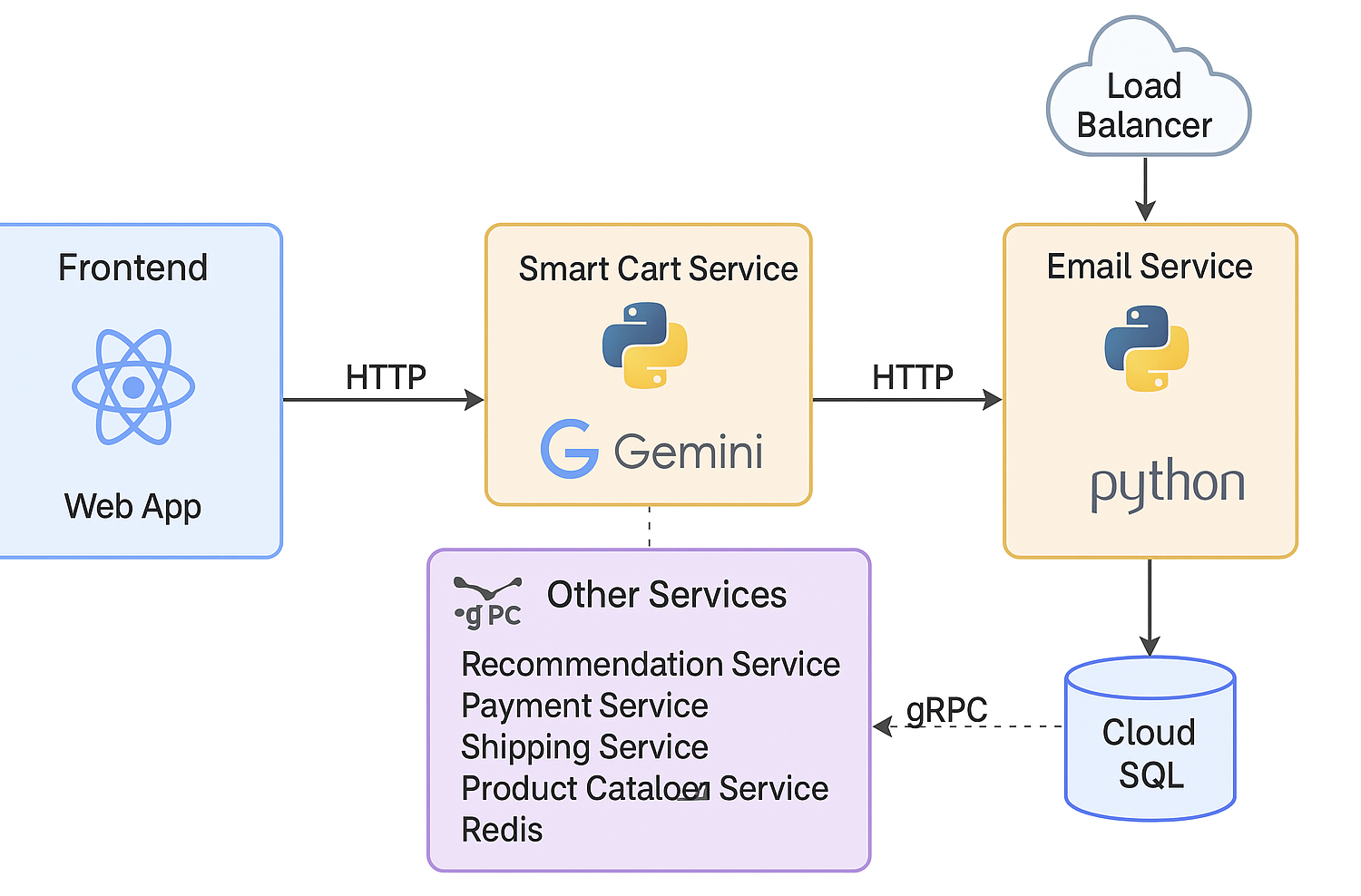
Inspiration
Choice overload makes online shopping tiring and irrational. We wanted an AI that helps users decide—not just “recommend”—by honoring user-defined priorities (quality, price, discount, after-sales, delivery, etc.), then warning before checkout if the cart deviates from those priorities.
What it does
• Lets users set personal weights for decision factors (e.g., Quality 0.5, Price 0.3, Discount 0.15, Service 0.05).
• Scores products with a transparent multi-criteria decision engine and returns a ranked list.
• Before checkout, computes a Deviation Score between the user’s weights and the current cart; if it’s high, prompts a confirm/adjust dialog.
• Uses Gemini 2.5 Flash to explain trade-offs (“why this item ranks higher”), propose what-if tweaks, and generate concise rationale in natural language.
How we built it
• Lets users set personal weights for decision factors (e.g., Quality 0.5, Price 0.3, Discount 0.15, Service 0.05).
• Scores products with a transparent multi-criteria decision engine and returns a ranked list.
• Before checkout, computes a Deviation Score between the user’s weights and the current cart; if it’s high, prompts a confirm/adjust dialog.
• Uses Gemini 2.5 Flash to explain trade-offs (“why this item ranks higher”), propose what-if tweaks, and generate concise rationale in natural language.
Challenges we ran into
Image/tag drift & “latest” pitfalls → fixed by letting Skaffold inject repo+tag. • Health probes initially 404 (paths didn’t exist) → aligned probes with service routes. • Multi-arch images (arm64 vs amd64) causing exec format error → standardized builds to linux/amd64. • Cluster resources (Insufficient memory) → tuned requests/limits. • Secrets & safety under time pressure.
Accomplishments that we're proud of
Shipped a decision-making AI (not just recommendations) on GKE with Gemini 2.5 Flash. • Clean integration as a new microservice—no core app changes. • Transparent, weighted decisions + pre-checkout deviation guard to reduce impulsive buys.
What we learned
Reliable delivery on GKE = clean image strategy, correct probes, resource tuning, and Secret hygiene—and that deployment/debug time often exceeds coding time.
What's next for SmartCart AI — Preference-Weighted Buying Assistant
• User profiles & persistent preferences; A/B test different weight presets.
• Constraint-aware “what-if” (e.g., “under $200 but +10% quality”).
• Voice & multilingual support.
• Package as a drop-in AI decision plugin for more e-commerce stacks.
Built With
- chatgpt
- docker
- fastapi
- flask
- gemini
- gemini2.5-flash
- gke
- javascript
- kubectl
- python
- skaffold

Log in or sign up for Devpost to join the conversation.