-
-
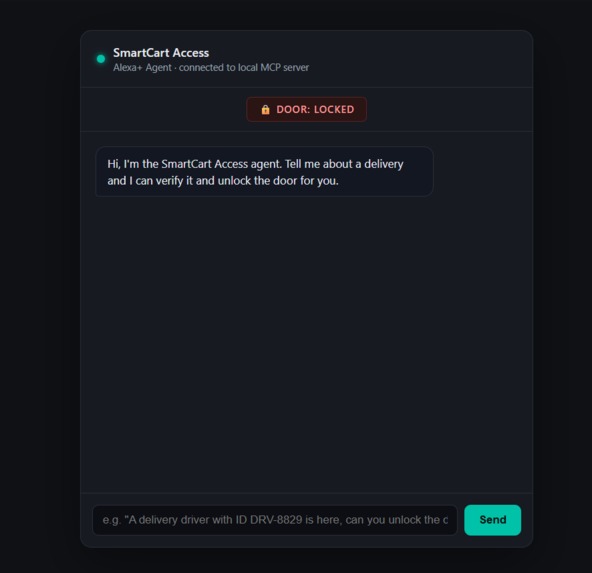
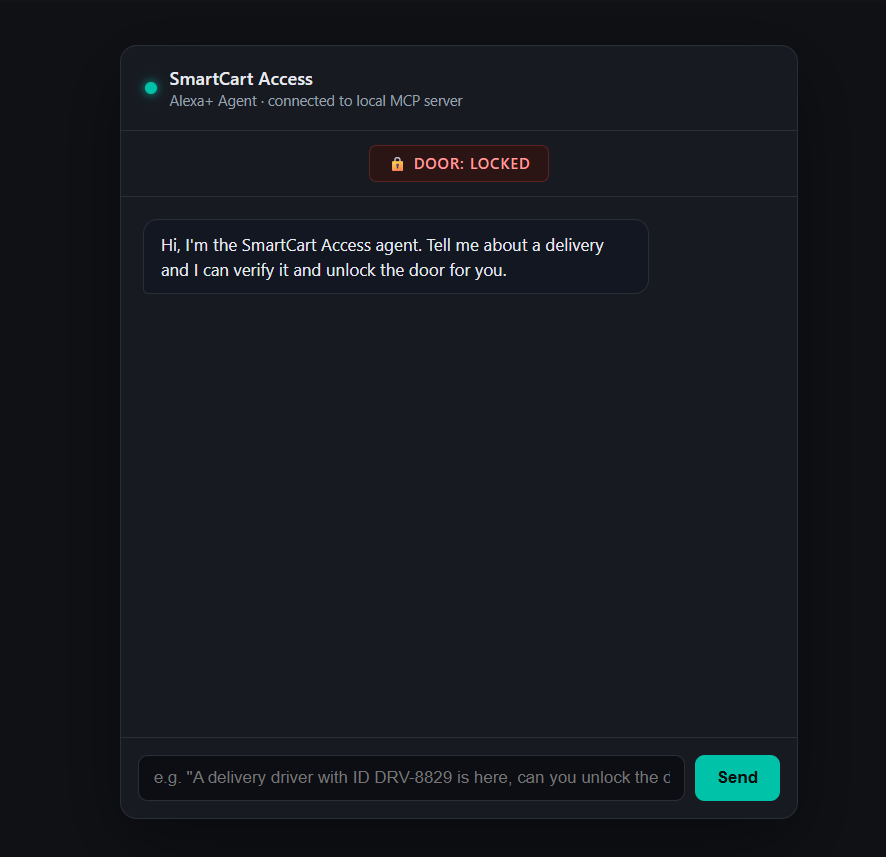
The default locked state. The Alexa+ Agent waits for a delivery driver to provide their credentials.
-
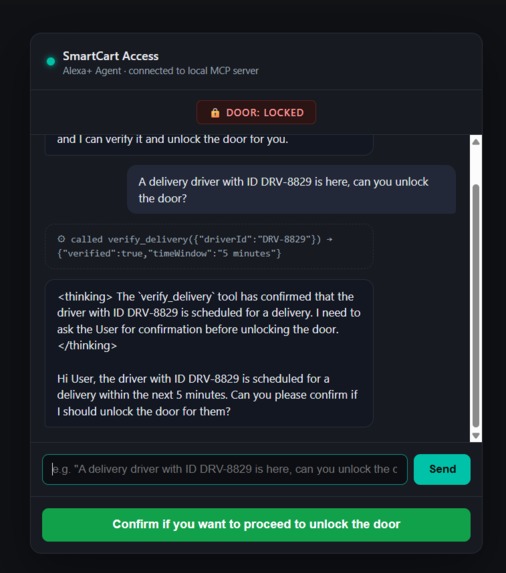
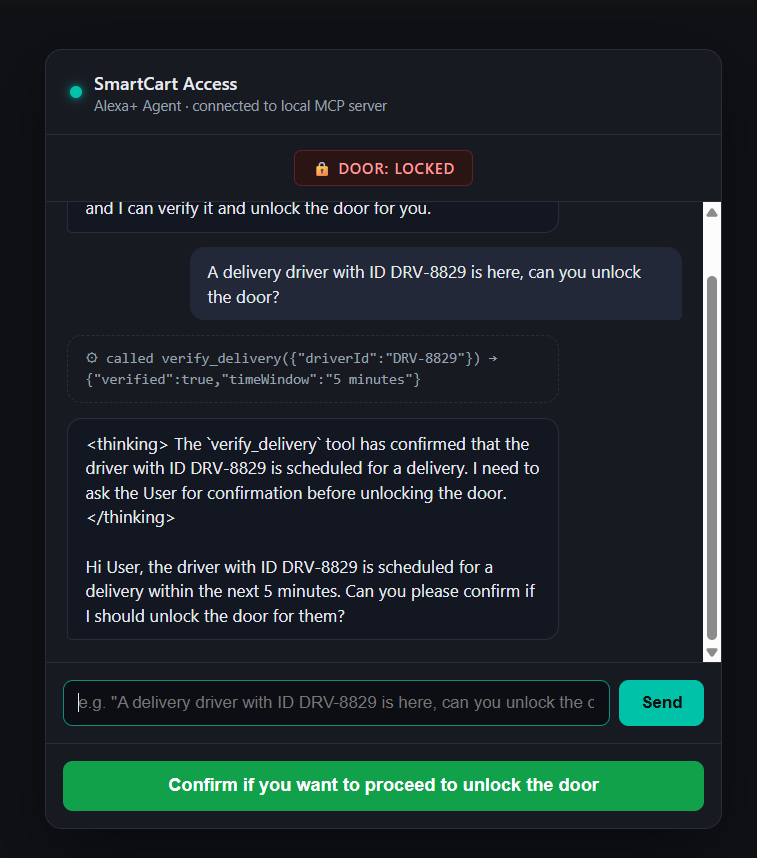
The AI agent processes the input in real time and verifies the credentials via the local MCP server.
-
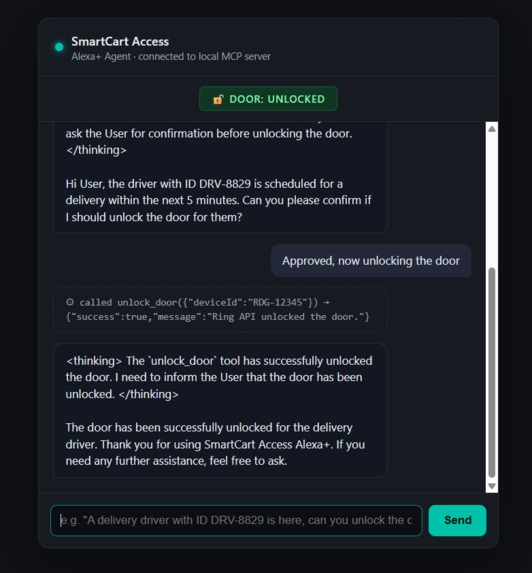
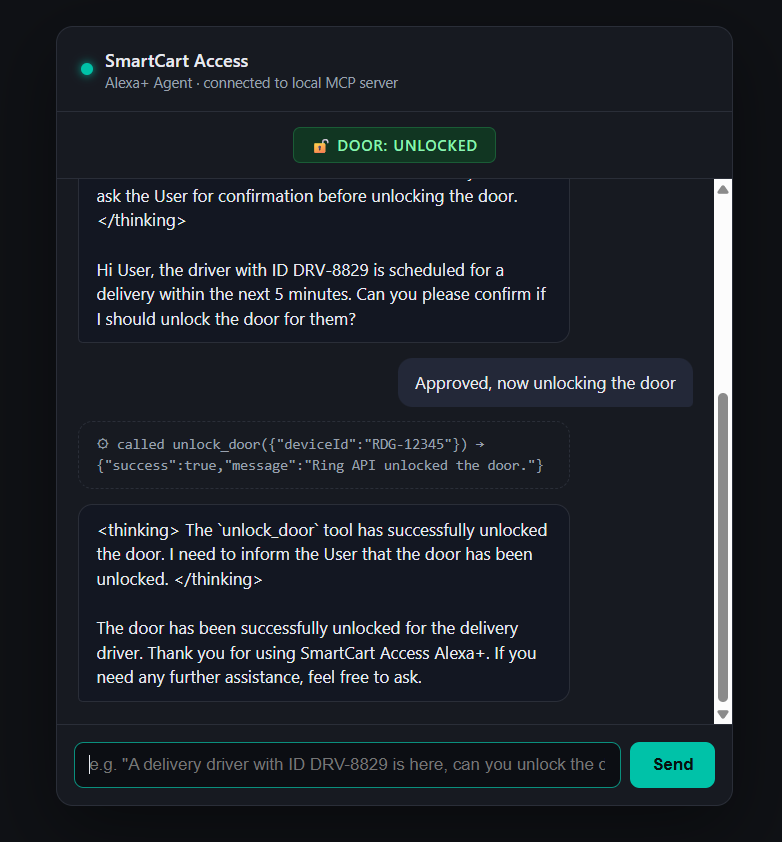
Verification successful! The local server triggers the unlock command, updating the UI to "UNLOCKED" instantly.
-
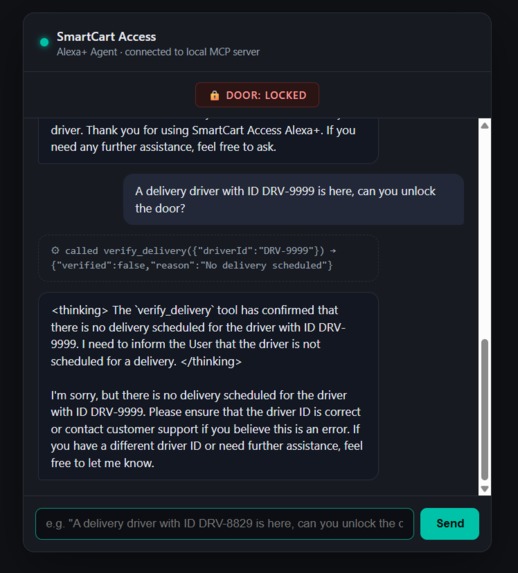
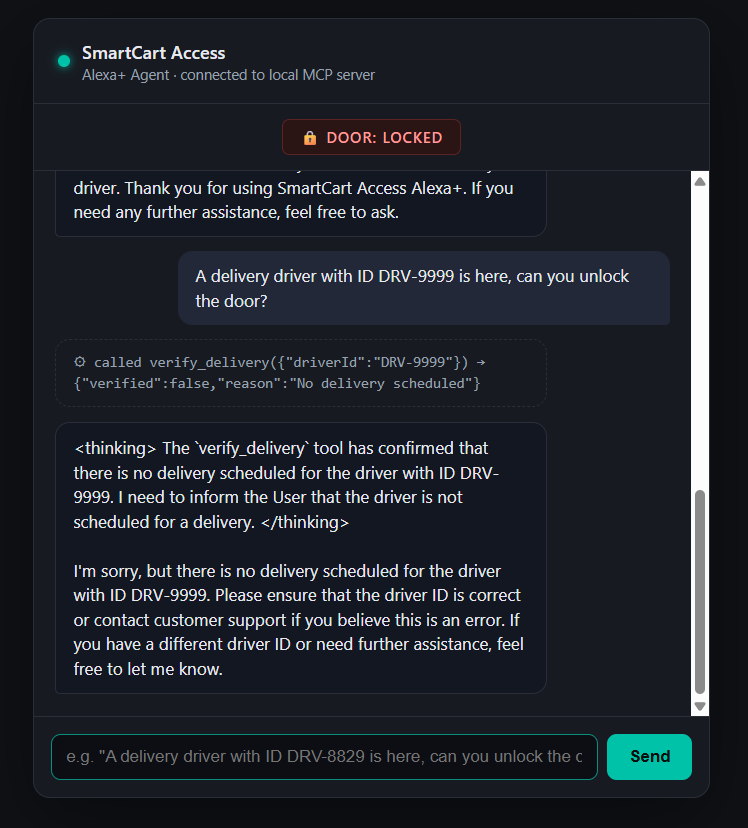
Invalid IDs are rejected, triggering an exponential backoff delay to prevent brute-force guessing attacks.
Inspiration
The idea came from a very real personal frustration: there are times when I'm not home and don't have anyone available to bring in a package. Whether it's unpredictable weather threatening to ruin a delivery or just wanting the peace of mind that a box isn't sitting outside on the porch for too long, I needed a way to secure deliveries remotely. I wanted to build a system that could intelligently verify a delivery driver and grant them temporary access to a safe drop-off zone so I could be completely worry-free.
What it does
SmartCart Access lets a delivery driver verify their identity conversationally at the door — through an AI agent rather than a keypad or app. Once verified, the system grants temporary access to a secure drop-off zone and unlocks it in real time. A dark-themed web control-center shows the live door state (DOOR: LOCKED → unlocked) so the homeowner always knows exactly what's happening with their delivery, even when they're not home.
How I built it
I designed a sleek, dark-themed web interface to serve as the user-facing control center. The core of the application is an Alexa+ Agent connected to a local MCP (Model Context Protocol) server. The frontend captures conversational queries — such as a delivery driver providing their ID at the door — and routes them to the AI. The agent processes the context, verifies the credentials, and communicates with the local server to trigger physical actions, updating the UI in real time when the door state changes.
Challenges I ran into
The most significant hurdle was establishing reliable, low-latency communication between the conversational AI and the local MCP server simulating the hardware lock. Managing the asynchronous state so that the UI instantly and accurately reflected the physical door status required careful event handling.
Additionally, ensuring the system was secure against brute-force verification spam by someone just guessing IDs at the door was critical. To mitigate this, I implemented an exponential backoff algorithm for failed ID verification attempts. The lockout delay increases exponentially based on the formula:
$$t_{\text{delay}} = t_{\text{base}} \cdot 2^n$$
where ( t_{\text{delay}} ) is the enforced wait time before the next attempt, ( t_{\text{base}} ) is the initial penalty duration, and ( n ) represents the number of consecutive failed verification attempts.
Accomplishments that I'm proud of
I am incredibly proud of successfully bridging the gap between a conversational AI and a local hardware-simulating system. Getting the Alexa+ Agent to accurately understand a delivery driver's input, verify it, and communicate with the local MCP server in real-time was a major technical win. I'm also really proud of the UI design; I managed to build a sleek, intuitive dark-mode interface that makes interacting with a security system feel modern and seamless rather than clunky.
What I learned
Building SmartCart Access taught me a lot about the Model Context Protocol (MCP) and how to build a server that can execute physical-world commands based on an AI's conversational intent. I learned how to handle complex asynchronous state management—ensuring that the frontend UI instantly reflects the backend door status without any confusing lag. Additionally, thinking through the security aspects taught me how to implement practical safeguards, like exponential backoff algorithms, to protect the system from malicious access attempts.
What's next for SmartCart Access
My immediate next step is taking this out of the simulated environment and integrating it with real-world IoT smart locks and doorbell cameras. I want to add a live video feed directly into the chat interface so I can see exactly who the agent is interacting with. Beyond hardware, I plan to integrate with major delivery carrier APIs (like UPS, FedEx, and USPS) so the agent can cross-reference the driver's ID with actual, real-time tracking numbers for expected packages. Finally, I'd love to expand the system to generate temporary, time-limited access codes for friends, family, or dog walkers.
Built With
- ai
- alexa
- amazon-web-services
- api
- aws-ce2
- css
- html
- iot
- javascript
- json
- mcp
- security
- smart-home
- web

Log in or sign up for Devpost to join the conversation.