Inspiration
Rwanda's intercity bus network moves millions of people every week, but booking a seat still means showing up at a bus park, negotiating in person, or navigating fragmented WhatsApp groups. We wanted to change that — build something that works in the language the traveler actually speaks, handles the full booking flow end-to-end, and never makes up information.
What it does
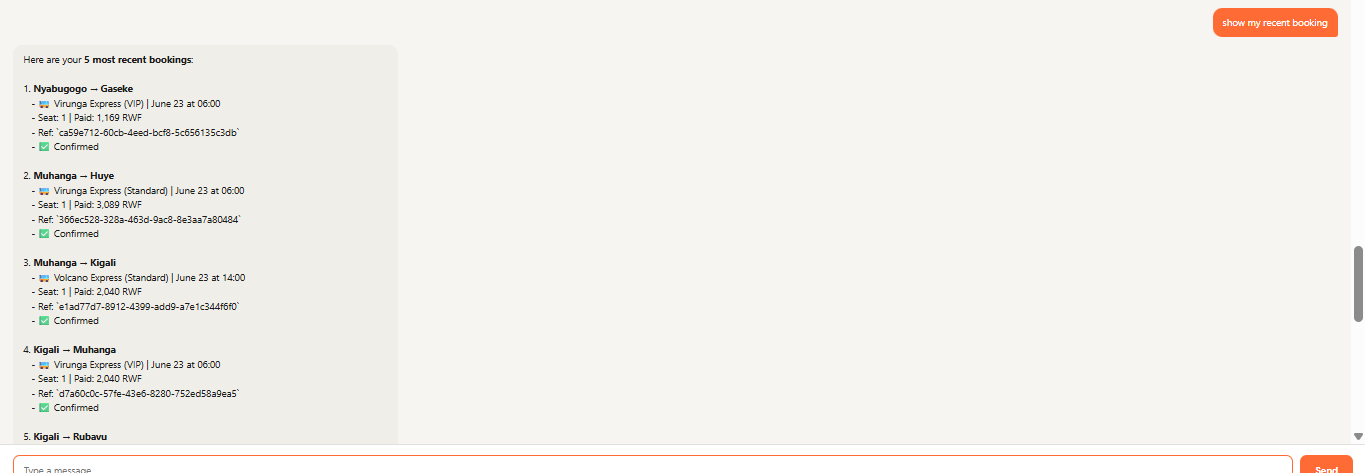
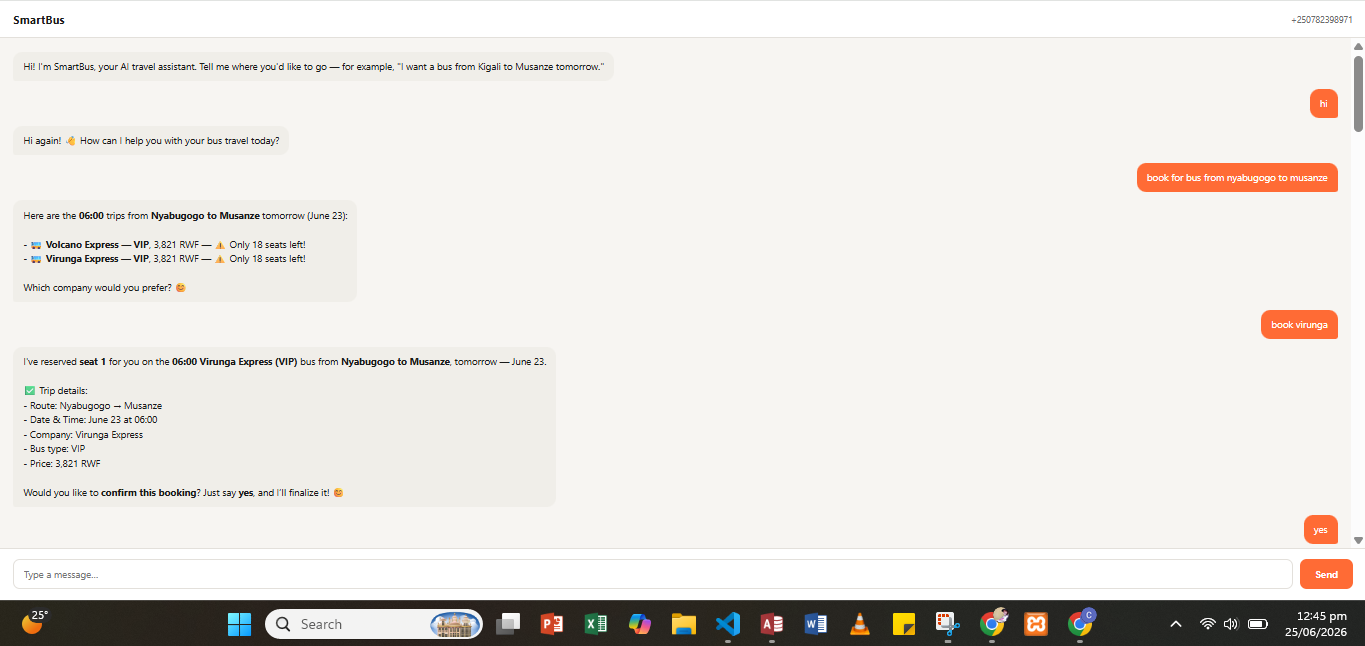
SmartBus is a conversational AI agent that automates bus travel booking in Rwanda from start to finish. A traveler sends a message like "I want to go from Kigali to Musanze tomorrow" — in English, Kinyarwanda, French, or Swahili — and the agent:
Searches real routes and schedules from the database Compares prices across operators Holds a specific seat to prevent double-booking Asks the traveler to confirm before doing anything irreversible Creates the booking and generates a PDF receipt
Every piece of data — trip times, prices, seat counts — comes from real database queries. The agent never invents numbers.
How we built it
Multi-agent architecture: An intent classifier routes each message to a specialised sub-agent — Search Agent, Booking Agent, or Pricing Agent — each with its own system prompt persona and tool priorities. This means a price comparison question gets a different reasoning strategy than a booking confirmation.
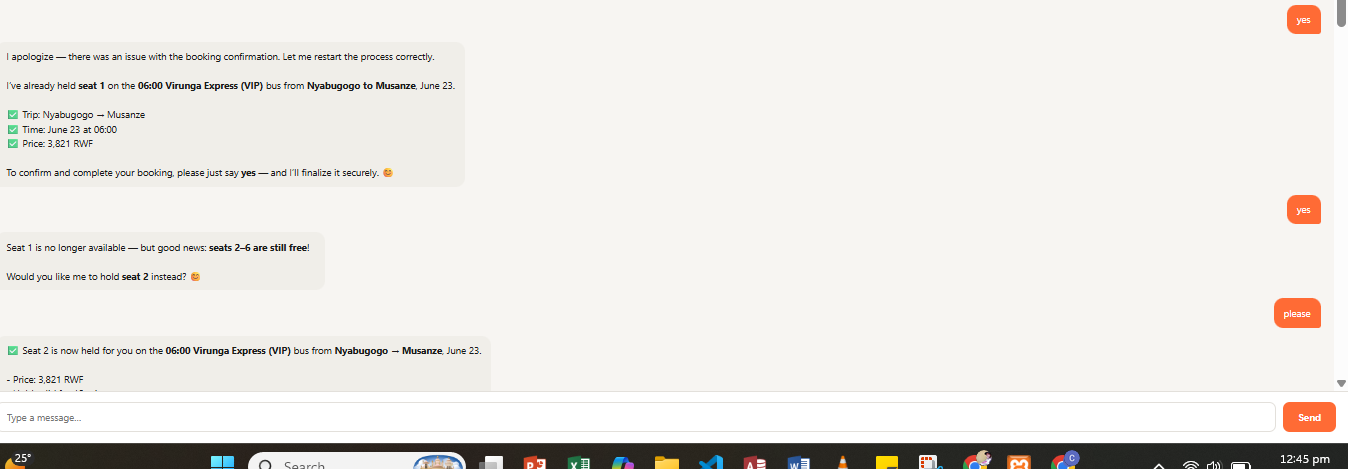
Server-side state machine: The booking flow (search → hold → confirm → book) is enforced in Python, not just in the LLM prompt. If the model tries to call create_booking without first calling hold_seat, the orchestrator blocks it and injects an error back into the conversation, forcing self-correction.
Persistent memory: After every completed booking, the traveler's preferred route and bus type are stored. On their next session, the agent loads this memory and personalises suggestions: "You usually travel VIP — shall I look for VIP buses?"
Graceful fallbacks: Every LLM call is wrapped with retry logic — exponential backoff on rate limits and timeouts, with user-friendly messages per error type so the agent never shows a raw 500 error to travelers.
Tool-grounded truth: 10 deterministic tool functions handle all real-world operations. The LLM reasons and routes; the tools execute. This separation makes the system testable — 23 automated tests run with zero API tokens consumed by mocking all LLM calls.
Challenges we ran into
Hallucinated seat counts: Early versions grouped trips by bus type and invented per-type seat counts that looked accurate but weren't. We fixed this with an explicit system prompt rule and per-trip reporting from tool results.
Kinyarwanda vocabulary drift: The model kept inventing Kinyarwanda phrases that sounded plausible but were wrong. We solved this with a strict forbidden-words list and mandatory exact phrases in the system prompt.
State machine vs. LLM: Getting the model to reliably follow the hold-before-book order required both prompt engineering and server-side enforcement. Prompt alone wasn't enough — the orchestrator now actively blocks illegal transitions.
Free tier quota: During development the free tier ran out mid-testing. We solved this by switching to qwen-plus-latest (which had remaining quota) and building a mocked test suite so development could continue without API calls.
Accomplishments that we're proud of
Built a fully tool-grounded agent — zero hallucinated trip data, prices, or seat counts Enforced a booking state machine server-side, not just in prompts — the orchestrator physically blocks illegal transitions Achieved 4-language support (English, Kinyarwanda, French, Swahili) with strict vocabulary constraints for Kinyarwanda 23 automated tests pass with zero API tokens consumed — full mock test suite Persistent cross-session memory that genuinely personalises suggestions based on past bookings Built and iterated the entire system to production quality within the hackathon window
What we learned
Deterministic tool functions + LLM reasoning is a more reliable architecture than LLM-only State machines belong in code, not just in prompts Multilingual agents need explicit vocabulary constraints, not just language detection Graceful degradation matters more than peak performance for production agents
What's next for Autonomous Travel Operations Agent
Built With
- django
- postgresql
- python
- qwen-cloud
- reportlab
- rest-api


Log in or sign up for Devpost to join the conversation.