-
-
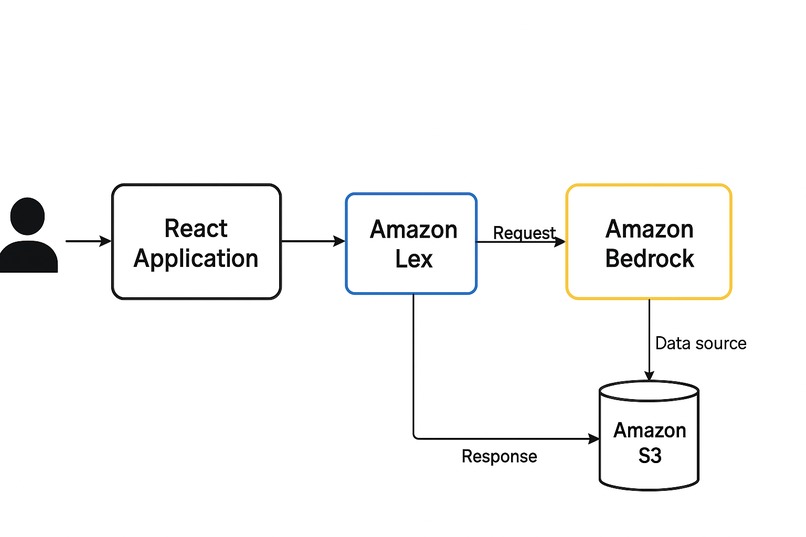
Architecture diagram for smartbot
Inspiration
We were inspired by the growing need for intelligent, context-aware customer support systems that go beyond static FAQ bots. With the rise of Generative AI and RAG (Retrieval-Augmented Generation), we wanted to explore how Amazon’s ecosystem—especially Lex and Bedrock—can be combined to build a chatbot that understands queries and provides precise, data-driven answers.
What it does
Our project is an AI-powered chatbot built using Amazon Lex integrated with Amazon Bedrock Knowledge Bases to provide natural language Q&A responses about products. The goal was to create a smart conversational assistant capable of retrieving product details, descriptions, and insights directly from structured and unstructured data — making information discovery faster and more human-like.
How we built it
Amazon Lex: Created a conversational chatbot interface and designed a QnA intent to handle product-related questions.
Amazon Bedrock Knowledge Base: Configured a knowledge base using product data stored in Amazon S3 and connected it with Titan Embeddings for vector-based search and retrieval.
Integration: Linked the Bedrock Knowledge Base with the Lex QnA intent so the chatbot could dynamically fetch relevant product information from the indexed data.
Testing & Validation: Used the Lex test console to verify conversational flows and ensure accurate retrieval from the knowledge base.
Challenges we ran into
Configuring permissions between Amazon Lex, Bedrock, and IAM roles was initially tricky, especially for enabling secure access to the Knowledge Base.
Understanding how Bedrock’s embedding and retrieval process worked under the hood required deep exploration of documentation and hands-on testing.
Managing time between ongoing client priorities and the hackathon deliverables was challenging, but we ensured meaningful progress and learnings.
Accomplishments that we're proud of and what we learned
Gained a strong understanding of Amazon Bedrock’s RAG pipeline and how embeddings power contextual responses.
Learned how to integrate Lex bots with external knowledge bases, making them smarter and more dynamic.
Explored ways to extend the same architecture for other use cases such as order tracking, customer support, and internal knowledge assistants.
What's next for smartbot
Expand the chatbot with additional intents like Order Tracking and Customer Support, each powered by their own Bedrock Knowledge Bases.
Add multi-language support and UI integration with web and mobile frontends.
Explore Amazon Agent Framework to enable reasoning-based multi-turn conversations.
Built With
- amazon-web-services
- bedrock
- iam
- lex
- react
- s3

Log in or sign up for Devpost to join the conversation.