-
-
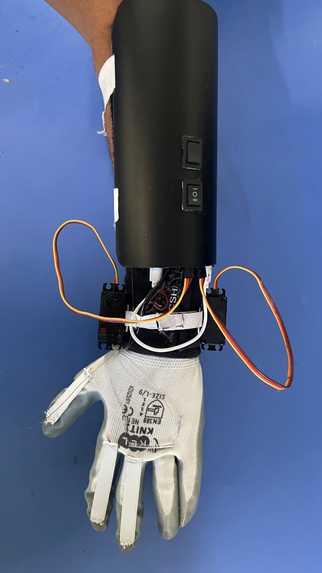
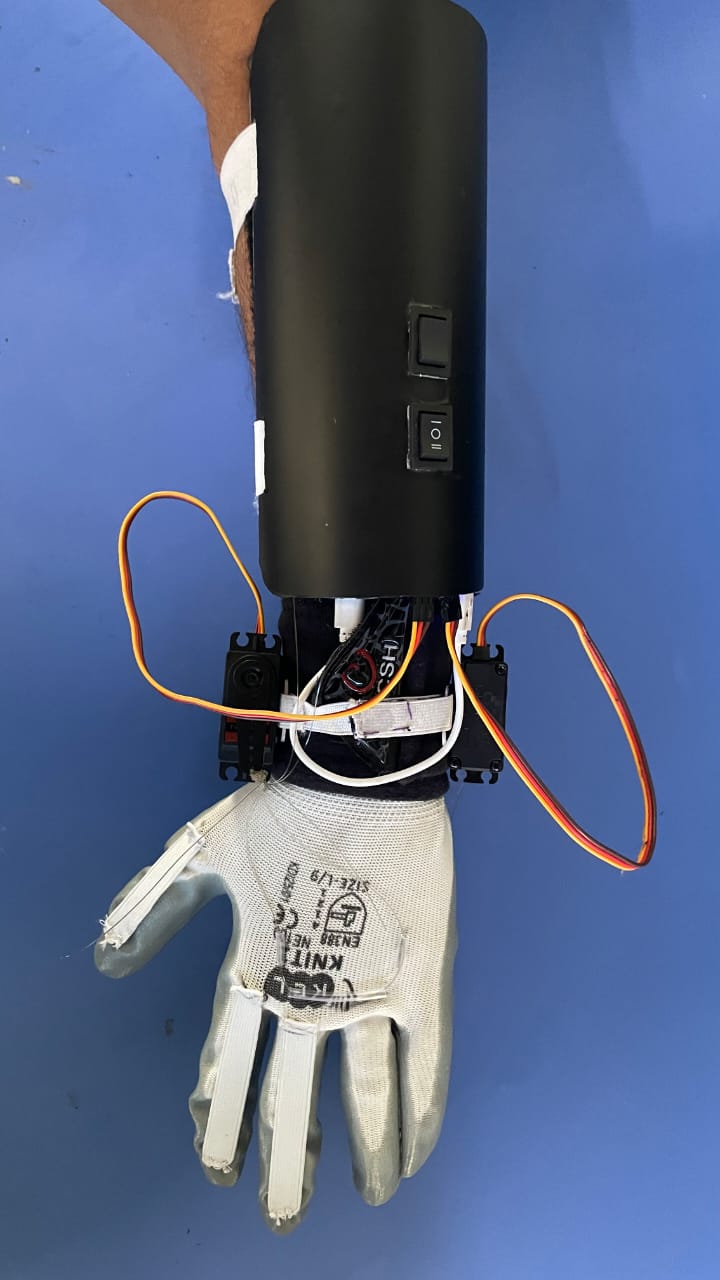
Wearable orthosis fitted on hand, demonstrating comfortable design
Inspiration
The idea for this project came from observing patients with upper-limb weakness and paralysis who struggle with daily activities like holding objects or writing. We also visited hospitals and interacted with Doctors, which helped us better understand their challenges and the limitations of existing passive support devices. Additionally, attending events like Smart India Hackathon (SIH), DIPEX, and startup showcases helped us refine our idea and align it with real-world needs.
What it does
This project is a smart wrist-hand orthosis that assists wrist and finger movement. It enables users to perform grasp and release actions using a simple switch, mobile app, and voice control, helping them carry out daily tasks independently.
How we built it
The system is built using an ESP32 microcontroller integrated with servo motors. A tendon-based pulley mechanism controls finger movement and enables effective grasping. The device is powered by a Li-ion battery and designed to be lightweight, comfortable, and wearable. App and voice control are integrated for ease of use.
Challenges we ran into
We faced challenges in achieving smooth and synchronized finger movement, maintaining optimal grip strength, and designing a compact and comfortable structure. Power management and ensuring reliable control were also key challenges.
Accomplishments that we're proud of
We successfully designed and built a functional prototype of a smart wrist-hand orthosis that enables active grasp and release. We validated our idea through hospital visits and user interaction. Additionally, presenting and refining our project through platforms like SIH, DIPEX, and startup events was a significant achievement.
What we learned
We gained practical knowledge in embedded systems, microcontroller programming, and actuator control. We also learned the importance of user-centered design and how to integrate hardware with mobile and voice-based interfaces for better usability.
What's next for Smart Wrist-Hand Orthosis for Functional Independence
We have developed a functional prototype of the device. Our next step is to conduct real-world testing with patients to validate its effectiveness. We also plan to collaborate with medical professionals to standardize the design and ensure safety. Ultimately, we aim to make the device accessible and help patients regain independence in their daily lives.
Built With
- arduino
- embedded
- embedded-c/c++
- esp32
- li-ion-battery
- mobile-app-(wi-fi/bluetooth)
- sensors-&-actuators
- servo-motors
- tendon-pulley-mechanism
- voice-control-integration


Log in or sign up for Devpost to join the conversation.