-
-
Smart weather forecasting using ML
Inspiration
Weather conditions play an important role in agriculture, transportation, environmental monitoring, and daily life. Sudden changes in temperature, humidity, atmospheric pressure, and rainfall can affect people and their activities. Traditional weather monitoring methods may require manual measurements and may not provide continuous, real-time information.
To address these challenges, we developed Smart Weather Forecasting Using Machine Learning (ML). Our inspiration was to combine the Internet of Things (IoT) and machine learning to build an affordable, intelligent system that monitors environmental conditions and supports the prediction of future weather trends.
What it does
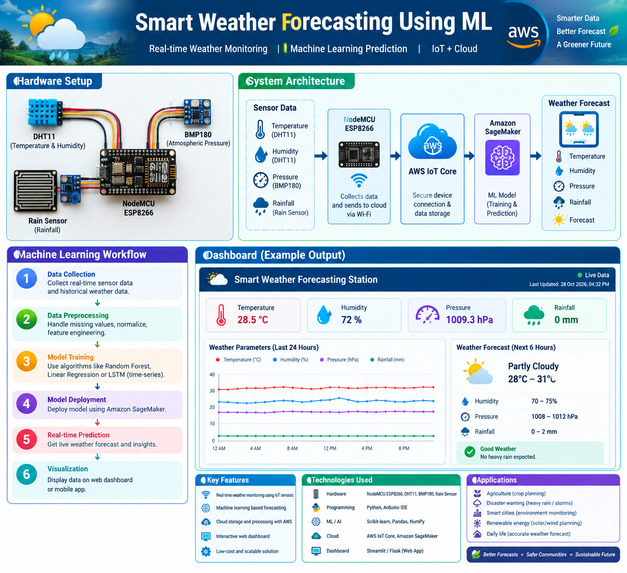
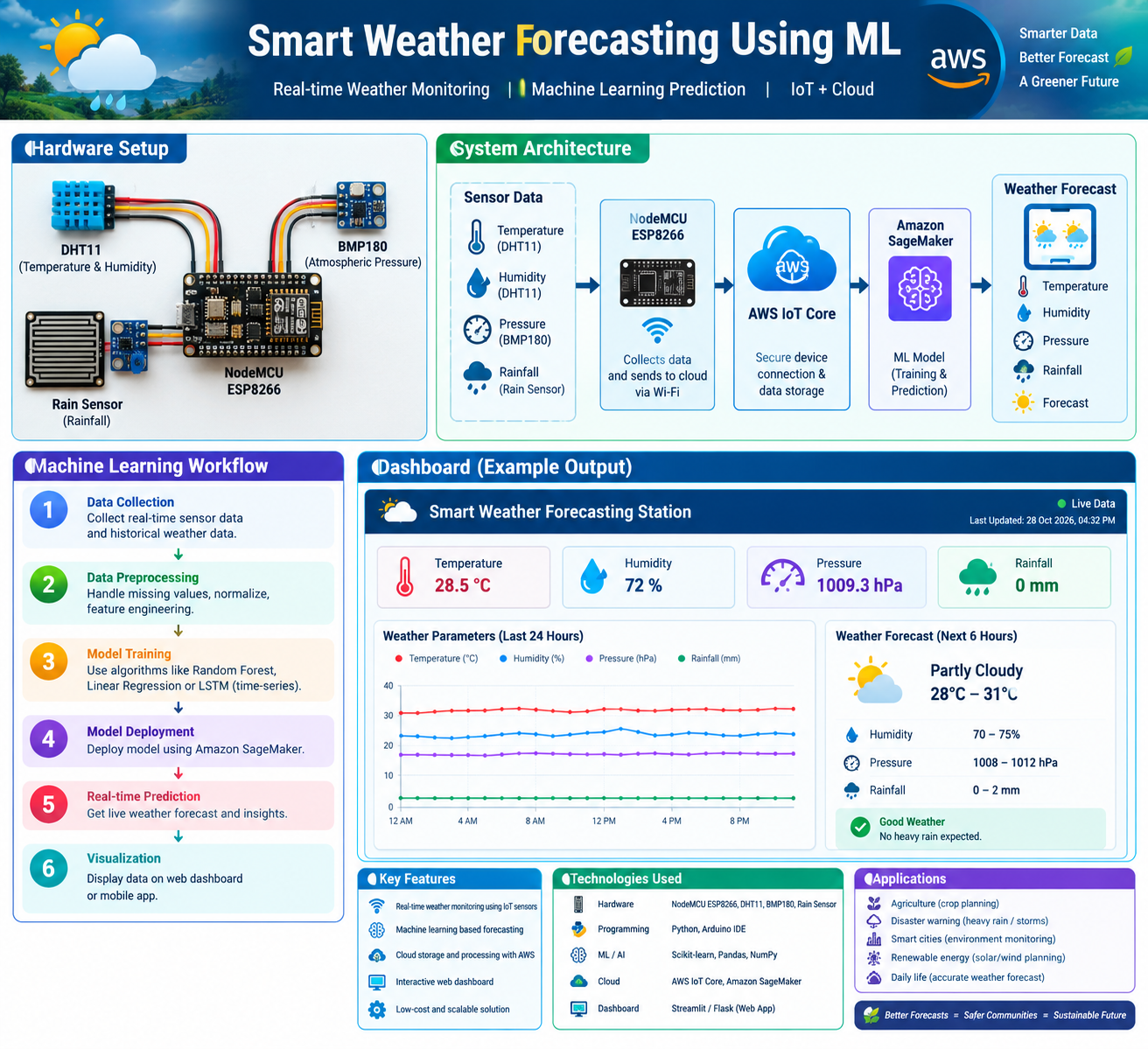
Smart Weather Forecasting Using ML is designed to collect environmental data, display sensor readings through an IoT cloud platform, and use machine learning techniques to analyze weather patterns.
The main features are:
- Temperature and humidity monitoring: Uses the DHT11 sensor to measure environmental temperature and humidity.
- Atmospheric pressure monitoring: Uses the BMP180 sensor to measure atmospheric pressure.
- Rain detection: Uses a rain sensor to identify changes in rainfall-related conditions.
- IoT cloud connectivity: Uses the NodeMCU ESP8266 Wi-Fi module to send sensor readings to ThingSpeak.
- Weather data analysis: Uses collected and historical data to identify patterns and support machine learning-based forecasting.
- Future improvements: The system can be extended with weather alerts, prediction dashboards, and additional environmental sensors.
The forecasting component depends on suitable historical weather data and a trained, validated ML model.
How we built it
We developed the system by integrating hardware components, embedded programming, cloud connectivity, and machine learning concepts.
Hardware components:
- NodeMCU ESP8266 microcontroller
- DHT11 temperature and humidity sensor
- BMP180 atmospheric pressure sensor
- Rain sensor module
- Connecting wires, breadboard, and USB power supply
Software and technologies:
- Arduino IDE for microcontroller programming
- Embedded C/C++ for sensor interfacing and Wi-Fi communication
- ThingSpeak for IoT data storage and visualization
- Python for data preprocessing, machine learning model training, and evaluation
- Machine learning algorithms for identifying weather patterns and predicting weather conditions
The NodeMCU reads sensor values and transmits the collected data through Wi-Fi to ThingSpeak. The data can then be organized with historical weather records for training and evaluating an ML model.
A simplified representation of the input data is:
$$ X = [T,H,P,R] $$
where (T) represents temperature, (H) represents humidity, (P) represents atmospheric pressure, and (R) represents a rainfall-related sensor measurement.
The forecasting model can estimate a future weather variable using:
$$ \hat{y}_{t+1}=f(T_t,H_t,P_t,R_t) $$
Here, (f) represents the trained machine learning model, and (\hat{y}_{t+1}) represents the predicted value for the next time step. Actual forecasting performance must be evaluated using suitable test data.
Challenges we ran into
During development, we encountered challenges in connecting the sensors correctly, obtaining reliable readings, configuring the NodeMCU ESP8266, establishing Wi-Fi connectivity, and transmitting data to ThingSpeak.
We learned that sensor readings may be affected by wiring problems, power supply issues, sensor limitations, and environmental conditions. Another important challenge is that machine learning models require sufficient, accurate, and representative historical data.
We approached these challenges through systematic hardware testing, code debugging, checking sensor outputs, verifying cloud communication, and identifying the need for proper data preprocessing and model evaluation.
Accomplishments that we're proud of
We are proud of designing a low-cost weather monitoring system that combines multiple environmental sensors with IoT connectivity. The project demonstrates how a microcontroller can collect weather-related measurements and transmit them to a cloud platform for visualization and analysis.
We also developed an understanding of how machine learning can extend a basic monitoring system by identifying patterns in historical weather data. The modular design provides a foundation for building a more advanced forecasting solution.
What we learned
Through this project, we learned:
- How to interface DHT11, BMP180, and rain sensors with a NodeMCU ESP8266.
- How to collect environmental measurements using embedded programming.
- How Wi-Fi communication connects hardware devices to an IoT cloud platform.
- How ThingSpeak can be used to store and visualize sensor data.
- How historical datasets can be cleaned and prepared for machine learning.
- Why model training, testing, and evaluation are important for forecasting.
- How to debug hardware and software problems through systematic testing.
- How IoT and ML can work together to support environmental monitoring and decision-making.
This project improved our practical knowledge of embedded systems, cloud computing, data analysis, and machine learning.
What's next for Smart Weather Forecasting Using ML
Our future plan is to improve the system by collecting more historical weather data and training suitable machine learning models. We aim to compare different algorithms, evaluate their prediction errors, and select a model based on measured performance.
We also plan to develop a user-friendly dashboard that displays real-time sensor readings, historical trends, and predicted weather conditions. Additional features may include rainfall alerts, changing-pressure notifications, mobile access, and integration with external weather datasets.
In the long term, the system could be adapted for agriculture, smart cities, educational laboratories, and local environmental monitoring. Our goal is to develop a reliable, affordable, and scalable solution that makes weather information easier to monitor and understand.


