Inspiration
The smart wearable/portable device project was inspired by the significant challenges faced by visually impaired individuals in their daily navigation. With 39 million people blind worldwide, the need for accessible and empowering solutions is critical. Existing solutions have limited accessibility, which highlights the need for a more effective and comprehensive tool to improve mobility, independence, and safety.
How We Built It
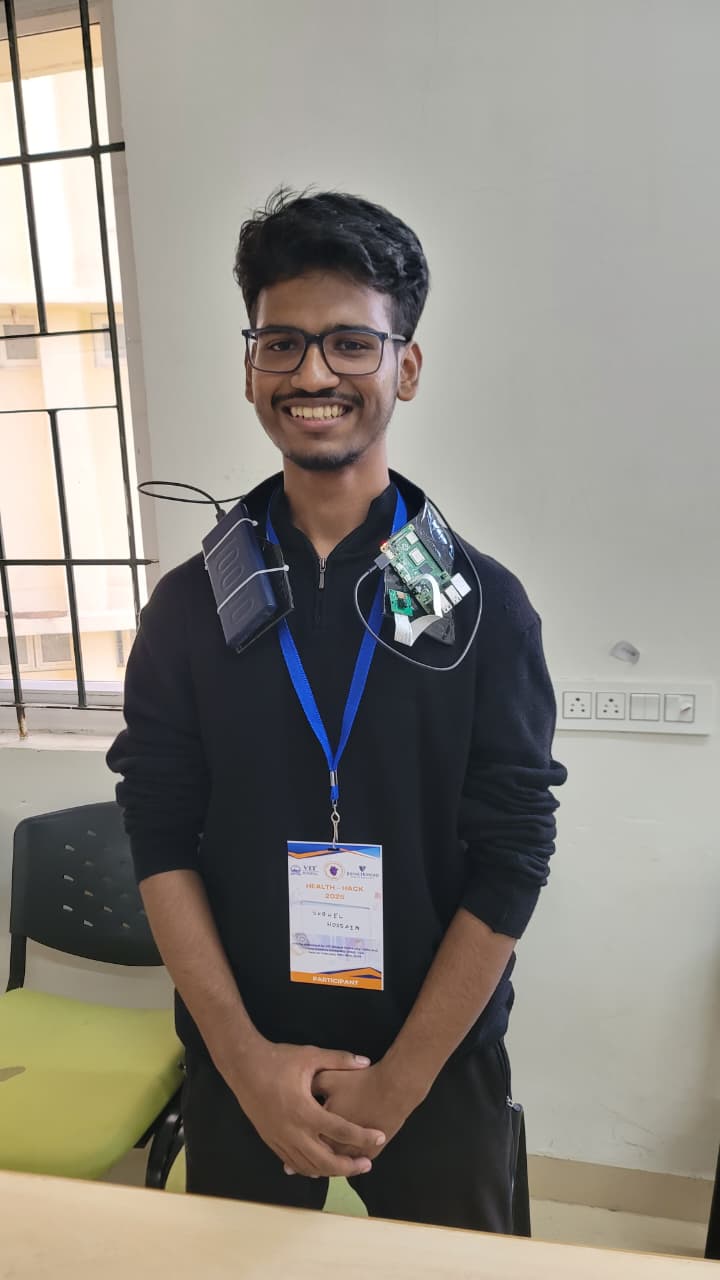
It is a smart wearable and portable device that uses real-time navigation and obstacle detection. The system is built with a combination of functional hardware and software. The core components include a Raspberry Pi 8GB, a monocular camera, and a power source.
The system's workflow begins by initializing the sensors and continuously checking for obstacles. If an obstacle is detected, the device plans a new path to avoid it. If no obstacles are detected, the user can move forward along their path. The device then updates its position and checks if the destination has been reached. This continuous loop ensures safe navigation.
The technical implementation uses several advanced techniques: 1) vSLAM (Visual Simultaneous Localization and Mapping): For real-time location tracking. 2) Sensor Fusion: Combining data from multiple sensors for improved accuracy. 3) A* (A-star) Algorithm:For efficient pathfinding and planning. 4) OpenCV:An open-source computer vision library used for image and video processing.
Challenges We Ran Into
During development, we faced challenges related to processing power and creating custom datasets. We addressed these issues by using the Raspberry Pi's NPU (Neural Processing Unit) and building our own datasets to optimize performance. Other common challenges in wearable tech include limited screen size, battery life, and seamless integration with other devices and platforms. Wearable device design must consider the product's weight, how it rests against the body, and how it feels to wear it for extended periods.
Accomplishments
That We're Proud Of We are proud to have developed a working prototype that provides real-time navigation and obstacle detection. The low-cost hardware and efficient on-device processing are key accomplishments that make the device accessible and have the potential to save lives by reducing accidents. The project's business model is centered on its strong market potential in assistive technology and its affordable design for mass production.
What We Learned
Through this project, we learned the importance of balancing innovation with practicality. We gained a deeper understanding of real-time navigation and obstacle detection, as well as the commercial potential and scalability of assistive technology. We also learned that wearable technology design is a complex process that requires an interdisciplinary approach, bringing together engineers, designers, and data scientists to create devices that are both functional and user-friendly.
What's Next for Smart Wearable Device The next steps for smart wearable/portable device include several future enhancements. We plan to implement path segmentation for improved route accuracy using computer vision. We also want to provide real-time directions with optimized pathfinding and add SOS alerts with location sharing for emergencies. Finally, we aim to integrate the device with Google Maps for seamless navigation and live traffic updates. The future of wearable technology is moving towards more intuitive, seamlessly integrated, and AI-powered devices that are personalized and discreet.
Built With
- a*
- django
- google-maps
- opencv
- pip
- postgis
- postgresql
- python
- raspberry-pi
- sensorfusion
- vslam