-
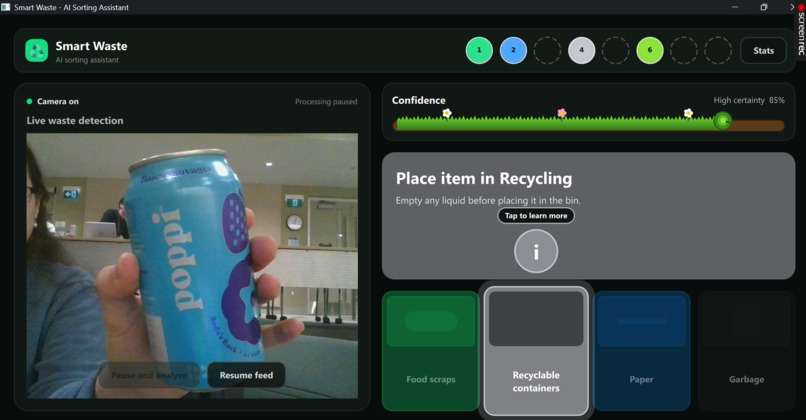
Main GUI identifying a can
-
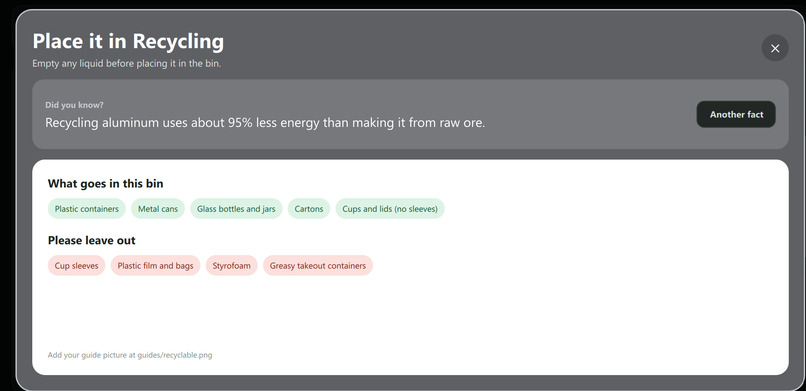
More info - can identification
Inspiration
Improper waste sorting remains a huge challenge in Vancouver: a 2023 Metro Vancouver waste audit found that 40% of items in multi-family residential garbage were actually compostable and should have been placed in Green Bins. Furthermore, a 2022 study conducted by the city found that 30–55% of inspected recycling and organics bins contained visible contamination.
This challenge is further complicated by local recycling guidelines. This confusion has measurable consequences: A study conducted across nine US cities found that products accepted for recycling in some cities but not others had a 52% sorting error rate, compared with just 8% for products accepted everywhere. This is likely part of the issue in Vancouver, where disposal instructions can differ depending on whether someone lives in a house or apartment, and the collection service available in their community.
And so the problem is that waste is being mis-sorted and people are getting confused. So what can we do about it? The answer might be surprisingly close to home.
A UBC study by Luo et al. (2019), published in the Journal of Environmental Management, demonstrated that immediate digital feedback can improve recycling and composting accuracy. In controlled experiments involving UBC undergraduate students, participants who received immediate feedback on their sorting decisions demonstrated significantly greater accuracy than those who did not receive feedback. These improvements persisted even when feedback was removed and remained observable one week later.
This led us to wonder- if our team could design a solution that provided immediate feedback on waste sorting, available at the click of a button... how much more of an impact could we have on the way our cities recycle? By simplifying waste classification and making sorting instructions more accessible, we aim to reduce incorrect disposal, and improve recycling participation, leading to a
Our Solution
We implemented a Computer-Vision-powered Smart Waste-Sorting Tool, which, upon capturing an image of the item the user wishes to discard, identifies the type of waste it is. For example:
- Recyclable containers
- Paper
- Food scraps
- Garbage
Rather than requiring residents to memorize complicated guidelines or search through municipal websites, users simply photograph an item and receive immediate, location-specific disposal instructions. This aims to make waste disposal the easiest it has ever been.
Features
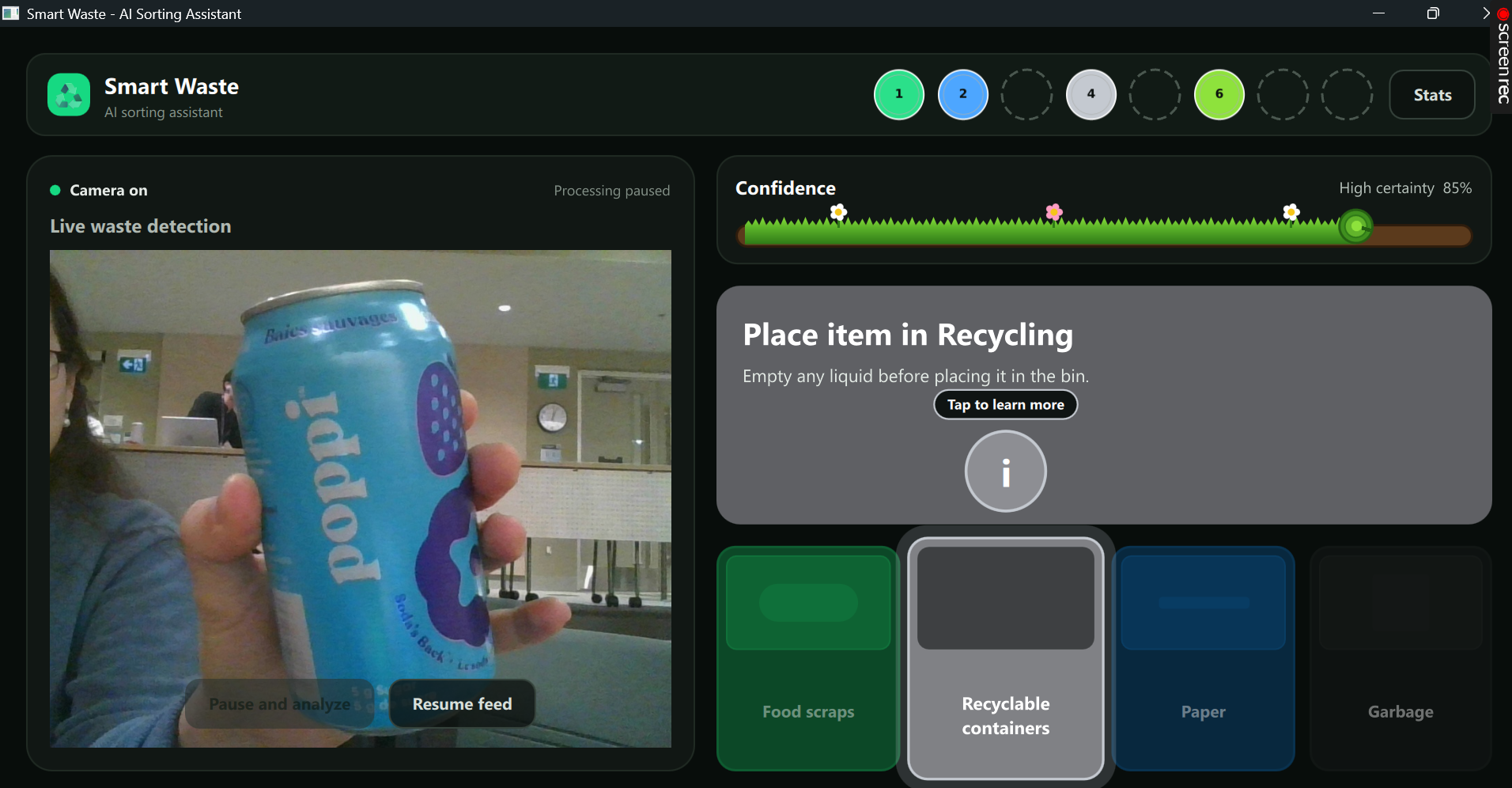
Camera feed: Our camera feed, along with "pause and analyse" and "resume" buttons allows for live capture and identification of different items in an efficient and intuitive way.
Progress badges: Knowing the power of gamification in promoting healthy habits, we added a badge system where over time, users can earn "rewards" for their good recycling habits, which is intended to motivate users to recycle well and more frequently.
Certainty meter: We also added is a "percent certainty" meter bar: we understand that, considering the complexity of items to recycle, our computer vision model might detect more than one waste sorting category in a picture. To help provide more context for the user, the certainty meter bar reflects the certainty of the model in predicting that particular category.
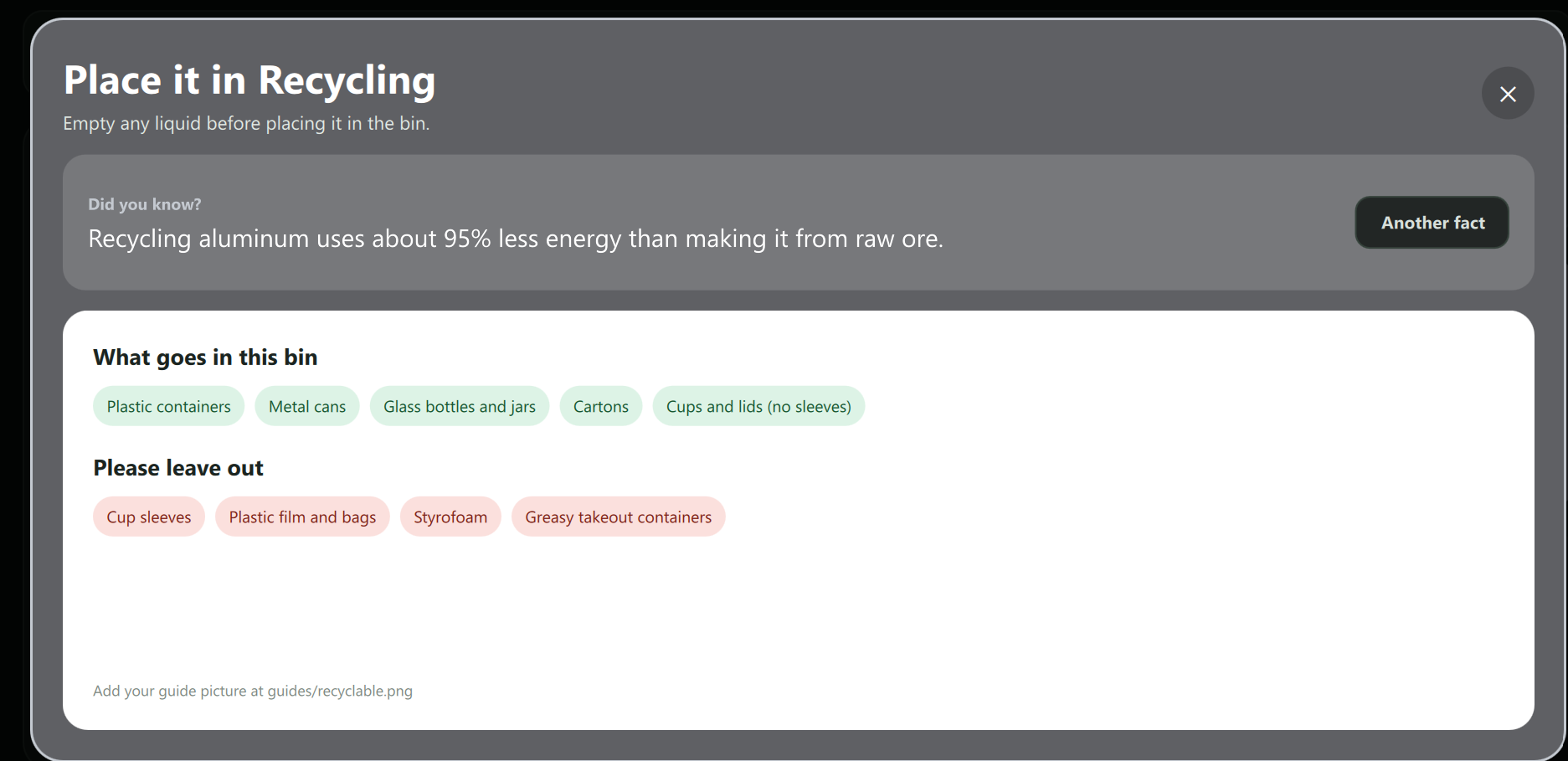
Info button + fun facts: Since users might want to understand more about why a particular item goes into a particular bin, the identified correct bin appears with an info button, which when clicked, opens a pop-up tab that explains the details of recycling for that category.
How we built it
We split the project into manageable components for each member, including the sections: hardware, back end, front end, and computer vision implementation. The front end was written in QML on QT Creator, communicating directly with the back end. The back end provides the live camera feed over FastAPI, as well as the classification and uncertainty of the estimate made by computer vision. In return, the front end contains pause/resume buttons that allows the user to control the video feed, choosing when to send the image to the backend for processing. The back end also controls the LEDs. We used an open source computer vision trained model (https://huggingface.co/watersplash/waste-classification) for classifying waste based on a catalog of different waste items and their classifications. We tested countless models to empirically decide on the most accurate one.
Challenges we ran into
The main challenges we ran into were Git issues, especially with members who were unfamiliar with Git. Several nested repositories were accidentally made, and changes were at times pushed to the wrong branch, and it was challenging to figure out how to best overcome these issues while keeping the project going for other members. We had issues implementing the statistics and badges, as we found that our app was not able to update the statistics, which was difficult to troubleshoot as we were running out of time. However, we kept the feature as a proof of concept, as it should be feasible to implement given a little more time.
What we learned
- Live scan and capture of images to classify
- Scanning animation on image when paused
- Implementing CV model that can accurately sort cans, paper, and some organic material
- Connected with Arduino and LEDs to provide a tangible feedback response, which in future applications could be applied as LEDs directly on waste bins, flashing to indicate to users that they are the correct bin for their current item.
What's next for Smart Waste !
- Implement location-specific waste sorting: Our current prototype was based on UBC waste sorting criteria. But one of the greatest benefits of this system is being able to easily tailor waste sorting to the region the user is in. Since the CV model detects very specific categories of waste down to specific categories of glass (e.g. "metal", "paper", "cardboard", "green glass"...), the identified waste types can be sorted into different bin waste destinations depending on the region. This could greatly help reduce confusion in waste sorting across Canada.
- Implement points system and badges: While the badges are currently there as a placeholder, a close next step would be to actually implement the badges system to motivate recyclers country-wide.


