-
-
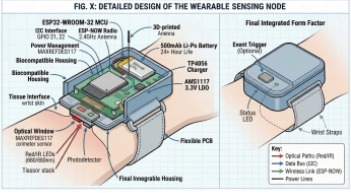
Features an ESP32-WROOM-32 microcontroller paired with a MAXREFDES117
-
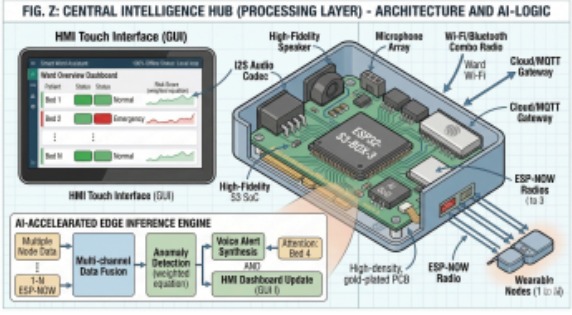
Powered by the ESP32-S3-BOX-3 platform at the nursing station, utilizing AI vector instructions and the ESP-SR framework for local data
-
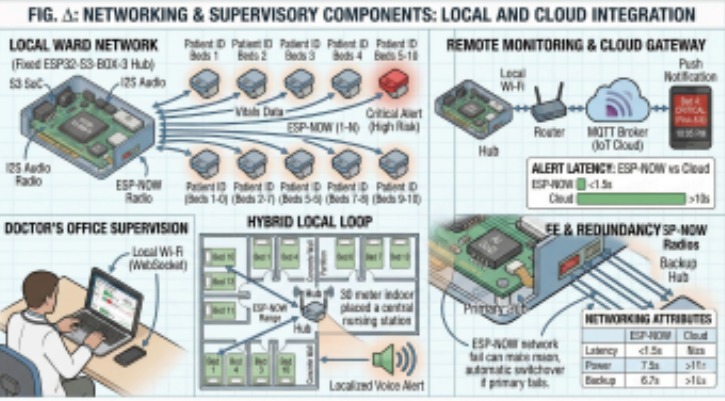
Operates entirely offline using the connectionless ESP-NOW protocol,
Project Story
Inspiration
The project was inspired by the stark digital divide in healthcare, particularly the vulnerability of rural Primary Health Centers (PHCs) in developing regions like India. While urban tertiary care centers benefit from expensive ICU monitors, rural wards often lack continuous monitoring infrastructure. This gap leads to delayed recognition of patient deterioration during the critical hours between manual checks, highlighting an urgent need for an affordable, reliable safety net. Furthermore, resource-constrained clinics frequently struggle with power outages and a chronic shortage of trained medical staff, making traditional high-maintenance equipment impractical.
How We Built It
The Smart Ward Assistant utilizes a decentralized, hierarchical edge-computing model built around two main hardware units:
- Wearable Sensor Node: Features an ESP32-WROOM-32 microcontroller paired with a MAXREFDES117 optical sensor to continuously capture Photoplethysmogram (PPG) signals via a high-frequency interrupt-driven I2C interface.
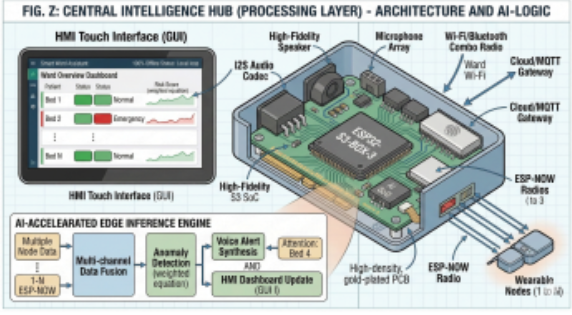
- Edge-AI Processing Hub: Powered by the ESP32-S3-BOX-3 platform at the nursing station, utilizing AI vector instructions and the ESP-SR framework for local data fusion, LVGL touch UI rendering, and voice synthesis.
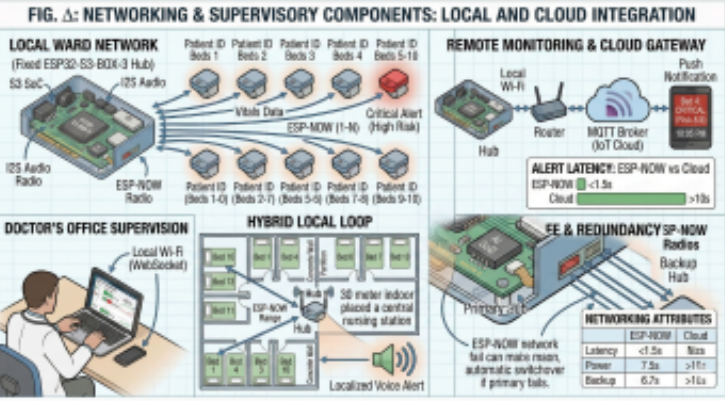
- Communication Layer: Operates entirely offline using the connectionless ESP-NOW protocol, avoiding reliance on external routers or internet connectivity while maintaining a 30-meter indoor range through concrete walls.
- Software Logic: Managed via FreeRTOS for uninterrupted task execution, implementing peak-detection algorithms, digital band-pass filtering (0.5Hz to 5Hz), and a weighted risk-scoring formula: $$\text{Risk Score} = W_{1}(\text{HR}{\text{dev}}) + W{2}(\text{SpO}_{2\text{ drop}})$$
Challenges Faced
- Infrastructure Independence: Designing a system that functions reliably in resource-constrained environments without internet access or stable cloud connectivity required shifting intelligence directly to the edge using a dedicated low-power wireless mesh topology.
- Alarm Fatigue and Power Optimization: Overcoming the limitations of traditional beeping alarms by implementing a localized voice-alert synthesis engine and optimizing battery consumption via light-sleep cycles to achieve a 26-hour operational window on a 500mAh Li-Po battery.
- Cost Constraints: Keeping total deployment costs under ₹10,000 (roughly 1/20th the cost of commercial ICU monitors) while maintaining medical-grade accuracy above 96% and an ultra-low alert latency under 1.2 seconds.
What We Learned
- The critical importance of edge computing in medical applications where network latency and internet dropouts can jeopardize patient safety.
- How to balance low power consumption with high-frequency optical signal acquisition (100 Hz sampling) using an interrupt-driven architecture that separates wireless tasks from AI inference across dual cores.
- The effectiveness of localized text-to-speech alerts and color-coded UI dashboards in helping medical staff prioritize emergencies efficiently without screen fatigue or missed alarms.
Built With
- 3dprinting
- c++
- esp-now
- esp-sr
- esp32-s3-box-3
- esp32-wroom-32
- freertos
- lvgl
- maxrefdes117
- micropython

Log in or sign up for Devpost to join the conversation.