-
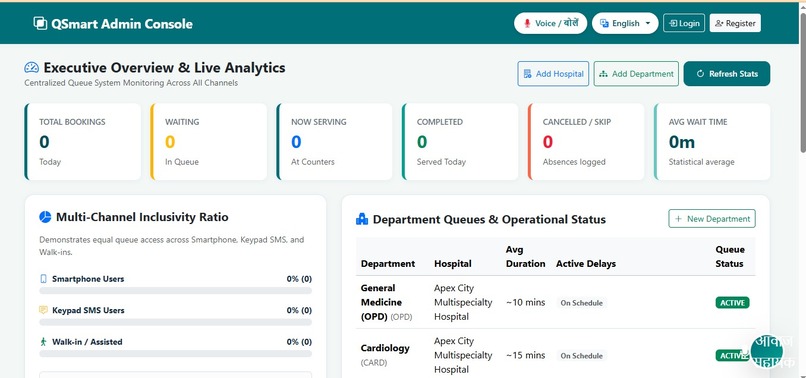
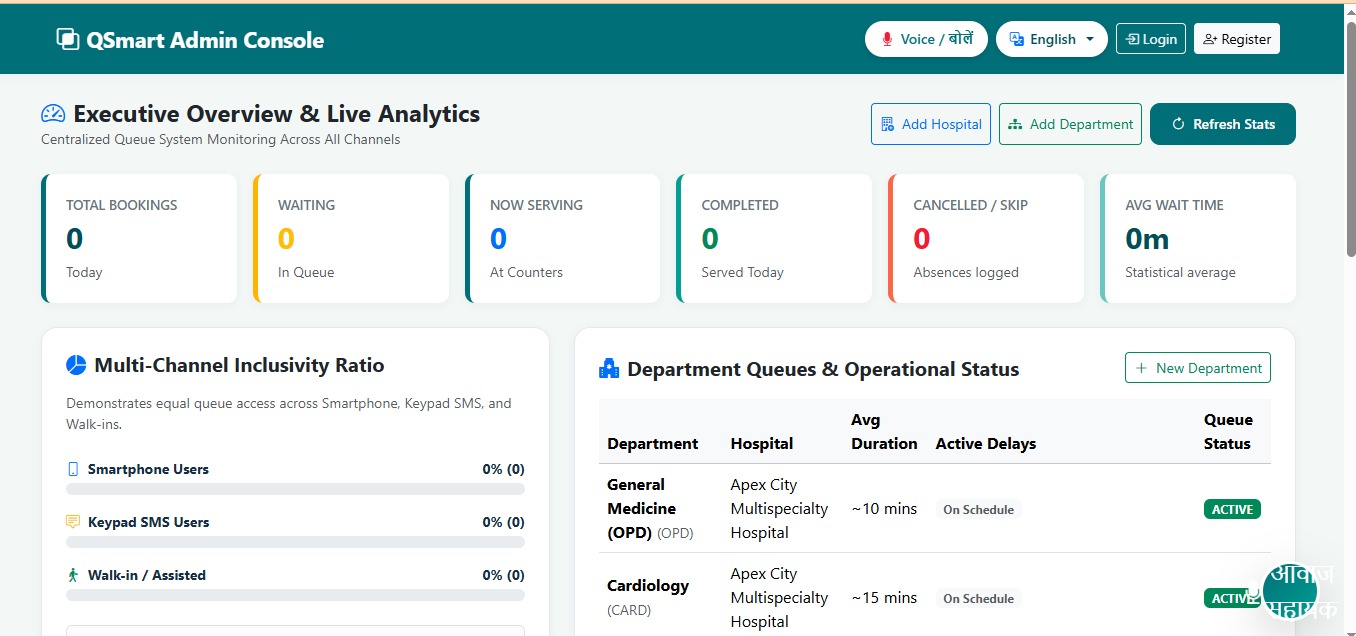
is a admin dashboard
Inspiration
Long waiting lines at hospitals and service centers often waste people's time and create inconvenience. We realized that not everyone has access to a smartphone or reliable internet, yet everyone should have the opportunity to access queue services conveniently. This inspired us to build QSmart, a smart virtual queue management system.
What it does
QSmart allows users to join a queue, receive a digital token, track their position, and check estimated waiting times. Its key feature is a centralized queue system that supports three ways of joining:
Smartphone: Users can book and track tokens through a web dashboard.
SMS: Keypad phone users can book or check tokens using SMS commands.
Walk-in: Staff can register visitors directly through the staff dashboard.
All three channels connect to the same queue, helping service providers manage patients and visitors efficiently.
How we built it
We developed QSmart using Java 21 and Spring Boot 3 for backend services, HTML, CSS, JavaScript, and Bootstrap 5 for the frontend, and MySQL 8 for database management.
We implemented REST APIs, role-based authentication, centralized FIFO queue management, token booking and cancellation, live queue tracking, estimated waiting times, notifications, and separate dashboards for patients, staff, doctors, and administrators.
We also integrated WebSocket-based updates with polling as a fallback. An SMS simulator demonstrates keypad-phone interactions during development
Challenges we ran into
One of our major challenges was maintaining a single, consistent queue across smartphone bookings, SMS requests, and walk-in registrations. We also worked on preventing duplicate bookings, managing token status changes, calculating estimated waiting times, implementing role-based access, and handling service delays.
Real SMS delivery requires an external SMS provider and telecom compliance, so we used a mock SMS provider for our prototype.
Accomplishments that we're proud of
Building QSmart helped us understand full-stack development, REST API integration, database relationships, authentication, real-time communication, and queue management. Most importantly, we learned how to design a more inclusive digital solution that considers users with different levels of technology access.
