-
-
Logo
-
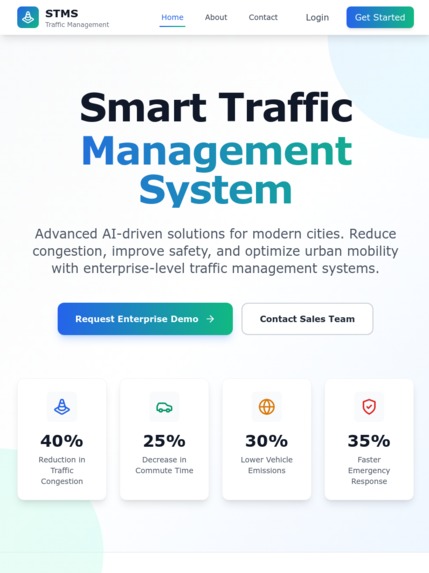
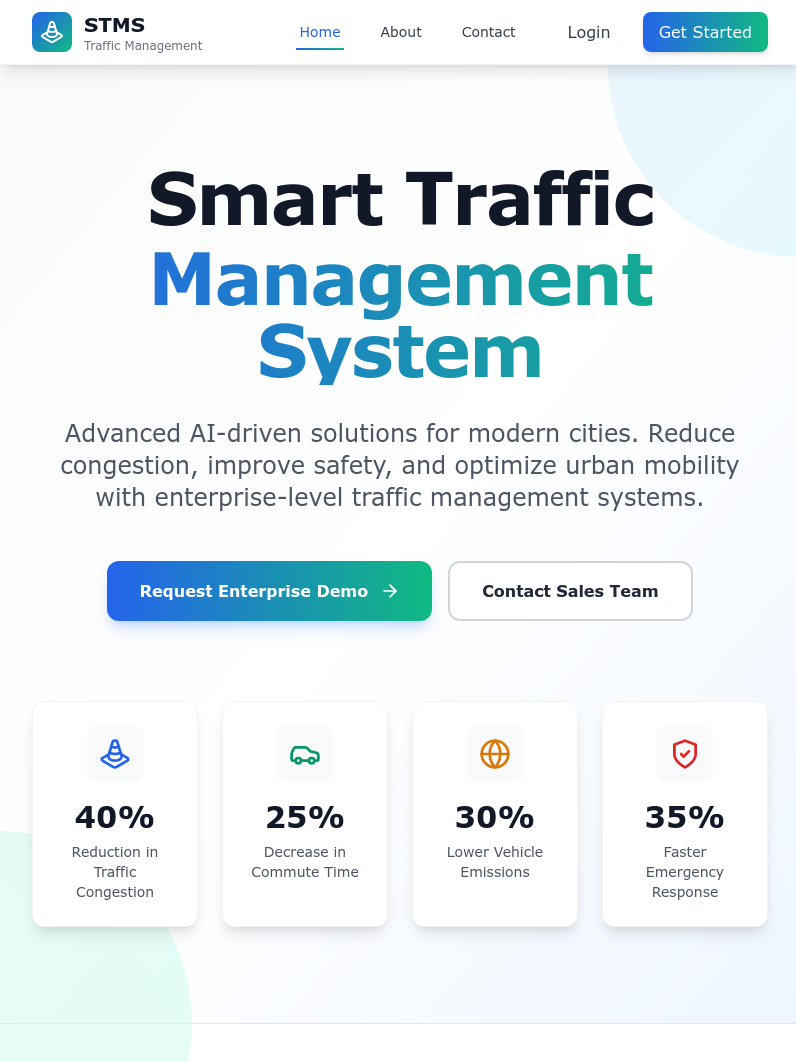
hero section
Inspiration
- The main inspiration for our Smart Traffic Management System (STMS) comes from the persistent problem of urban traffic congestion: long waits at intersections, inefficient signal timing, and limited visibility into real-time traffic flow.
- There is a desire to build a “smarter, more sustainable solution” — leveraging AI and IoT — to help cities or municipalities better manage traffic, reduce congestion, and offer real-time insights.
- More specifically, the idea is to offer an accessible prototype that can simulate traffic conditions and show how dynamic signal control can lead to smoother traffic flow.
- The project is also motivated by the gap between what “smart” city traffic systems can do and what many small towns / municipalities actually implement — thus aiming for a solution that is cost-effective and flexible.
What it does
- Provides real-time traffic monitoring per intersection, classifying traffic as Low / Medium / High.
- Uses color-coded intersections (Green for smooth flow, Yellow for moderate traffic, Red for congested) to give at-a-glance status of traffic conditions.
- Implements AI-based signal optimization: the system can automatically adjust green/red light durations based on live (or simulated) traffic data.
- Visualizes vehicle count and average speed, giving more detailed traffic metrics rather than just “light vs heavy”.
- Presents data via an interactive dashboard — with charts, heatmaps, and (potentially) map-based visualization (using something like Leaflet) to help users see traffic patterns and hotspots.
- Offers short-term traffic prediction (via ML models), along with alerts/notifications for high-congestion areas.
- Allows exportable reports (CSV / PDF) summarizing traffic trends over time — useful for analysis or reporting.
- Simulation controls: Users can simulate different traffic scenarios, test how signal adjustments or varying traffic loads would behave under different conditions.
- Stretch / optional features include IoT integration (e.g. real sensors via Raspberry Pi or Arduino), multi-city simulation, mobile-friendly dashboard, polished UI/UX — making the prototype more realistic and scalable.
So in short: STMS creates a software-driven (and optionally hardware-backed) environment to monitor, simulate, predict, and optimize traffic at intersections — aiming for dynamic, data-driven signal control — rather than fixed timers.
How we built it
Tech stack:
- Frontend: React.js.
- Backend: Node.js + Express.
- Database: MongoDB.
- Realtime updates: Socket.IO.
- AI/ML for traffic prediction & optimization: using Python or (optionally) TensorFlow.js.
- Visualization / mapping: Chart.js or Recharts for charts/heatmaps, and Leaflet for map-based visualization (if implemented).
- Deployment: Frontend deployed via Vercel or Netlify; backend via Render or Heroku.
**Work flow / Architecture
- Simulated IoT sensors (or real sensors, if integrated) send traffic data to backend.
- Backend stores data in MongoDB, and processes it using AI/ML logic. ([markdownpaste.com][1])
- Based on processed data, the AI logic dynamically adjusts signal timing for optimal traffic flow.
- The dashboard displays real-time data: charts, heatmaps, predictions, live intersection status.
- Users can interact with the simulation: run different traffic scenarios, see outcomes, test parameters (e.g. simulate heavy traffic, emergency scenarios, different signal timing logic).
Team roles: full-stack / MERN developer, AI/ML engineer, UI/UX designer, IoT engineer (for optional hardware), and someone for partnerships/pilot planning.
Development timeline — e.g. Week 1 for core dashboard + simulation; Week 2 for AI signal optimization; Week 3 for prediction + alerts + simulation controls; Week 4 for optional features, UI polish, bug fixing, and demo prep.
Challenges we ran into
- Simulating real-world traffic data accurately: representing realistic traffic flows, density, variation, unpredictable events (accidents, pedestrians, variable speeds) in a simulation is hard. The difference between simulation and reality can be large.
- Building a system that remains performant and responsive under real-time data streaming, processing, and UI updates — especially if scaling to many intersections, or integrating with real sensors / IoT hardware.
- For optional IoT/hardware integration: dealing with sensor reliability, calibration, environmental factors (weather, lighting), connectivity (sensor → backend → cloud), and latency. This is a known challenge in many IoT-based traffic projects.
- Complexity of AI/ML: developing robust ML models for traffic prediction and signal optimization requires sufficient data (historical and real-time), careful tuning, and validation to avoid overfitting or misprediction.
- Usability & UX — building a dashboard that’s both informative and intuitive: presenting complex data (counts, speeds, congestion levels, predictions) in a way that’s easy to interpret by users (e.g. city planners, or non-expert stakeholders) is not trivial.
- Scaling / portability: making the system generic enough to be applied in different junctions, intersections, or cities — with different traffic patterns. Ensuring the system remains flexible.
- Deployment & maintenance concerns: if real-world IoT sensors are used, there will be ongoing overhead: hardware maintenance, sensor calibration, data storage, security concerns, and possibly privacy implications (if cameras or vehicle tracking are used). This is a common concern with STMS systems.
Accomplishments that we're proud of
- We’ve defined a clear, end-to-end architecture combining frontend, backend, database, real-time updates, and AI/ML — showing a full-stack solution.
- We have implemented a working simulation prototype: a dashboard with real-time monitoring, signal logic, data visualization (charts, heatmaps), and controls — which demonstrates the core value of STMS even without real sensors.
- The design is modular and extensible: since we laid out optional IoT integration, ML-based prediction, multi-intersection support, and stretch features, we built a flexible foundation that could evolve into a full-fledged system.
- By using widely used technologies (React, Node, MongoDB, Python) and easy-to-deploy infrastructure (Vercel / Heroku / Render), the project is accessible and portable for demos or pilot testing.
- The project helps highlight — in a tangible, demonstrable way — how dynamic signal control and data-driven traffic management could work, which is valuable when presenting to stakeholders like city planners, or during hackathons / smart city proposal contexts.
What we learned
Based on the structure and goals:
- Learned how to architect and implement a full-stack web-based system that integrates real-time data ingestion, processing, and visualization. (From sensors → backend → ML → dashboard.)
- Gained experience with real-time programming (Socket.IO) and handling continuously-updating data streams — which is different from static web apps.
- Understood the challenges and tradeoffs involved in designing a traffic optimization system: what features are essential (real-time monitoring, dynamic signal control), what features are “nice-to-have” (prediction, IoT integration), and how design choices (tech stack, modularity) affect flexibility.
- Appreciated the complexity of mapping real-world problems (traffic congestion, variable flow, unpredictable events) into software/algorithmic solutions. Learned that simulations are useful but real-world deployments bring many additional challenges (hardware, edge cases, noise, reliability).
- Recognized how important data visualization is for making the system useful and comprehensible — it’s not enough to have raw data or signals; users need clear charts, heatmaps, interactivity to make sense of traffic trends.
- Understood that for a prototype — especially in hackathon / pilot context — balancing scope (core features) and stretch features is necessary. Trying to over-build may cause delays; instead, focusing on a minimal viable product with clear demonstration value is often more effective.
What’s next for STMS
- Integrate real IoT / sensor hardware (e.g. Raspberry Pi / Arduino + sensors / cameras) instead of simulation — to gather real traffic data and test how well the system works under real conditions (noise, sensor errors, variable traffic, multiple intersections).
- Expand from single intersection simulation to multi-intersection or city-wide simulations / deployments — see how the system scales, whether the signal optimization logic still works when traffic flows interact across intersections.
- Improve AI/ML models — enhance traffic prediction (short-term and possibly longer-term), maybe using more advanced techniques / historical data, and refine signal optimization logic for better performance under varied conditions (rush hour, emergency vehicles, accidents, peak vs off-peak).
- Add user-facing features — mobile-friendly dashboard, real-time alerts/notifications, exportable reports, support for multiple cities / junction types, customizable signal logic per city or user needs.
- Pilot testing / real-world deployment / collaboration with municipalities — if possible, partner with local city authorities to test STMS in a real junction (maybe during low-traffic times), gather data, and evaluate impact on congestion, wait times, traffic flow.
- Evaluate and monitor performance, reliability, scalability, and safety — track metrics such as average wait times, throughput, congestion levels, errors or failures (sensor misreads, downtimes), and system stability over prolonged real-world usage.
- Explore integration with vehicle-to-infrastructure (V2I), public transport, emergency vehicle prioritization, or city-wide traffic planning — evolving STMS from intersection-level control to a more comprehensive “smart city traffic management” platform.
Built With
- ai
- express.js
- mongodb
- node.js
- pypal
- python
- react.js
- socket.io



Log in or sign up for Devpost to join the conversation.