-
-
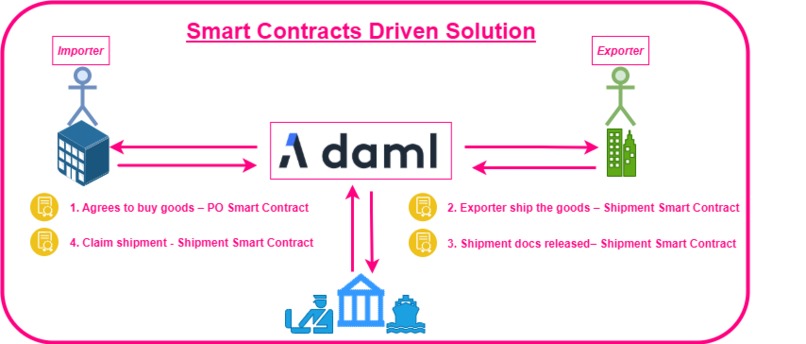
Solution
-
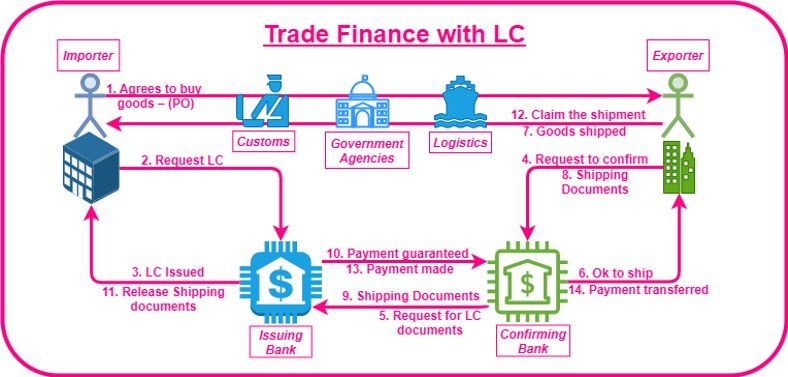
Problem
-
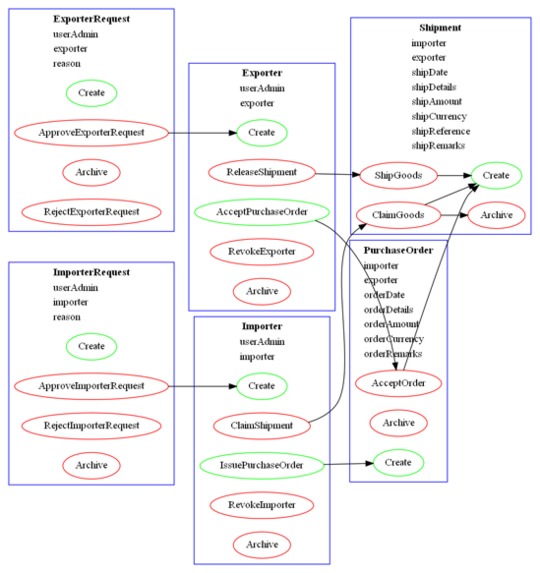
Design
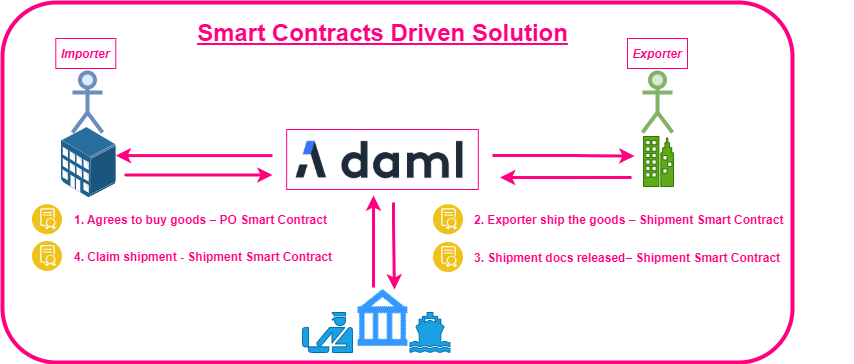
Hi, my name is Gaurav Bansal and today, I want to show you how I adopted DAML smart contracts to solve a specific problem within the Trade Finance domain.
Inspiration
In nutshell, Trade Finance is the financing of goods or services in a trade transaction, from a supplier to the end buyer. It accounts for 3% of global trade, worth some 3 trillion dollars annually.
What it does
Trade Finance is an umbrella term, which involves lot of parties.
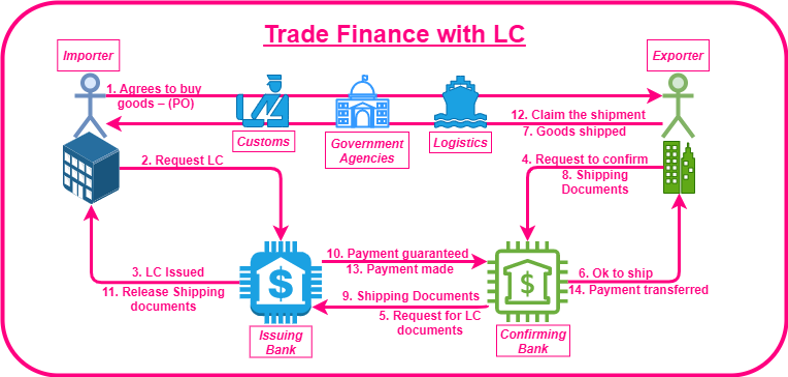
Let’s take an example with a very versatile financial instrument which is LC or Letter of Credit that is commonly used in Trade Finance.
An importer agrees to buy goods from an exporter & issues a purchase order.
The importer then approaches an issuing bank (or a trade financier) which requests a letter of credit. The bank issues a LC if the company fulfils the bank’s criteria (e.g., they are creditworthy).
The exporter then works with a confirming bank, which requests the LC documents to be checked from the issuing bank (or the importer’s bank)
The confirming bank then check the LC and, if the terms are agreeable, the exporter will ship the goods
The exporter then sends the relevant shipping documents to the confirming bank.
Once the confirming bank has examined the shipping documents in strict compliance against the LC terms from the issuing bank, they forward these documents on to the issuing bank.
The Payment is guaranteed by the issuing bank according to the agreed terms.
The issuing bank then releases the shipping documents so that the importer can claim the goods that were shipped.
Depending on the terms agreed, the issuing bank transfers money to the confirming bank which then transfer the funds to the exporter.
Along with these parties, other middlemen like Government Agencies, Port Authorities, Logistic Companies etc are also involved in a real time transaction. This multi-party involvement mainly creates three problems:
Time – The transaction settlement time becomes due to the involvement of so many parties & middlemen. And each of them has their own SLA and capacity to act on their part.
Cost – The overall cost of the trade becomes very high due to each middleman between an Importer & Exporter takes their cut in the pie with a range from 0.5 % to 3% or more as commission or what they call it a facilitation fee.
Complexity– The overall process is very complex in itself, and a lot of paper trail or documentation moves between the parties which makes it even more complexed.
One might wonder, why are so many parties involved between the importer and the exporter, despite these parties add more burden on the settlement of a transaction?
Well, the answer is “Trust” and “Security”- the Importer & the exporter, they don’t trust each other, and both have the capacity to act maliciously in a trade transaction. And if one goes sideways, the other might suffer heavy losses.
So, to avoid that situation, these parties involve the middlemen which brings trust and security and for which they pay very high commissions or fees, which substantially increasing the time, cost & complexity for trade transaction.
How I built it
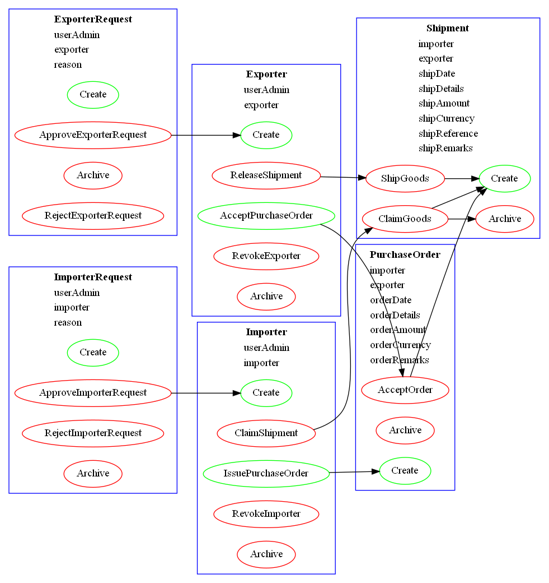
My solution is to codify all the business logic and workflows into DAML smart contracts and deploy them on the top of a distributed ledger.
Challenges I ran into
I was trying to store the contract Id of an Archived contract (PO) to my new contract (Shipment) for backtracking but unable to do so. I tried to find on the forum but didn't get enough to make it working. Time was short so for now I am okay but I will certainly find a way.
What we learned
This journey really took me to learn something new and now I am very confident to build DAML based applications and I really learned functional programming & looking forward to deep dive more.
Accomplishments that I am proud of
This smart contract-based solution with distributed ledger can significantly reduce time, cost & complexity by providing fast, efficient, secure & authentic access to information and by reducing the number of middlemen to settle a trade transaction.
What's next for Smart Trade Finance
I know I could have done better by including some other pieces like adding financial flow but considering the time and fact that DAML is not Ethereum within which money gas flows, I am quite happy for now and in fact I see a huge potential with DAML Smart Contract based solution and it can become a single stop shop to on-board all these stake holders like banks and these authorities & agencies and other parties to become part of a common ecosystem to carry out these transactions and save more time, money & bring much more simplicity than ever before.
Built With
- daml


Log in or sign up for Devpost to join the conversation.