-
-
Demo of the Website
-
Demo of the Website
-
Demo of the Website
-
Demo of the Website
Inspiration
The 2026 FIFA World Cup will attract millions of visitors to stadiums across North America. This creates major challenges for transportation, parking management, and traffic control. During big sporting events, congestion often happens because operators only react after parking lots fill up and roads become jammed. We wanted to see how AI agents could go beyond just answering questions. Instead, we aimed to create a system that could predict congestion before it happens, generate response plans, and execute operational updates in real time. This led to the development of Smart Stadium Fleet Dispatcher, an AI transportation management agent created for large-scale sporting events.
What it does
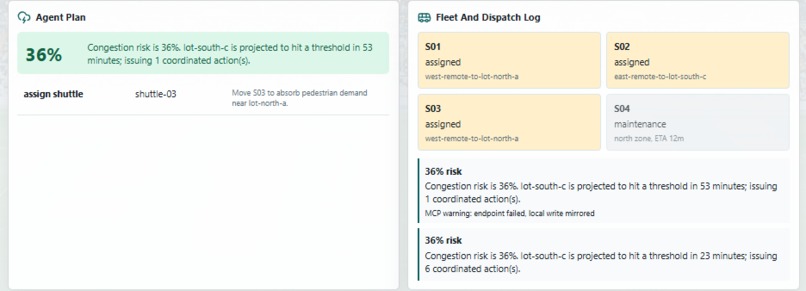
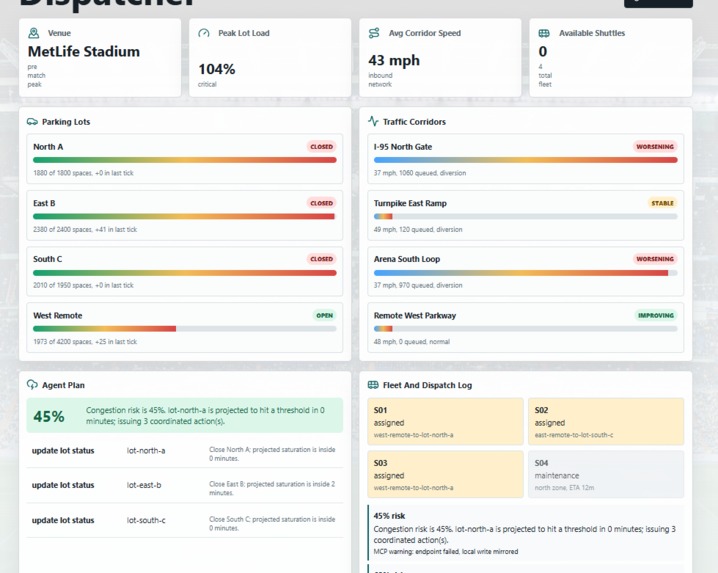
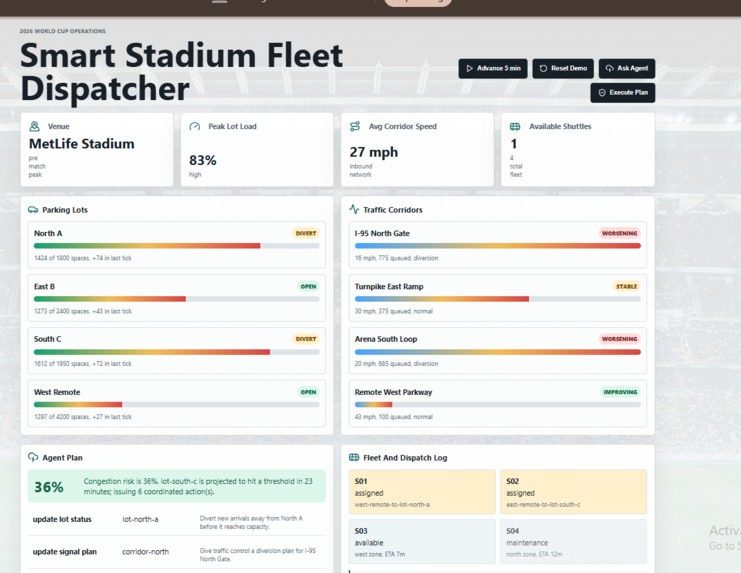
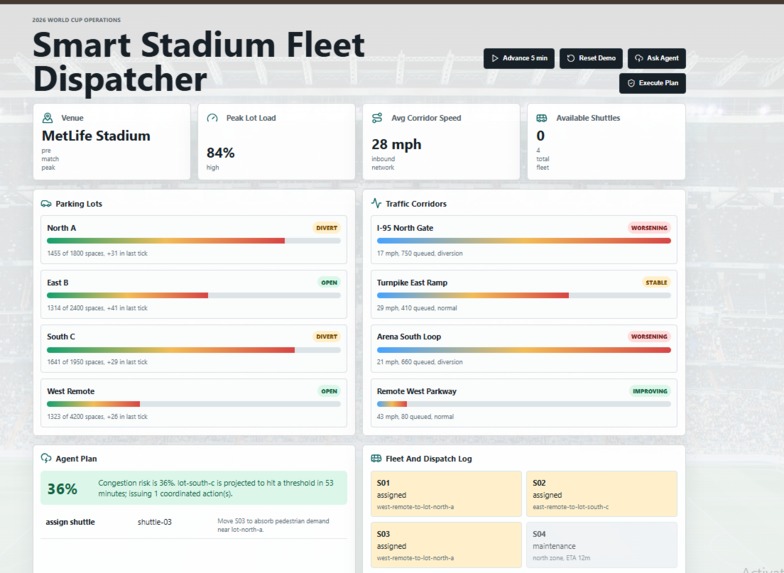
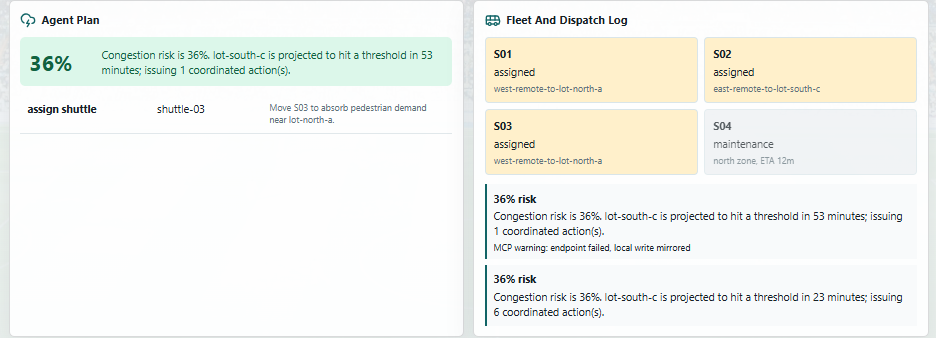
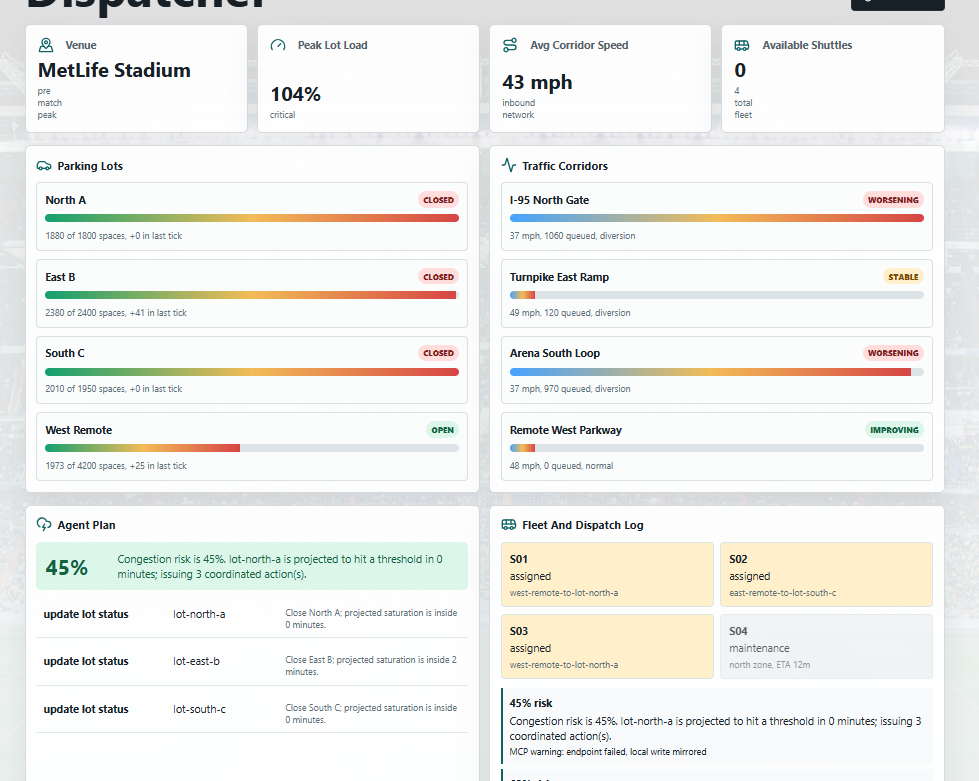
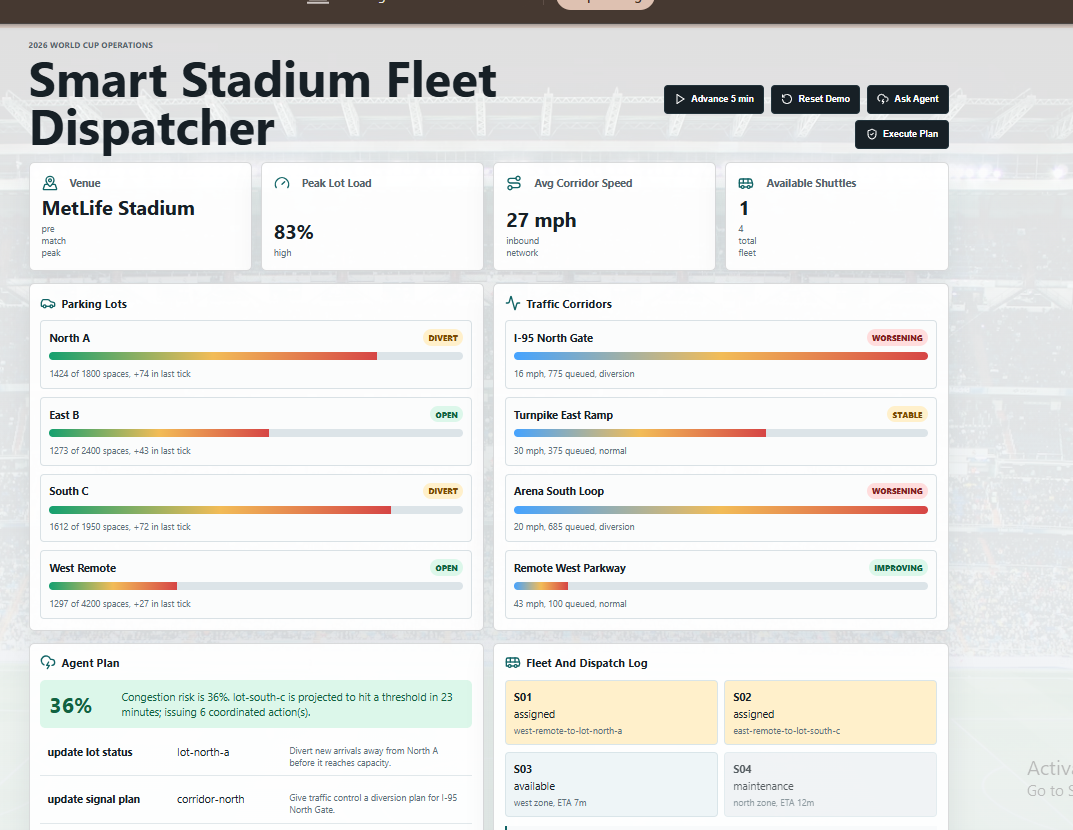
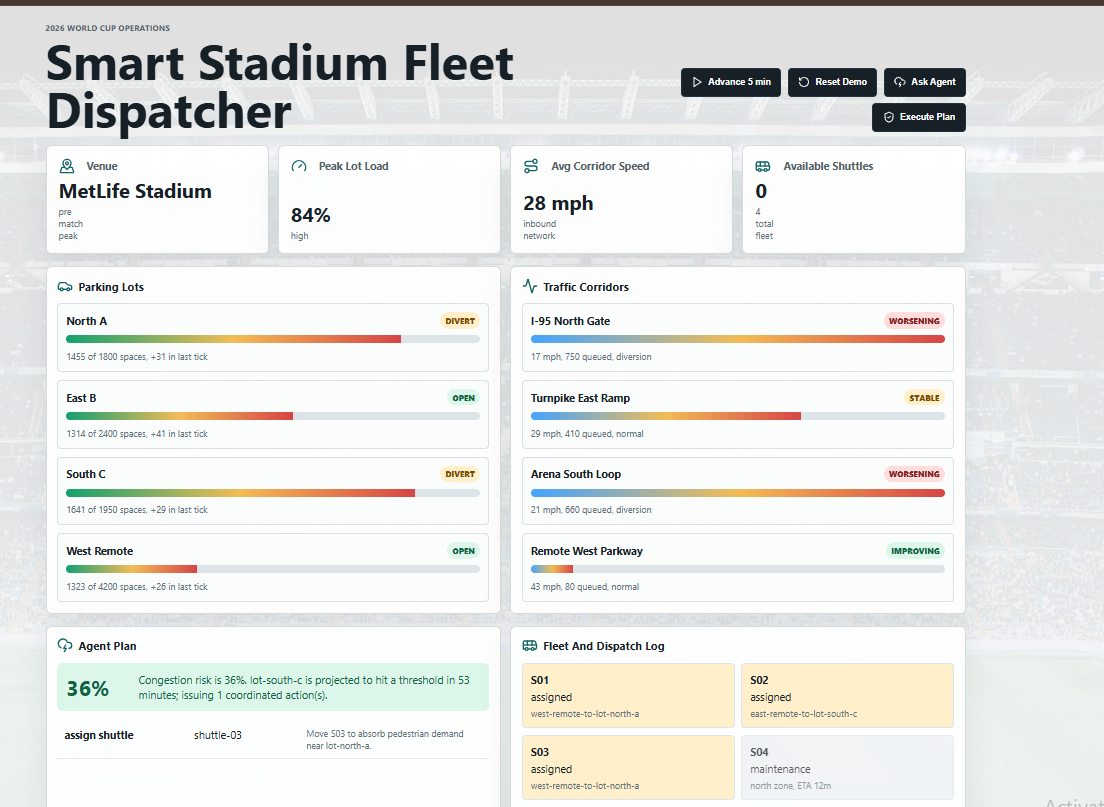
Smart Stadium Fleet Dispatcher keeps track of parking occupancy, traffic conditions, and shuttle fleet availability around a stadium. Using Gemini's reasoning abilities, the agent looks at incoming traffic patterns and predicts when parking lots or transport corridors are nearing critical levels. It then creates a coordinated response plan that may include: - Redirecting vehicles away from crowded parking lots - Updating parking lot statuses - Suggesting traffic diversion strategies - Coordinating shuttle fleet assignments - Keeping an operational dispatch log The system shows these recommendations on a real-time dashboard and makes operational updates through MongoDB using the Model Context Protocol (MCP).
How we built it
We built the project using a mix of Google AI and MongoDB technologies. Core Components - Gemini for reasoning, congestion analysis, and decision generation - Google Cloud Agent Builder for managing the agent workflow - MongoDB Atlas for storing operational data - MongoDB MCP Server for interacting with the database and execution - React and TypeScript for the dashboard interface - Node.js and API services for backend integration Agent Workflow The system follows a Reason, Plan, Execute structure: Reason - Analyze parking occupancy - Monitor traffic corridor performance - Track shuttle availability - Estimate congestion risk Plan - Generate coordinated mitigation actions - Identify parking lots that need diversion - Determine fleet allocation needs - Prioritize operational responses Execute - Update parking lot statuses - Write dispatch assignments - Record operational decisions - Synchronize state through MongoDB MCP The dashboard gives operators insight into both the agent's reasoning process and the actions being carried out.
Challenges we ran into
ne of the main challenges was designing a system that felt like a genuine agent rather than just a chatbot. We wanted the project to showcase autonomous reasoning and execution instead of merely providing recommendations. Another challenge was merging various operational data sources like parking lots, traffic corridors, and shuttle fleets into a single decision-making workflow. Figuring out how the agent should prioritize actions when multiple congestion points arose at the same time took several rounds of logic and testing. We also emphasized making the decision-making process clear so users could understand why certain actions were recommended or performed.
Accomplishments that we're proud of
Building a complete Reason, Plan, Execute agent workflow - Creating a realistic stadium operations dashboard - Integrating Gemini into a transportation management scenario - Utilizing MongoDB MCP as an execution layer, not just a data store - Visualizing congestion predictions and operational responses in real time - Showing how AI agents can help with large-scale event logistics Most importantly, we developed a system that moves beyond conversation and takes real operational actions.
What we learned
This project gave us a better understanding of designing agent systems and how modern AI can coordinate real-world workflows. We learned how to: - Structure multi-step agent workflows - Combine reasoning models with external tools - Use MongoDB MCP for managing state and execution - Design operational dashboards for AI-assisted decision-making - Balance automation with human oversight The project reinforced the idea that the most powerful AI applications often merge reasoning with action.
What's next for Smart Stadium Fleet Dispatcher
Future versions of the platform could include: - Real-time traffic feeds and GPS data - Dynamic route optimization for shuttle fleets - Integration with city transportation systems - Predictive crowd movement modeling - Mobile applications for fans and operators - Multi-stadium coordination during major tournaments - Automated communication with navigation providers Beyond the 2026 World Cup, the same setup could support concerts, festivals, conventions, university campuses, and other large events where transportation and crowd management are crucial. Our vision is to evolve Smart Stadium Fleet Dispatcher from a stadium operations tool into a general-purpose AI coordination platform for large public events.
Built With
- agent
- atlas
- builder
- cloud
- css
- gemini
- javascript
- mcp
- mongodb
- next.js
- node.js
- react
- rest
- server
- tailwind
- typescript

Log in or sign up for Devpost to join the conversation.