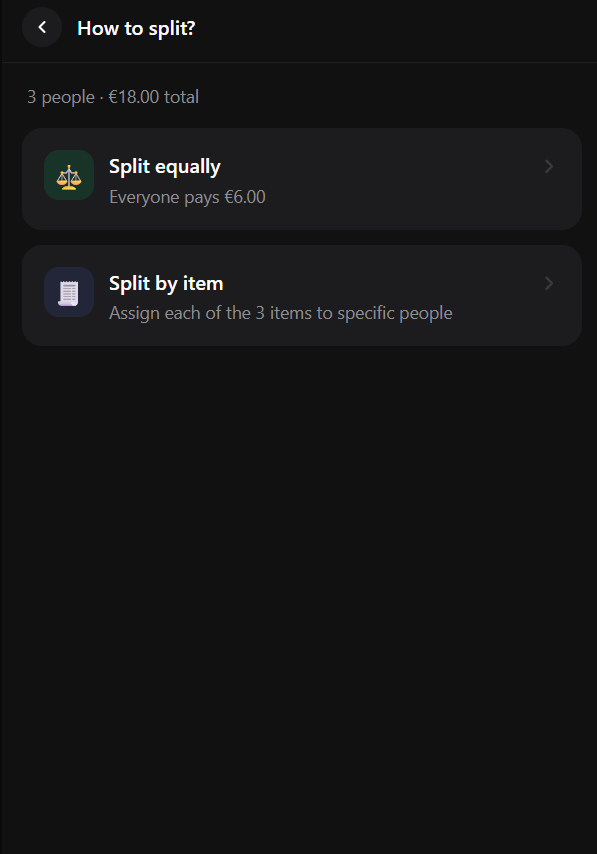
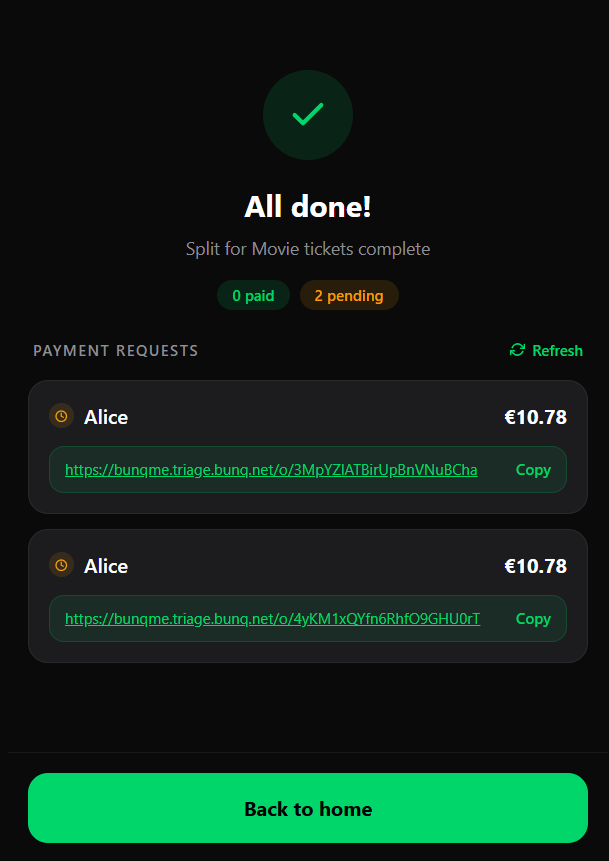
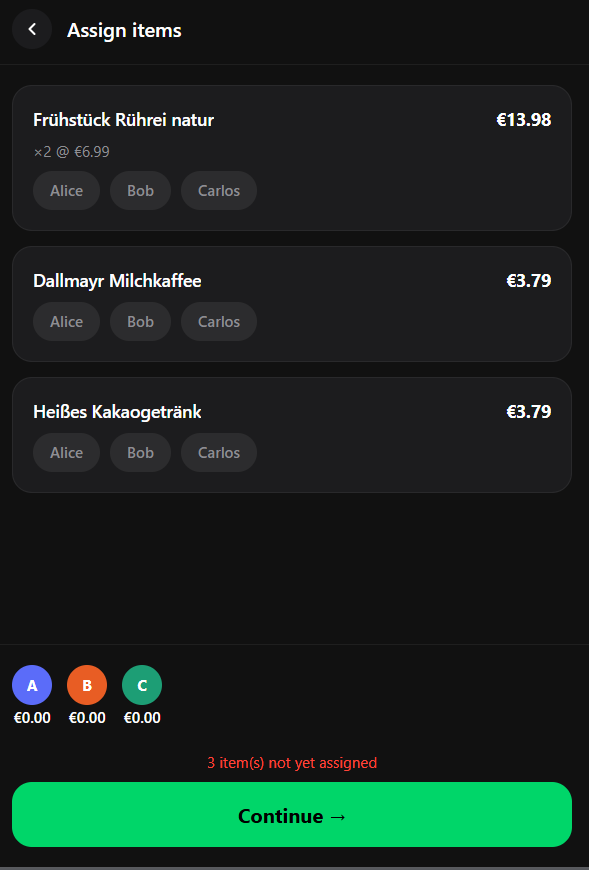
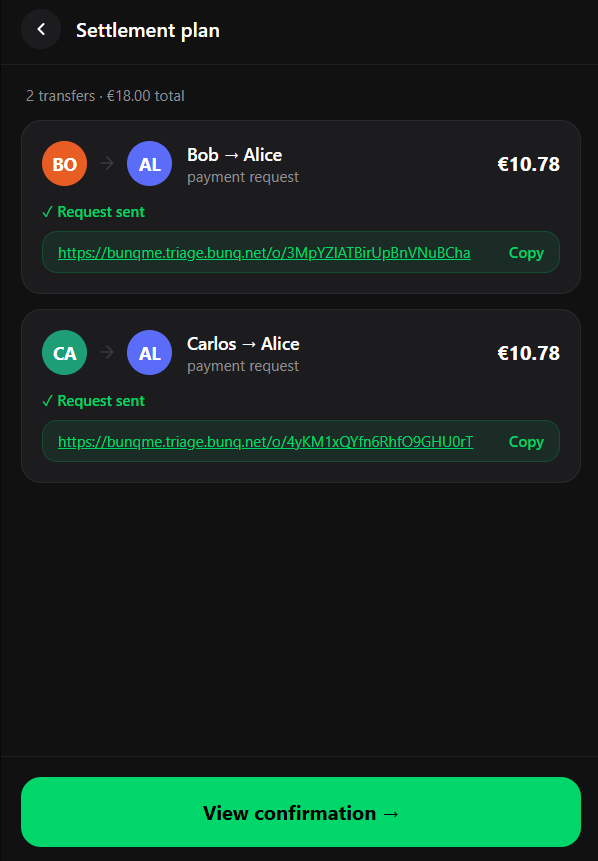
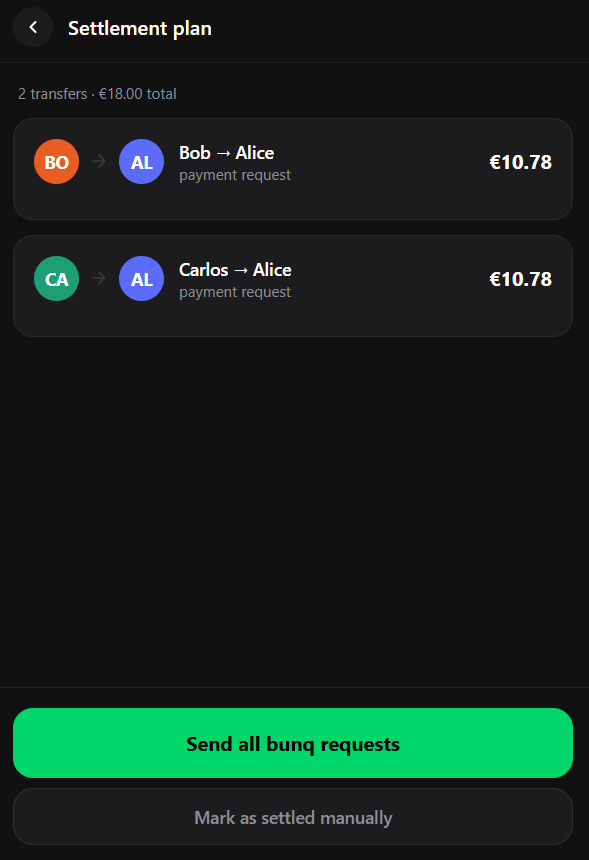
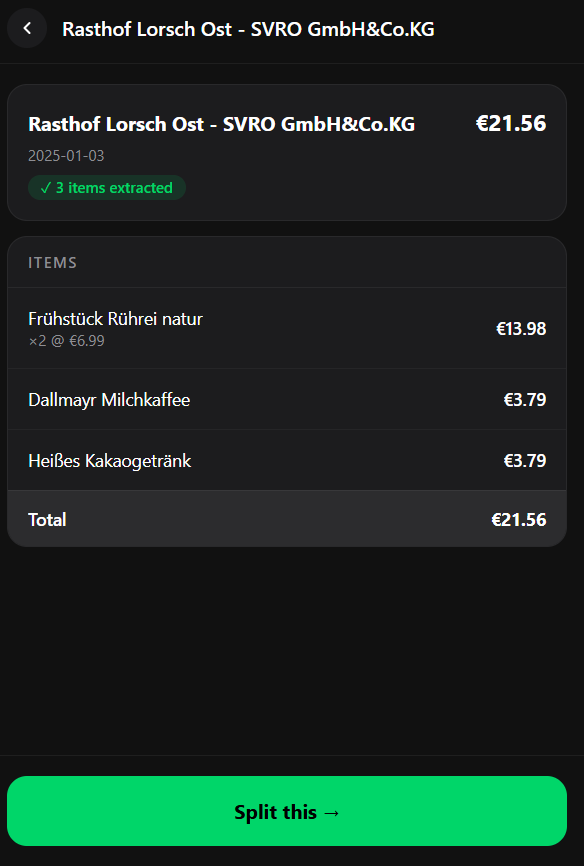
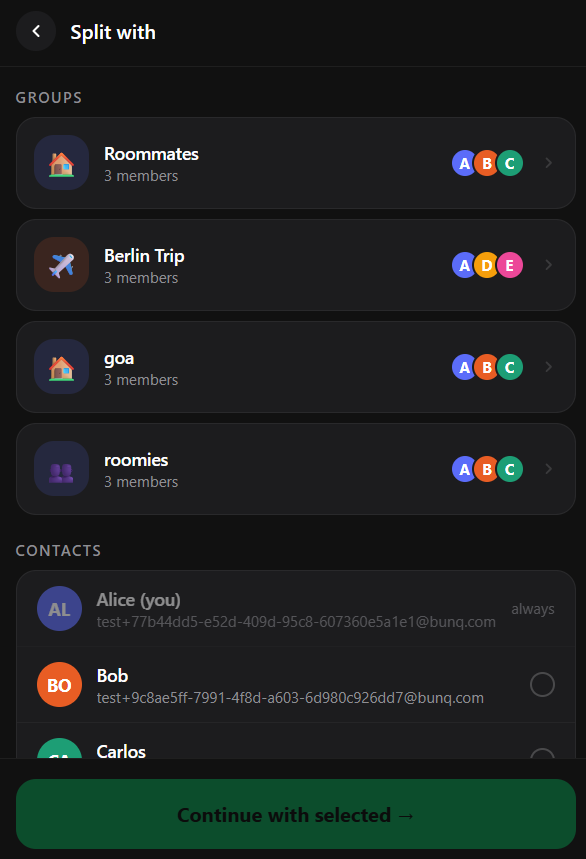
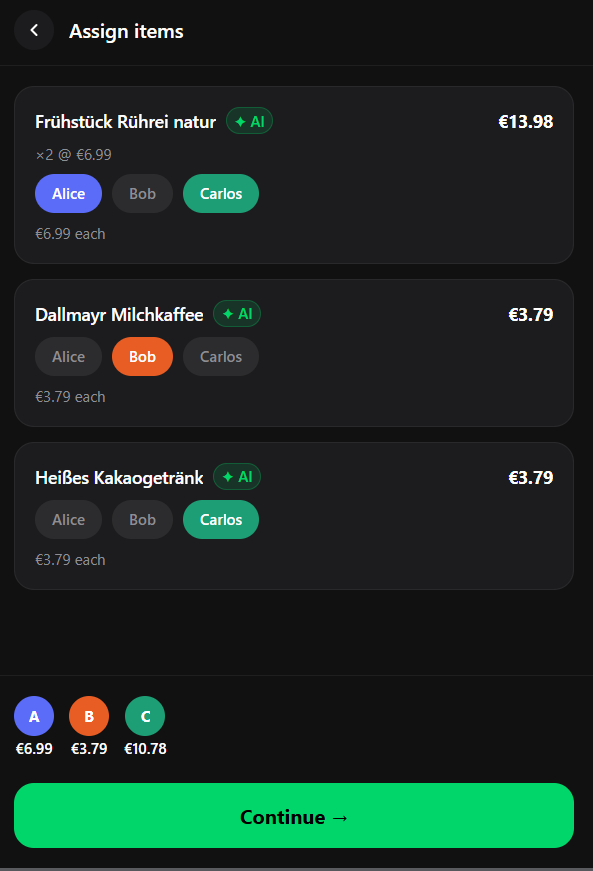
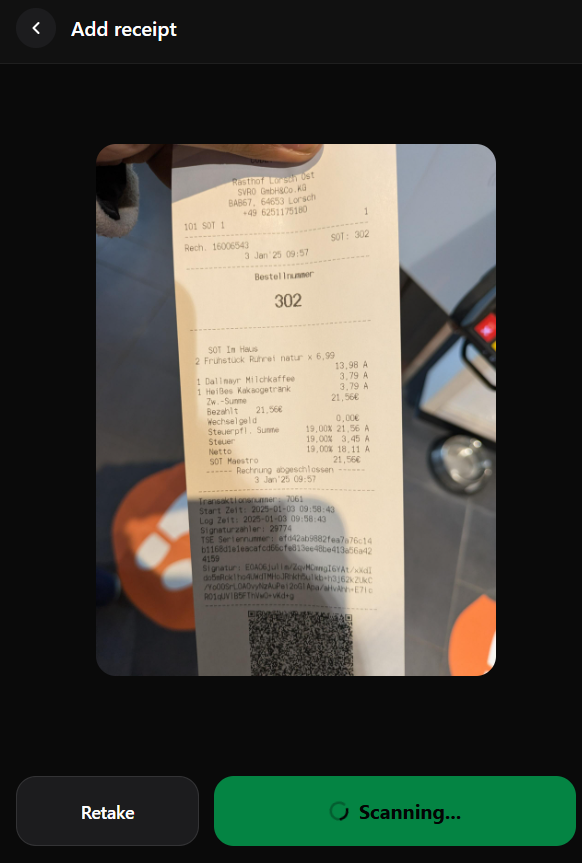
Inspiration Alice and her roommates share everything — but every expense becomes a group chat nightmare. Receipts lost, math wrong, Carlos still owes €18. bunq had the infrastructure to fix this, but four real gaps made it impossible: no native split endpoint, bunq-only requests, fixed amounts only, and no retroactive splits. We built the layer that was missing. What It Does Smart Splitting lets users snap a receipt, choose a group, assign items per person, split shared costs by percentage or equally, and send requests instantly. bunq users get in-app requests; non-bunq users like Carlo get a bunq.me payment link via WhatsApp. Reminders fire automatically. Past payments can be split retroactively
How We Built It We built a Split Intelligence Engine — a microservice layer on top of bunq's API combining: • OCR pipeline — Google Vision API + LLM to extract line items from receipt photos. • Participant router — detects bunq vs non-bunq users, routes to request-inquiry or bunq.me link • Pattern Recognition — After few transactions are made, the model will also decide who is likely consumer of that individual item in a group based on history
• Our model is generating individual patterns puts it in a database. That database becomes the input for next transaction. That’s how multimodality is achieved by adding memory layer
OCR · Prev Transactions ↓ Split Intelligence Engine ↓ bunq API · bunq.me · WhatsApp · Push ↓ Analytics · Pattern Recognition ↓ Split Intelligence Engine ↓ bunq API · bunq.me · WhatsApp · Push
Challenges We Ran Into
- Using bunq api at first was not very easy. Some steps did nit work, but eventually we were able to use it for our solution.
- Non-bunq recipients — The API requires a valid bunq alias. We worked around this by generating bunq.me links with pre-filled amounts, delivered via WhatsApp, then auto-reconciling payments through webhook matching.
- OCR on messy receipts — Tesseract alone failed ~30% of the time on crumpled or rotated receipts. Switching to a multimodal LLM with the raw image raised accuracy significantly. We added optimistic UI to hide the latency.
Accomplishments We're Proud Of • End-to-end receipt-to-split flow working in a single camera tap • Non-bunq users fully included via WhatsApp bunq.me links — no app download required • Retroactive split linking on past payments, something bunq's API doesn't natively support • A unified multimodal architecture where mage, transitional data , and memory layer all feed the same engine
What We Learned • APIs expose capability, not experience. The orchestration layer between primitive and delight is where product engineering earns its keep. • Non-bunq users are the silent retention leak. One person outside the ecosystem breaks the whole group — fixing that is a retention firewall, not a nice-to-have. • Multimodal is empathy. Alice reaches for her camera. Lars uses his voice. Priya uses WhatsApp. A great product meets all three without asking them to change. • Churn is predictable — if you instrument the right behavioral signals and act on them fast enough to matter.
What's Next for Smart Splitting, Personalized by Your Habits • Group memory — learn recurring roommate groups and pre-fill them automatically • Merchant integration — direct POS-to-split, skipping the receipt photo entirely • Fairness analytics — surface insights like "Carlos has owed the group money 7 of the last 8 months" • Cross-app identity — when Bob eventually joins bunq, retroactively link his payment history • Multilingual NLP — serve bunq's pan-European user base in Dutch, German, French, Spanish and more
Built With
- ai
- api
- bunq
- claude
- multimodal
- sonnet

Log in or sign up for Devpost to join the conversation.