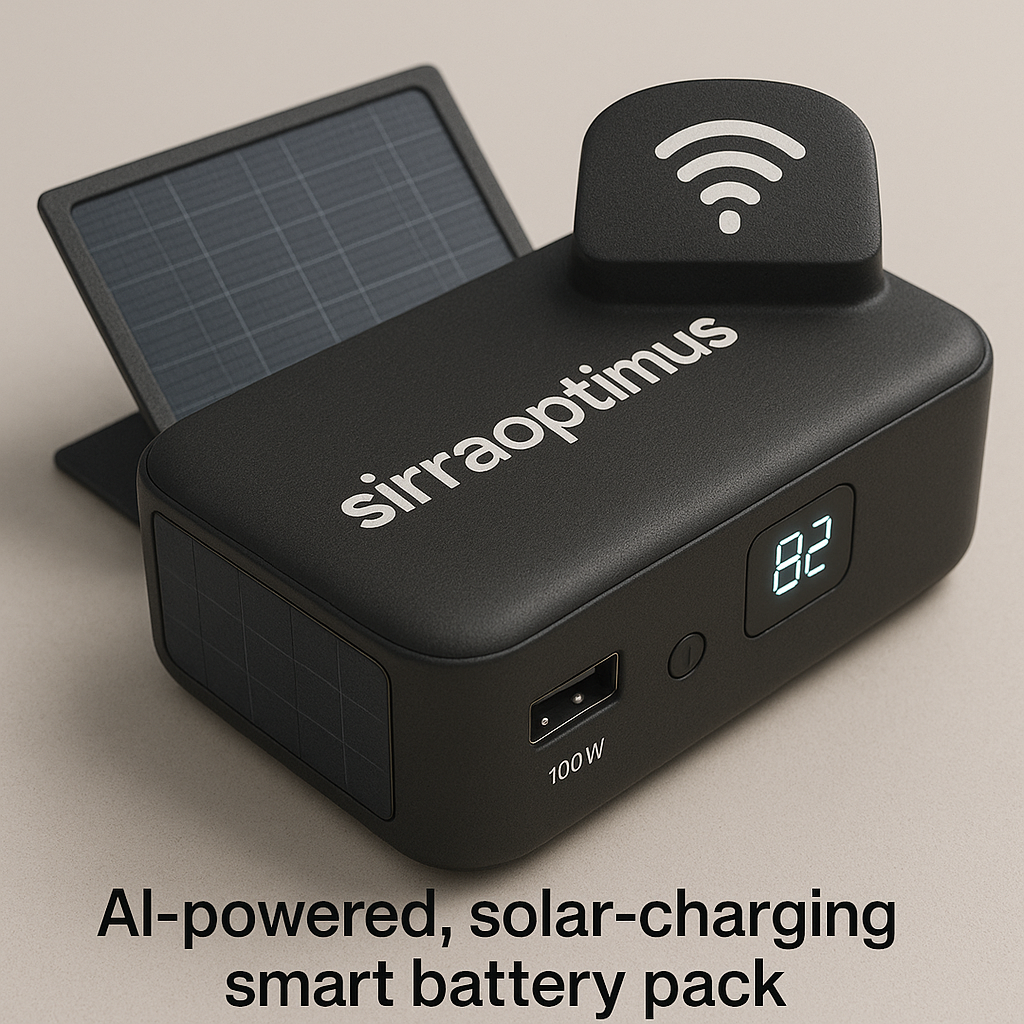
An AI-powered, solar-charging smart battery pack designed to optimize laptop performance and provide intelligent, portable energy for modern mobile professionals Subject title: "Smart, solar-powered battery intelligence — anywhere you take your laptop A portable smart external battery pack designed specifically for laptops and PCs, powered by solar energy and optimized using AI to extend device life, manage heat, and intelligently balance charging cycles.
- Laptop-Compatible High-Capacity Battery o Can power all major brands (USB-C, MagSafe, etc.) o Smart voltage control to protect laptops
- AI-Powered Energy Management o Learns your laptop usage patterns o Prevents overheating, overcharging o Extends laptop battery health
- Solar-Powered Auto-Charging o Portable solar panel integration o Can charge itself off-grid
- Mobile Companion App o Monitor charge status, health, and usage tips o Predict usage time left based on laptop workload
- Lightweight & Travel-Friendly o Designed for remote workers, students, travelers, off-grid digital nomads
- Fast-Charging Output (USB-C PD, etc.) ________________________________________ 🔧 Possible Technical Components: • Lithium Iron Phosphate (LiFePO4) cells (safe, long-lasting) • AI chip (e.g., Raspberry Pi Zero W or ESP32 with TinyML) • Integrated MPPT solar controller • Portable foldable solar panel • USB-C PD board with programmable output ________________________________________ 🎯 Target Users: • Remote workers / digital nomads • Field researchers, journalists • Campers, hikers, and off-grid users • Students in regions with unstable electricity Feature Your Product Existing Products Laptop-focused smart battery ✅ ❌ Built-in AI usage prediction ✅ ❌ Adaptive charging based on workload ✅ ❌ Compact with integrated solar ✅ 🔸 (bulky kits) Mobile app companion ✅ ❌
Ideation & Research • Define use cases: Remote workers, digital nomads, students, etc. • Market study: Review existing products, identify gaps. • Feature validation: AI charging, solar integration, Wi-Fi connectivity, mobile control.
- Hardware Design • Battery Module: Choose safe, long-lasting battery tech (e.g., LiFePO4). • Power Management: o Use an MPPT solar charge controller. o USB-C PD board for output (100W+). • AI Module: o ESP32 or Raspberry Pi Zero W (with TinyML). • Wi-Fi Integration: o ESP32 chip for wireless control. o Antenna or embedded signal booster. • Digital Control Panel: o Small OLED screen or LED display (e.g., 0.96" I2C OLED). o Button or touch interface for user input. ________________________________________
- Software Development • Firmware (ESP32 or Pi): o Control charging cycles based on AI patterns. o Heat and voltage sensors integrated. • Mobile App (Flutter or React Native): o Monitor charge, usage time, and health. o Control charging mode (fast, eco, adaptive). o Real-time alerts and solar optimization tips. • Cloud Dashboard (Optional): o Store performance logs and usage trends. o Allow remote firmware updates. ________________________________________
- Prototyping • Develop PCB board integrating battery management, AI chip, Wi-Fi, and screen. • Assemble casing with embedded solar panels. • Test under multiple conditions: indoor, outdoor, heat/cold, different laptops. ________________________________________
- Testing & Validation • Run stress tests on charging/discharging cycles. • User testing with target groups (e.g., travelers, students). • Measure: o Heat performance o Battery efficiency over time o Accuracy of AI predictions ________________________________________
- Manufacturing Preparation • Finalize design for mass production (CAD, BOM list). • Choose eco-friendly, durable materials. • Partner with OEM/ODM manufacturers. ________________________________________
- Launch Strategy • Beta testers and early access program • Online marketing: Product page, YouTube demos, pitch deck • Distribute through direct eCommerce and B2B channels ________________________________________
- Post-Launch Support • Collect user feedback for firmware updates • Expand compatibility (more laptops, more solar types) • Introduce app premium features (smart insights, reports, etc.) TARGET AUDIENCE
- Remote Workers & Digital Nomads • Need reliable, portable energy while working from cafes, vans, nature, or co-working spaces. • Often use laptops for extended periods and value sustainability. 🏕️ 2. Outdoor Enthusiasts & Campers • Use laptops, cameras, drones, or GPS devices off-grid. • Appreciate solar-powered, compact, and durable tech. 🧪 3. Field Researchers & Journalists • Operate in remote or rural environments with limited or no power supply. • Require dependable energy sources to power critical devices like laptops, routers, or sensors. 🎓 4. Students in Unstable Power Regions • Live or study in areas with frequent blackouts or unreliable electricity. • Benefit from smart, solar-charging batteries to complete assignments, research, and attend online classes. 🌍 5. Humanitarian & Emergency Response Teams • Work in disaster zones or off-grid regions. • Need portable power for communication and operational tools. 💼 6. Sustainable Tech Enthusiasts • Interested in clean tech, smart devices, and reducing carbon footprint. • Early adopters of green, AI-powered, energy-efficient products.
Visit Site web
- Titre du projet: Smart Battery with AI & Solar Fusion – A solar-powered, AI-powered smart battery pack designed for laptops to optimize performance and provide off-grid, portable energyENERGIECHALLENGESirraoptimus_Pitch_Deck.
- Choisissez votre problématique: Problem: Laptops drain quickly in mobile/off-grid use. Generic power banks aren't optimized for high-wattage laptops. Remote workers and students face electricity instability. There is no smart, solar-powered energy management system designed specifically for laptopsSirraoptimus_Pitch_Deck.
- Description de la solution: Sirraoptimus™: An AI-powered, solar-charging smart battery pack for laptops. The battery integrates solar energy, optimizes charging cycles based on usage patterns, and features a portable foldable solar panel. The system includes a mobile app for monitoring and predictionsENERGIECHALLENGESirraoptimus_Pitch_Deck.
- Méthode d'implémentation: • Ideation & Research: Define use cases (remote workers, digital nomads, students), conduct a market study to identify product gaps, and validate key features like AI charging and solar integrationENERGIECHALLENGESirraoptimus_Pitch_Deck. • Hardware Design: Choose safe and long-lasting components (e.g., LiFePO4 cells), integrate MPPT solar charge controller, and AI modules like ESP32 with TinyMLENERGIECHALLENGESirraoptimus_Pitch_Deck. • Software Development: Develop firmware to control charging cycles and integrate a mobile app for real-time monitoringSirraoptimus_Pitch_Deck. • Prototyping & Testing: Build and test the product under different conditions (indoors/outdoors, various laptops)Sirraoptimus_Pitch_Deck.
- Aspect innovant: The system integrates AI for adaptive charging based on laptop usage, solar-powered off-grid charging, and a mobile app companion for real-time control and prediction of usage time leftENERGIECHALLENGESirraoptimus_Pitch_Deck.
- Avantages: • Sustainable & Portable: Off-grid charging via solar power and smart energy management. • AI-Powered: Prevents overcharging and overheating, extends laptop battery life. • Compact & Efficient: Designed for remote workers, students, and outdoor enthusiastsENERGIECHALLENGESirraoptimus_Pitch_Deck.
- Niveau de maturité de la solution: The project is in the development phase, with plans for prototyping and field testing. The timeline includes product launch in about 12 monthsSirraoptimus_Pitch_Deck.
- Évolutivité et viabilité: The product is designed to scale with modular components that can handle larger capacities. It's cost-effective, using off-the-shelf components, and has potential for cloud services and B2B licensingSirraoptimus_Pitch_Deck.
- Technologies utilisées: • LiFePO4 battery cells • ESP32 microcontroller with TinyML for AI • MPPT solar charging system • USB-C PD for fast charging • OLED display and mobile app (Flutter/React Native)ENERGIECHALLENGESirraoptimus_Pitch_Deck.
- Ressources et moyens: • Team: Engineers, developers, designers, project managers. • Materials: LiFePO4, ESP32, solar panels, enclosures. • Tools: 3D printers, firmware IDEs, test benches. • Partners: OEMs, logistics companies, NGOs, accelerators. • Budget: $183,000 for prototyping, marketing, and distributionSirraoptimus_Pitch_Deck.
- Chronologie de la mise en œuvre: • M1: Planning, research, and team setup • M2–3: Hardware prototyping • M3–5: Firmware and app development • M5–6: Integration and field testing • M7–8: Industrial design and casing • M9–10: Manufacturing setup • M11: Launch campaign • M12: Post-launch support and V2 planningSirraoptimus_Pitch_Deck.
- Public cible ou utilisateurs principaux: • Remote workers, digital nomads • Students in unstable power regions • Outdoor enthusiasts (campers, hikers) • Field researchers, journalists • Humanitarian and emergency response teamsSirraoptimus_Pitch_Deck.
Built With
- ai
- database
- energy
- lot
- solar

Log in or sign up for Devpost to join the conversation.